
S Viswanath
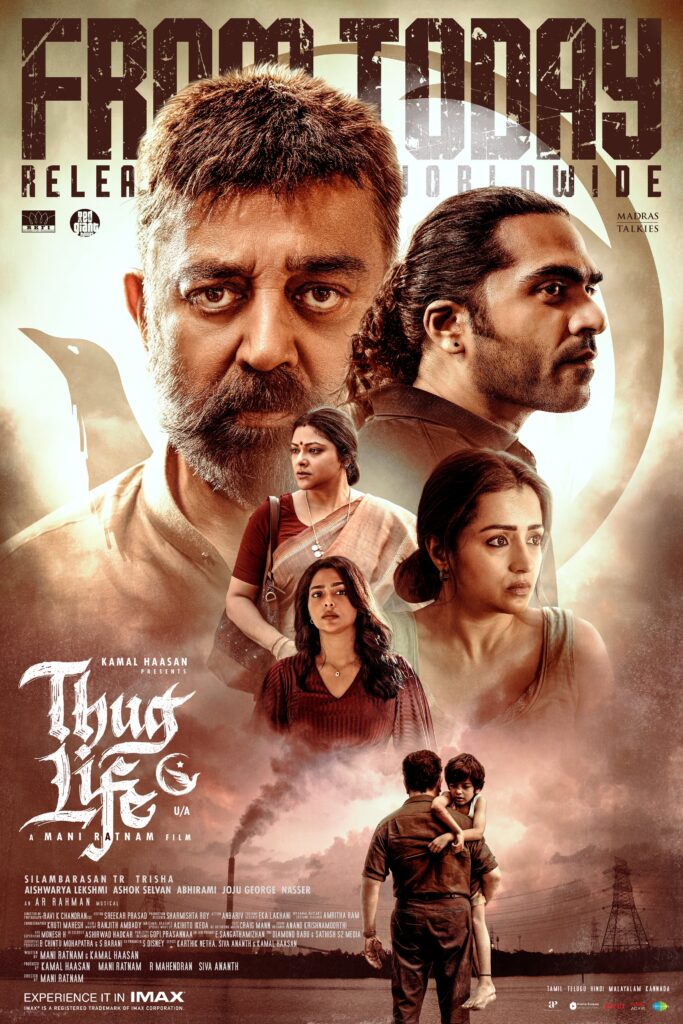
Sakthivel ‘Velu’ of 1987 returns in 2025 as Rangaraaya Sakthivel Naicker from Kayalpattinam, a municipality in Thoothukudi district of Tamil Nadu. The notorious smuggler of the yesteryear eponymous film now self-styles himself as a Yakuza the Japanese term for a gangster.
A brother Manickam, and an adopted son Amaran, in tow, with pledge to ferret out his lost sister Chandra, this modern day Tamil Yakuza, running a violent syndicate, is in perpetual internecine conflict with Delhi’s Sadanand whose nephew Ranvijay having impregnated Manickam’s daughter Dr Anna Chandra washes his hands of her when she questions “what the hell we do now,” to which he scornfully snubs “I don’t care” leading to her suicide.
This, with the fact that, the sly fox Sadanand sought to two-time Sakthivel informing cops pretending to strike truce between the two warring factions is another matter. Furthermore, with the insulted brother Manickam plotting to wrest the fiefdom Sakthivel has assiduously built during his incarceration from where he still runs the shows, feeding falsehood about the man to Amaran, provide the context for the fiery and tragic climactic denouement of the derring-do drama. All setting the setting for the 2:39:17 mins of Thug Life’s meandering, mundane and misadventurous pathetic playtime seeking audiences indulgence to be engaged and invested in it.
If, in Nayakan, the site of film’s major action is the Dharavi ridden Maximum City of Metropolis Mumbai, the site of action in Thug Life is transposed to the by-lanes of India’s Capital New Delhi, from the West of India to the North of India.
From academic viewpoint seeking to read and interpret metaphorical meaning into the two films one finds an interesting contrast between the two as also two Indias they represent. Nearly 38 years ago one witnessed India going through a multiple meld of economic challenges, political events, and cultural shifts, with the country hosting the first Cricket World Cup.
Furthermore, the country was facing severe economic issues with a severe drought affecting agricultural production and declining domestic savings. Besides, the year saw new states formed, a controversial election in Jammu and Kashmir, and emergence of political scandals.
Into this milieu rose the man Sakthivel, son of anti-government labour union leader, who went on to stamp his hegemony into the nefarious and notorious smuggling activity of the crime infested Mumbai. This is what director Mani Ratnam had said of his inspiration to make Nayakan: The two years I studied in Bombay (1975–77), he Varadarajan Mudaliar was at his peak. People in Matunga belt thought he was God. I used to wonder how anyone could treat a fellow human as God. I never understood why they would do this. It fascinated me. It was such a dramatic story, this man going from Tamil Nadu to Bombay and ruling the City. I outlined this thought to Kamal Haasan and he said fine. That’s it. It was done. Decided.
The main premises being a South India asserting his dominance over his Western counterparts, given that Madras or today’s Chennai has always opposed imposition of the Hindi language besides other festering issues with the Centre.
Flash forward to 2025. The template is the same. A Southerner seeking to stamp his authority on the Northerner in his own territorial space – the Capital City of Delhi. Only this time around India, in 2025, is the fourth-largest economy globally fuelled by continued robust domestic economic growth, in turn, catalysed by strong urban consumption, steady growth in service sector, and ongoing infrastructure investment with a Centre that has been in power for three consecutive terms, led by a no-nonsense Prime Minister.
Besides, of course, increasing social inclusivity, income inequality and unemployment, with the Centre pushing towards a common civil code, electoral contests in states like Bihar, and ongoing debates on social justice and inclusion. Not to forget the recent skirmish with neighbour Pakistan following the heinous and barbarous Pahalgam terrorist attack claiming 26 innocent lives of tourist Indians.
With the language row at its zenith between the Centre and Chennai, besides other politically surcharged issues, it was only to be expected that Mani Ratnam would seek to place his Thug Life in the Ground Zero of Delhi for it to play out, as the film traverses across several cities – Jaisalmer, Goa, et al., with Delhi’s Red Fort witness to the gang war between the two feuding factions.
As Sakthivel himself describes in the film as to how fate has fixed his life as “a gunda, a thug, a yakuza” with the “Lord of Death” being very “fond of him” with a duel between the two as to who will oust the other, with the death of his mother as the train reach national capital turning him into a yakuza.
No wonder than Mani Ratnam’s Thug Life traverses from the Old Delhi of 1994 which sets the prologue for the film’s development before the thick of gangster gun battles spans out to 2016 New Delhi when Sakthivel surrenders to court for his incarceration following the murder of Sadanand’s nephew whose desertion led to the suicide of Dr Anna, brother Manickam’s daughter.
Of course, Maximum City Mumbai is very much part of part of Thug Life’s discourse in the form of Indrani the nautch girl of the Mumbai’s (in)famous Red Light interiors setting up his second home with her.
But the problem with Thug Life is Delhi being the political power capital of the country Mani Ratnam seeks to replicate Nayakan’s usurping of Mumbai’s underworld activities with Delhi as the convenient site of gangsta wars both within and without.
On the one hand Sakthivel has to contend with Sadanand and his cohorts and on the other a peeved and pained brother Manickam who seeks to right the insult to his injury when Sakthivel anoints Amaran as his de facto heir in his absence while he spends time in jail.
A fuming and furious Sakthi observes, on being informed by Amaran that he and brother Manickam have struck lucrative deal with Sadanand to take over his territory since the latter wishes to dabble in politics: “The Simla Agreement pales in comparison to your deal,” an indirect inference to the recent retraction of the Simla pact between India and Pakistan in the wake of the Pahalgam attack to fume sense into the neighbour. The pact also enabling expansion of their business into Dubai and London besides ensuring the release of Sakthi from prison.
Tomorrow “he will ask for my head next. Will you give that to him too? Amaran’s reasoning being “politicians will line up wanting us to partner with them. Politics is big business. Money will pour down,” alluding to the corruptive malfeasance that has manifested itself on the Indian political landscape. Sakthi storms out warning Amaran “don’t outreach yourself.”
Despite the Hindi language imposition fracas between Tamil Nadu and New Delhi, Mani liberally laces his film with bouts of Hindi dialogues, with even Kamal Haasan, who recently raked up the Tamil is the Mother of Kannada row, speaking few lines, to provide authenticity to the setting of Thug Life besides providing it with the Pan India texture, peopled with stars assorted film making states/cities.
If the first segment of Thug Life is about the rivalry between Sakthi and Sadanand, the second half has Sakthi fighting his own kin in the roulette game of death, destruction and survival, the familiar template and trope of gangsta flicks, before Sakthi returns to his village and takes to farming with grandson also named Sakthi running wild in gleeful happiness for a much more tranquil and tempered life.
It is really unfortunate and sad that return to screen for an encore of Nayakan 38 years later both Kamal Haasan and Mani Ratnam fail to whip up the magic and mesmerising combination with Thug Life turning it into a very poor, painfully and pitifully pastiche that drowns in the morass of its own mediocrity and mundanity of making.
Thug Life, in sum, is a lifeless and listless gangster thriller tour de force that decimates itself after all the hype and hoopla that it sees the return of two thinking icons of Tamil cinema were delivering yet another delectable and definitive Nayakan in the avatar of Thug Life.
It is indeed miserable to watch the two seasoned representatives of Tamil Cinema have lost their mojo and the Midas Touch and it is better they call time on their otherwise illustrious career that gave Kollywood its superlative flicks that have etched themselves in the annals of cinema history and collective conscious of the cinephile citizens.
Like Thug Life’s titular character and its principal protagonist and producer resignedly ruminates with the sickle in hand “I heard her call Dei Sakthivel. But it was her grandson she was calling. She does not remember my name even now,” is how avowed audiences and admirers of Mani-Kamal will remember Thug Life a dampener of a dud that they delivered 38 years after the monumental Nayakan. Amen!

S VISWANATH is a veteran film critic who officiates as JURY at several National & International Film Festivals. He deputises as CHIEF CINEMA CURATOR/PROGRAMMER & CREATIVE ADVISOR for Bengaluru International Film Festival (BIFFes). He also curates & advises on the selection of shorts & documentaries for Bengaluru International Short Film Festival (BISFF). Mr Viswanath is the author of “RANDOM REFLECTIONS: A Kaleidoscopic Musings on Kannada Cinema”.



Leave a Reply