
S Viswanath
“If there’s specific resistance to women making movies, I just choose to ignore that as an obstacle for two reasons: I can’t change my gender, and I refuse to stop making movies,” – Kathryn Bigelow – American film director.
Inclusivity has been the new normal at film festivals in recent years. Ensuring parity in fair, if not, above par, representation of films by woman directors has become the guiding principle among film festival circuits.
As a result, film festivals ensure otherwise conspicuously absent “female gaze” in cinemas and way women engage in providing ‘feminine’ perspectives to works they bring has become a welcome and healthy development.
In an industry, which, predominantly, since its birth, has been a privileged men dominated workplace, the steady and significant rise of female directors in cinema, bringing in the “otherness” to the talking points of narratives that the audiences get to ruminate upon reflects the significant cultural shift within the film industry.
The significant surge in number of women directors being represented at film festivals world over, thereby, enabling and catalysing growing movement to promote gender equality, by expanding the narrative has been a welcome one.
In the sense, these conscious and curated attempt helps bring that distinct viewpoint that female filmmakers bring to their craft by frequently challenge conventional gender norms and stereotypes and touching upon narratives involving women and girls across the spectrum.
With film festivals have becoming singular platforms for promoting trailblazing works of women filmmakers showcasing female voices, they are providing visibility and support to emerging talents. The specially and specifically curated programmes with women filmmakers in mind, film festivals have become instrumental enabling networks, help secure funding, and encouraging projects championing gender equality in filmmaking.
In this regard, IFFI – International Film Festival of India – like its peer film festivals – has been ensuring adequate representation of films by woman for audiences to engage in and assimilate the diversity of narratives and explorations on various social issues affecting their ilk brought the cine table.
Thanks to the rise of the charge of the, and rise of the, female directors, on the cinema coliseum, bringing unique perspectives and narratives challenging traditional storytelling has led to not only an enriching storytelling experience but also have broadened perspectives.
The representation of female directors in the five major film festivals, may still below 30 per cent, according to the Kering Women in Motion and Annenberg Inclusion Initiative study, however, the healthy number of films by women directors, with many in competition sections, is an happy augury as far as IFFI is concerned. Raising a toast to this https://travel2films.com/ provides a ringside view of films by women directors that await to indulge and engage the itinerant IFFI-ians as they congregate to celebrate contemporary cinemas at IFFI’s 56th Edition that gets underway.
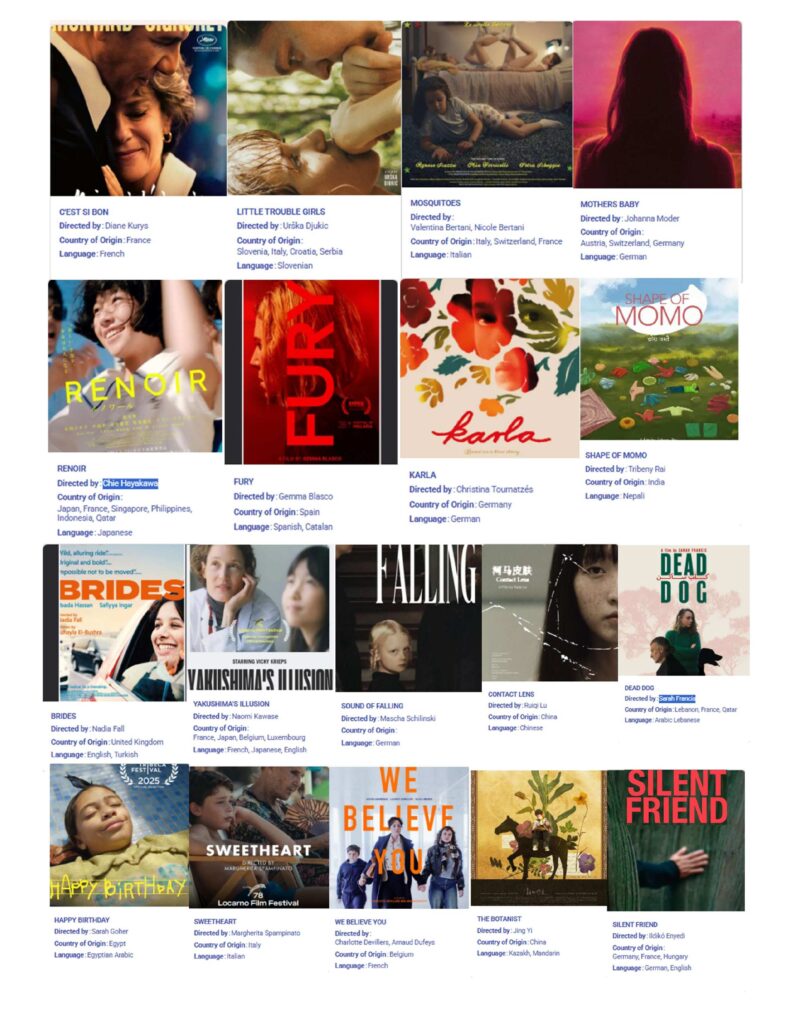
French director Diane Krys’ C’EST SI BON (MOI QUI T’AIMAIS) I WHO LOVED YOU based on a real life story centres around the tumultuous cupid play between two cinema stars at the height of their glory. Set amidst the charming old Paris—with its smoky cafés, bohemian nights, and timeless romance director Diane not only captures the spirit of a lost era, but poignantly portrays the tumultuous love, betrayal, and passion of two celebrated achievers. Lyron, Rohne born actress-director Diane’s films which have garnered attention are mostly semi-autobiographical in their thematic content.
The Slovak film LITTLE TROUBLE GIRLS aka KAJ TI JE DEKLICA by Urška Djukic is a winner of the FIPRESCI Prize in the Perspectives Section at the Berlin International Film Festival 2025. The film has been lauded by the FIPRESCI Jury as “this Perspectives film explores a kaleidoscope of emergent awakenings as driven by an evocative sensory experience and epitomised by its exceptional opening scene. The filmmaker beautifully portrays the struggles of a teenage girl stepping into adolescence—the push and pull of sexuality and societal restrictions—through excellent cinematic expression.”
The coming-of-age film spotlights on a young 16-year-old Lucia on the cusp of adulthood who joins the Catholic school choir and befriends senior Ana-Maria. How, during the choir retreat at convent, Lucia’s first flush of attraction to a restoration worker creates tension with her bestie Ana-Maria and challenges her faith, forms the fulcrum of Urska’s sensitive and intuitive film. This the first foray into filmmaking by Ljubljana, Slovenia born Urska which has coveted the critics attention.
MOSQUITOES ( LE BAMBINE-THE GIRLS) by Bertani sisters-director duo – Nicole & Valentina Bertani is an Italian coming-of-age comedy caper which takes viewers to the whirlwind era of 1990s, is a punkish portrait of a group of teen girls who decide to live by their choices and spotlights on eight-year-old Linda who drifts away from her wealthy grandmother’s Swiss villa with her carefree mother Eva.
In Italy, she comes across Azzurra and Marta in a sisterhood bond which sees the three girls go all out to protect each other, their youth, and their freedom. Touching and exhilarating the Bertani sisters weave a highly personal story about their childhood, constructing and imagining themselves beyond the impositions of a patriarchal society.
While Mantova, Italy born Valentina is a drum playing musician making ad films on commission, who took to film making, her sister Nicole is a creative director, graphic designer and producer, who joined hands for the Mosquitoes project.
MOTHERS BABY from Austrian filmmaker Johanna Moder takes the thriller format wherein issueless couple Julia, 40, successful conductor, and her partner Georg, longing for a child consent to fertility specialist Dr Vilfort to go in for an experimental procedure. Following successful birth of the baby it is removed away from Julia on some pretext but reunited with the child later on. What has happened in the interregnum and why does the mother feel rather distant from her new born forms the fulcrum of Johanna’s flick. Graz, Austria born Johanna’s 2014 debut film – HIGH PERFORMANCE went on to bag the Audience Award at Max Ophüls Prize Film Festival.
Young Japanese filmmaker Chie Hayakawa’s RENOIR (RUNOWÂRU) which takes the name of French artist Pierre-Auguste Renoir is a coming of age fare centring around a 11 year old Fuki whose terminally ill father Keiji is to be constantly administered by her mother Utako. The young girl, left to her own devices, soon descends into a fantasy world of her own being given to fertile imagination.
Drawing form her own childhood experience of having a father with cancer, Chie has appropriately set the film in the 1987 of Japan which witnessed the asset price bubble sending the country’s economy into a tailspin of troubles. Tokyo, Japan born Chie who debuted with PLAN 75 which won the Camera d’Or Special Mention at Cannes Film Festival 2022, has his sophomore film Renoir praised as “an elegant, thoughtful piece of filmmaking that digs into the guilt and confusion that underpins a child’s struggle to process death.”
Los Angeles & Ho Chi Minh City based Vietnamese born Ashleigh Mayfair’s SKIN OF YOUTH which won the Special Jury Award at New York Asian Film Festival 2025 spotlights on the turbulent romance between a transgender sex worker seeking to realise her dream of sex change, and San’s beau, Nam, who must work as an underground dog-cage fighter to support the dream, and trials and tribulations they face in 1990s Saigon.
Incidentally, UK and US educated Ashleigh’s debut feature THE THIRD WIFE won the NETPAC Jury Award besides a score of awards worldwide. Ashleigh was an alumna of the Sundance Film Two Lab 2020 and a recipient of the Berlinale Nipkow Fellowship 2020.
Damascus Syria born Farida Baqi’s THE VISUAL FEMINIST MANIFESTO winner of Youth Jury Award, IFFR 2025 is her debutant feature which takes viewers on a lyrical and emotional journey through the life of a young woman from birth to adulthood in an unnamed Arab City as she confront and questions the patriarchal society in her quest for realising her dreams and hopes.
The experimental film bespeaks of the “conflict between society that uses the power of religion and fear of God to impose a permanent state of girlhood on females who are on the way of becoming women on the one hand, and the female body and its biology on the other hand.”
The above features are in fray, among others, contending for International Competition Award, wherein it would fetch the eventual winner being bestowed the prestigious Golden Peacock – Best Feature Film the main prize of IFFI which comes with a handsome cash prize of Rs 40,00,000 shared between the Director and Producer. The Director also gets the Golden Peacock and a Certificate, while the Producer a Certificate. While Silver Peacock – Best Director IFFI Award in the same section sees the recipient receives a Cash Prize of Rs 15,00,000, the Silver Peacock and a Certificate.
The Barcelona Spain born Gemma Blasco’s Catalan feature FURY (LA FURIA) as the title suggests is a high adrenaline revenge saga wherein a guilt ridden Adrian, driven by rage, the brother of date rape victim sister actress Alexandra during a New Year’s party, goes on the overdrive to avenge his sister’s tragedy, while she herself takes the situation she is in stoically performing the role of Medea in Euripides’ tragedy. Gemma, besides dabbling in filmmaking, is primarily a teacher of acting.
Greek-German filmmaker Christina Tournatzés’s KARLA inspired by a true story and set in Munich in 1962, spotlights on 12-year-old Karla, runs away from her family and enters a police station seeking justice against her sexually abusive father, seeking protection from his years of domestic incestuous, paedophile abuse. Does the State and its Law help the youngster break through her own silence and make her voice heard forms the crux of the disturbing film.
India’s very own Sikkim resident Tribeny Rai’s debut Nepali feature SHAPE OF MOMO centres around Bishnu, 32, who returns to her ancestral Himalayan village after quitting her city job, only to face mounting family pressures and rigid societal expectations.
With her family eager to see her married and settled her tentative relationship develops with Gyan, a “suitable” local architect, sees Bishnu caught betwixt tradition and her desire for independence and how she navigates the tenuous web of expectations and defiance, and choose whether to conform or forge her own path.
The above three are in contention for the Silver Peacock for Best Debut Feature Film of a Director that seeks to recognise and promote most promising new directorial talent in international cinema with the ultimate winner bagging the award comprising cash prize of Rs 10,00,000, the Silver Peacock and a Certificate.
Southwark, London born Nadia Fall of South Asian parentage’s eponymous titled BRIDES a debut feature tracks the tumultuous sojourn of two teenage girls in search of freedom, friendship, and belonging whilst they run away from their troubled lives after experiencing Islamophobic discrimination in school emboldened by a rather misguided plan of traveling to Syria. The two, stranded in Istanbul, with their fixer not turning up, must find a way to travel to Syrian border before their absence from home is discovered.
The film which won the Fritz Gerlich Trophy at the Munich Film Festival for its contribution to human rights and antiracism through cinema had the Jury described BRIDES “as an examination of how young people must be cared for with care and attention, warned against, and protected from dangerous manipulation, and how a series of minor catastrophes ultimately escalate into a major catastrophe,” appreciating the film for its topicality.
Nara, Japan born Naomi Kawas nee Naomi Sento, her former husband’s surname, showcases her film YAKUSHIMA’S ILLUSION (L’ILLUSION DE YAKUSHIMA) chronicles the trials and tribulations of Corry, a French coordinator of paediatric heart transplants sent to Japan where organ donation is a taboo. Even as she fights to save a young boy, her partner Jin, a photographer from Yakushima, suddenly vanishes to be referred to as “Johatsu”, as Japanese call the 80,000 people who disappear overnight each year. Corry now faces a double ordeal: saving a child while coping with the loss of the man she loves providing for an interesting engagement with the social and personal challenges the protagonist confronts.
These two are in contention with others for the International Film Festival of India (IFFI) and International Council for Film, Television & Audiovisual Communication (ICFT), Paris’ special ICFT prize to a film which reflects the ideals promoted by UNESCO – especially: Tolerance, Intercultural Dialogue & Culture of Peace. The Award comprising the UNESCO Gandhi Medal and a Certificate.
Mascha Schilinski, born in Berlin German, brings her film SOUND OF FALLING (IN DIE SONNE SCHAUEN) which, set in a remote German pastoral village, showcases four women, separated by decades, but united by trauma, whilst it uncovers the truth behind its weathered walls. The film is described as a prose-poem of guilt, shame and yearning in 20th C Germany, and a drama of intergenerational trauma and genetic memories.
The experimental films section brings Zhejiang, China born Ruiqi Lu’s debut feature CONTACT LENS (HE MA PI FU) which imagines the emancipation of women from the confines of narrow spaces and the tedium of routine lives and imagines the emancipation of women from the confines of narrow spaces and the tedium of routine lives, echoing a deeply felt yearning to break free.
Beirut, Lebanon born Sarah Francis’ DEAD DOG (KALB SAKEN) is described as a “is a measured dissection of a marriage that is simultaneously breathing and decomposing.” While Breau, Cavennes France born Elsa Brès’ SHE BOARS ( LES SANGLIÈRES) set in the 16th C, in a forest in Cévennes, in France, speaks of how peasant women from many regions band together to fight the enclosure of common lands. Her films focus on forces of resistance in spaces on the margins, on the edges or under the ground.
South Bronx, New York City born Egyptian-American filmmaker Sarah Goher to Egyptian immigrant parents, showcases her Egyptian feature HAPPY BIRTHDAY speaks about Toha, eight-year-old, working as maid for a wealthy family in Cairo, who is determined to organise a perfect birthday party for Nelly, her employer’s daughter. But, will the social hierarchy between the two allow this to happen? Is what her debut flick tries to answer which is presented in the UNICEF section.
Among Rising Stars featured you have Palermo, Italy born Margherita Spampinato’s directorial debut SWEETHEART (GIOIA MIA) which beautifully examines the clash between modernity and the past, between reason and religion, between speed and slowness, as Nico, a lively, impertinent child from a modern, technological and hyper-connected world, forced to spend the summer in Sicily, with his very religious and grumpy elderly aunt who lives alone, in an ancient palace full of legends and superstitions, sans wi-fi or electrical appliances, completely out of time.
The other is Victoria born Toronto based Hungarian-Canadian filmmaker Sophy Romvari’s debut BLUE HERON
set in late ‘90s, revolves round a family of six in their new home on Vancouver Island, whose personal eqeuations are revealed through the eyes of the film’s child protagonist Sasha, as the family’s fresh start is interrupted by the increasingly dangerous behaviour of Jeremy, the oldest child.
The French-Belgian director duo – Charlotte Devillers & Arnaud Dufeys’ highly engrossing and engaging custody battle family drama – WE BELIEVE YOU (ON VOUS CROIT) – speaks of how Alice, a working mother, battles it out before the judge, for the custody of her two children from the estranged father, accused of child abuse, who seeks to wrest and win them over, from her.
The Mission Life Section features three women directors. Lima, Peru born Tatiana Fuentes Sadowski’s THE MEMORY OF BUTTERFLIES (LA MEMORIA DE LAS MARIPOSAS) spotlighting on the indigenous peoples of Peru today, descendants of workers of rubber factory, and their interventions, chronicles the lost and overlooked stories of a generation devastated by the rubber boom of the late 19th and early 20th century in Latin America, by melding the experimental and documentary format of cinema narrative.
Winner of FIPRESCI Prize for Best Film in Competition at the Venice Film Festival 2025 SILENT FRIEND by Budapest Hungary born Ildikó Enyedi was appreciated “for its poignant exploration of universal connections and unspoken bounds that tie life forms together,” as a bold film. Set in the botanical garden of a medieval town in Germany, the film references to the imposing Ginkgo biloba tree on the grounds of a medieval German university town, whose longevity stands in marked contrast to three intimate, human-scaled stories that the director delectably unfolds and dissects before us.
Xinjiang, China native Zhi wu xue jia’s Kazakh feature THE BOTANIST which bagged the Grand Prix of the Generation Kplus Award at Berlin International Film Festival 2025, revolves round a lonely Kazakh boy Arsin finds solace in the company of plants. How the arrival of Meiyu, Han Chinese girl, brings within him comfort and a strange sense of wonder as they grow like two distinct species. However, with the impending depaeture of Meiyu to distant City where the ocean actually exists, Arsin is left contending with quiet shifts in their small, fragile world.
Indeed, despite the odds, the ‘Nari Shakti’, to use the Indian coinage, speaks of how women directors are reclaiming their rightful place breaking the “celluloid ceiling” bringing in “diverse voices” to film festival templates, redefining narratives filmgoers get to engage with, which can be described as transformative movement

S VISWANATH is a veteran film critic who officiates as JURY at several National & International Film Festivals. He deputises as CHIEF CINEMA CURATOR/PROGRAMMER & CREATIVE ADVISOR for Bengaluru International Film Festival (BIFFes). He also curates & advises on the selection of shorts & documentaries for Bengaluru International Short Film Festival (BISFF). Mr Viswanath is the author of “RANDOM REFLECTIONS: A Kaleidoscopic Musings on Kannada Cinema”.




Leave a Reply