
S Viswanath
“Academia is the death of cinema. It is the very opposite of passion. Film is not the art of scholars, but of illiterates. “Film is not analysis, it is the agitation of mind; cinema comes from the country fair and the circus, not from art and academicism.” ― Werner Herzog, pioneer of New German Cinema.
“It’s not what a movie is about, it’s how it is about it.”―Roger Ebert, American Film Critic & Historian
“The world that the standard or mainstream film constructs is, like the world we live in and the air we breathe, so familiar that we rarely think about how it is put together. Films want to make us think they are reality. Mainstream film creates its world, a story, a tale with a beginning, middle, and an end. A tale that leaves you with a moral message….Often the message is not direct as the story of individuals, made to seem important because they have been singled out by the camera.”―Robert Rosenstone, American Author & Historian
Given that the country, being largest film producing nation, over 2,000 plus films are made annually. In almost as many as 22 official languages. Let alone the dialects. With Hindi, Telugu, Tamil, Malayalam, and Kannada, among others, being dominant ones, accounting for most of commercial, or run-of-the-mill films that light up the screens across the country, week after week.
Like cricket, cinema, and movie going, is as much a religion in India. A habit. A pastime. With devoted majority consuming cinema, more for larger than life ‘escapist’ entertainment or just ‘timepass’ it provides them in the darkened theatres.
Swayed more by their respective deified screen idols and starlets they cherish to adulate and drool over. These delirious consumers of the ‘opiate of the masses’ are provided their weekly dope dollops by pashas of entertainment or movie merchants who stake it all to provide these movers, shakers, makers or decimators of the film’s prospects, three hours of unbridled escape from worries of life and drudgery of their diurnal existence.
It is this tacit transaction between the itinerant providers and faithful consumers that ensures either the film, if it fulfils or ticks all boxes of filmgoers’ expectations, becomes runaway hit, or if not, consigned to dustbin of duds rejected contemptuously by the very same mass for not living up to their expectations or the hype built around the film that drew them to the theatres in the first instance.
Beyond this monetary mundanity neither the filmmaker or the consuming masses crank their cranium or lose sleep over what their hero, heroine or for that matter, the very film they are watching or watched, is seeking, if it is indeed doing so, to “educate,” “enlighten” them on the “State of theNation” and the “Politics of Visual Narratives” or for that matter “how their favourite stars symbolise or act as metaphors” for the larger “social treatise” or “academic discourse” that the films seem to be purveying, and thereof.
Be it the filmmakers, or the fans, fret and fuss beyond the box office or crowd pulling dynamics that has gone into making of the movie concerned. Imagine them paying hefty price, sit in theatre, and instead of watching with “suspension of disbelief” the high adrenaline, humdinger action drama unfold before them, put their thinking caps on, trying to analyse and allegorise or plough hidden meanings out of what their hero or heroine represents or the film itself is conveying beyond its peripheral function of “entertaining”and “engaging” them for two to three hours they have sought to spend in the AC auditoriums.
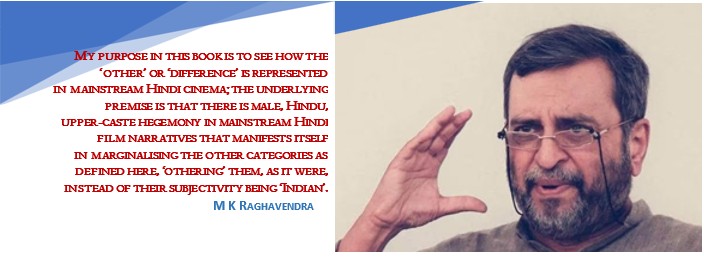
But then, mining politics and metaphors,interpretations and meanings into these very movies as to what possibly they may be indirectly purveying. Situated as they are in the socio political milieu of the time, as a subtext beyond their peripheral patent formulaic plotlines, and making it a fine art and his patent vocational academic discourse is M K Raghavendra, a self-styled film theoretician and academician of Indian films,a writer, observer and commentator on Indian socio-political happenings, on the aside.
A Homi Bhabha Fellowship recipient and National Award for Best Film Critic, Mr Raghavendra, who has to his credit, a score of books majorly on different aspects of films and film analysis, is ever wont to give his own spin on the Indian commercial films, more so, Hindi or Bollywood films.
Excavating hidden meanings, metaphors, allegories, and inherent politics playing out before the suspecting audiences, and elevating these films to the realm of academic discourse and dissection through his syncretic readings into them, from social, religious, cultural and ideological points of propositions.
It is, to state, in the words of historian Robert Rosenstone in his essay – The Historical Film: Looking at the Past in a Post literate Age “film is a disturbing symbol of an increasingly post-literate world (in which people can read but won’t),” agitates so much Mr Raghavendra that he seeks to coax and convince the cinema going public to consume films beyond their superficial narratives and explore the truth, they seemingly hide underneath them, for, as Martin Scorsese puts it “cinema is a matter of (not only) what’s in the frame and (but also) what’s out.”
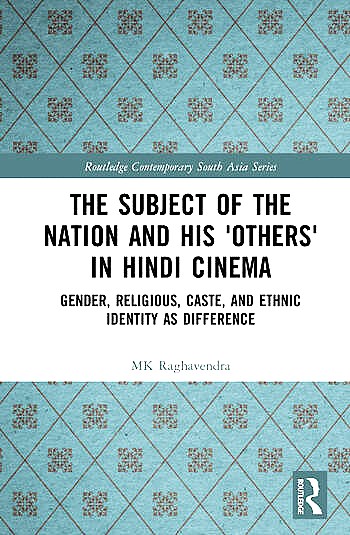
Precisely in pursuit of this very proclivity and prodigious pastime,to probe and propose newer nuances, eclectic understanding, and hitherto unexplored aspects that escape the ordinary eye that Mr M K Raghavendra seeks to give voice to, illustrate and illuminate in his latest tome – The Subject of the Nation and his ‘Others’ in Hindi Cinema: Gender, Religious, Caste & Ethnic Identity as Difference.
This Routledge Contemporary South Asia Series publication, running into 186 pages, we are given to understand that “the book analyses representations of subjects of Hindi cinema as a way ofgaining insights into the hegemony of the upper-caste Hindu male in narratives ofnationhood.”
Yes. Precisely. The very aspect of the “idea of nationhood” differs within cinemas of India. In that, how Bollywood or Hindi cinema is different from other regional films rarely ascribe to this notion, since they cater to very niche audiences, whereas Hindi films, addresses almost entire Indian diaspora that Mr Raghavendra elucidates and explains in this, and other books, he has penned thus far.
“The book,” as its promotional prelude puts it ,as also its title bespeaks for itself,“examines how these subjects were chosen and argues that they were upper-caste,Hindu and predominantly male.”“The author’s analysis,” it observes,“shows asymmetries in theconstitution of the ‘imagined nation’ in the public consciousness. Women, themarginalised categories, and minorities were presented as ‘others’ with separatestories for the issues dealing with them—but distinct from that of the nation.The book argues that it is the male protagonist whose story mirrors that ofthe nation as allegory.”
But then, why is it so that the hero and not the heroine gets to “represent” the “nation” as Mr Raghavendra propositions. Well, I would hazard to state that almost all films, with rarest of exceptions, of Bollywood or Hindi cinemas, are conceived, concretised, and made to order with the “bankable male star” in mind rather than the equally bankable heroine, who are consigned, in concert of course, to the margins as just being pretty putty playmates of the protagonist male to pander to the voyeuristic “male gaze” of hero adulating audiences.
That said, and dusted, as to why women rarely find voice in films, even it be heroine oriented, empowering film as well, what the book tries to argue and make out a convincing case for its birth is that “once the male subjectivity as innate organising principle is recognised in Hindi cinema in the process of ‘narrating the nation’, the position of those who mark a difference in terms of gender, religion, caste and ethnicity becomes that of ‘others’, and, in most cases, their ‘othering’ is intended to highlight that specific status in the scheme of the nation.”
For, according to Mr Raghavendra, “the nation has been inscribed consistently in mainstream Hindi cinema beginning in the silent era, even before the Indian nation became a political reality. This is largely achieved by allegorising common issues preoccupying Indians; among instances.”
This, Mr Raghavendra, goes on to enumerate and illustrate as to how “if the nation is inscribed in Hindi cinema, how thisreveals itself in the narratives,” be it “in the protagonists’ actions,” or “what gender, religion, region or caste,” the person is, and how “these aspects mark out identity within India.”
To buttress his arguments and suppositions,Mr Raghavendra bases his presupposition to Benedict Anderson’s Imagined Communitieswhose groundbreaking work described the nation was “an imagined political community.”
Mr Raghavendra posits that “Indian popular cinema takes the omniscient viewpoint in order to relay a pre-existent message, and character subjectivity is, hence, notably absent.Therefore, he further elucidates, “my purpose is to see how the ‘other’ or ‘difference’ is represented in mainstream Hindi cinema;” with “the underlying premise” being “there is male, Hindu, upper-caste hegemony in mainstream Hindi film narratives that manifests itself in marginalising the other categories as defined here, ‘othering’ them, as it were, instead of their subjectivity being ‘Indian’.”
The objective of the book being “to provide evidence of cultural hegemony operating in Hindi cinema in representing the national subject in film narratives where the archetypal ‘Indian’ is represented as male, upper caste and Hindu.”This, even as “women, religious minorities (usually Muslim) and Dalits (former untouchables) are portrayed as ‘different’.”
Asserting that “the caste structure was a creation of Brahminism,”Mr Raghavendra, in the light of this supposition, “justifies that Hindi cinema is ‘Brahminical’ in its basis,” with “films preoccupied with relaying a pre-existing message.”
Systemically structuring his book into eight definitive chapters as: Film Form and Ideology, The Trajectory of the Hero in Bollywood, Representing Women, The Portrayal of Muslims as Religious Minorities, Caste Identity and Conflict, Ethnicities and Hindi Cinema, Representing the Social ‘Other’, Pakistan as the National ‘Other’ with an Introduction and an Afterword: Asymmetric Nationhood, Mr Raghavendra leads his readers into how and wherewithal of his arguments while expounding on how this “othering” takes place in Hindi films especially.
With “filmshaving invaded the class-rooms,” and “the realisation films can do something written words cannot,”Mr Raghavendra has, it is evidenced, taken “the explicit approach that motionpictures to be reflections of the social andpolitical concerns of the era in which they were made,” as historian Robert Rosenstoneexplains in his essay. A “strategy” which as Robert Rosenstone “insists that any film canbe situated “historically.”
Given that Mr Raghavendra has confined himself to a miniscule universe of Indian cinema, in that, he has confined and constricted himself for heuristic purposes examining the various aspects of his literary cinematic treatise to only Hindi filmscritiquingthem for his hypothesis seems a tad inadequate to the claims he lays out.
Maybe, a much broader, and more encompassing approach, that would have included similar examples from films beyond the Hindi mainstream, not just a couple, would have made the perceptive and much welcome book more expansive and inviting for those audience-readers whose film going pursuits may not necessarily be Hindi movies.
Further, for the uninitiated in the film theory and academics, whose engagement with films is pureplay “entertainment” or even the students of film studies, yet to be ground in “reading films as texts beyond their peripheral visual narratives” the author’s assertions and implications cannot be easily gleaned and grasped.
The propositions and its presupposed premises may come across as bit obtuse and obscure, for a lay movie-goer, however, the book, per se, is not only provocative in its theoretical trajectories and treatises it discourses and debates upon, making it an insightful, incisive but formidable and exacting read, and a welcome addition to the literary exploration of cinema especially students of film studies, and for the lay audiences, meanings one can derive beyond its narrative obvious which blinkers an otherwise better and eclectic understanding and approach to The Seventh Art.

S VISWANATH is a veteran film critic who officiates as JURY at several National & International Film Festivals.




Leave a Reply