
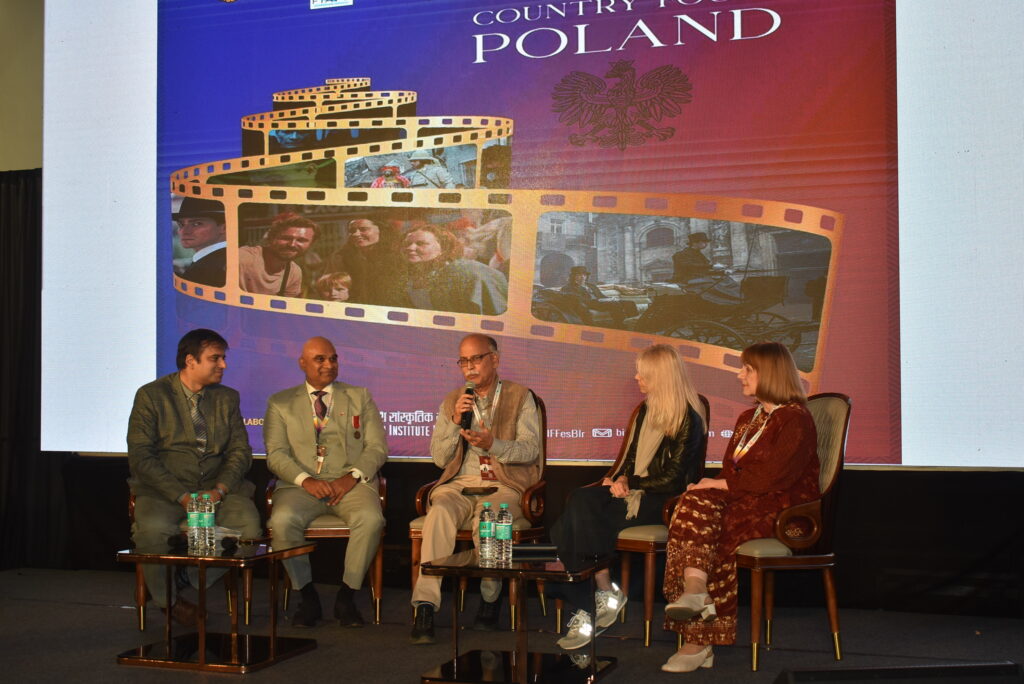
Andrzej Wajda was a great filmmaker. Whenever necessary, he spoke out and fought. But he fought very cleverly, because he had to struggle against the rigid censorship of his time. He found new ways to express what could not be said openly. He was not just a filmmaker, but also a fighter, said Joanna Wapińska, Artistic Director of the Gdynia Film Festival.
Speaking at a session titled “Polish Cinema and the Legacy of Andrzej Wajda”, organized as part of the 17th Bengaluru International Film Festival, Joanna said, “Wajda opened an entirely new chapter in Polish cinema. He initiated the movement known as the ‘Polish Film School’. Films such as Kanal and Ashes and Diamonds, which you may have heard of, heralded this movement. After the Second World War, the Polish government expected cinema to follow ‘Socialist Realism’, but Wajda’s films completely questioned this approach. He wanted to speak from the depths of the human heart.”
She also spoke about how Wajda lived not just for cinema, but for people. “He portrayed the anguish of the ‘Lost Generation’-young people who had lived through the Second World War. That generation had won the war on one hand, but on the other had lost their own country. This bitter reality and pain are powerfully reflected in Andrzej Wajda’s films. Man of Marble is one of his most important films. As soon as the film was completed, it sparked a wave of public awareness movements in Poland,” she said.
She added that the films of contemporary Polish directors such as Paweł Pawlikowski stand on the strong foundation laid by Wajda. “Wajda was not only a director; he was also a politician. In the 1990s, he served as a senator. His desire to fight for the nation and for freedom remained with him till the very end. At times, he described himself as an ‘excessive idealist’. That was the most gentle and touching aspect of his personality. He continues to live on in our memories,” she said.
Offering his perspective, Vidyashankar said, “Wajda was not merely a film director; he became the cultural voice of Poland. Through visual grandeur, he embedded the language of protest within his films. This is what made him a key cultural voice of civil resistance during the 1980s Solidarity movement.”
Speaking about the cultural diplomacy of the films being screened in Bengaluru, Małgorzata Wiśniewska-Gołębiak, Director of the Polish Institute in New Delhi, said, “Culture is the most powerful medium of communication. It enables us to collaborate beyond borders and share emotions.”
The session was moderated by film composer Murtuza Ali Khan, and was attended by Poland’s Honorary Consul in Bengaluru, Channarayapatna Rajappa Raghu.





Leave a Reply