
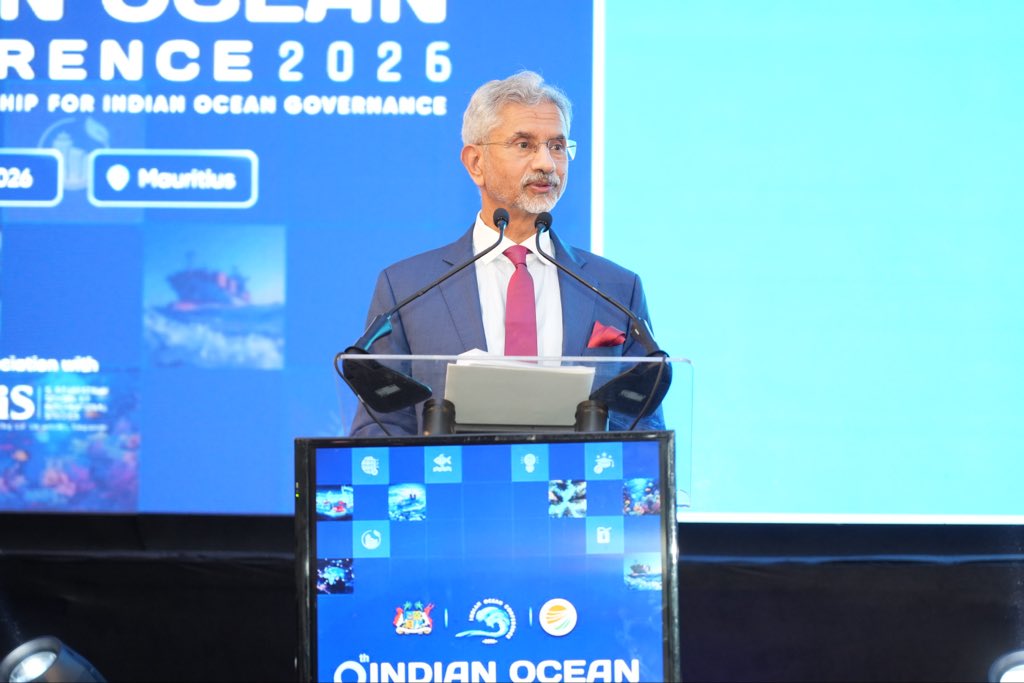
Port Louis :
Excellencies, Distinguished guests, Ladies and Gentleman,
It’s a privilege to share my thoughts at the 9th Indian Ocean Conference on collective stewardship for the Indian Ocean. Let me express my appreciation to the Government of the Republic of Mauritius, specifically to Prime Minister Dr. Navinchandra Ramgoolam, to Foreign Minister Mr. Dhananjay Ramful, to the organizers India Foundation, and to Ram Madhav ji, who has been the force behind this conference all these years.
2. We gather every year, at least we have for the last nine, to deliberate on the Indian Ocean, its achievements, prospects and challenges. And we do so again at a time when the turbulence in the world and in the Indian Ocean itself is at a high. This gives our conversations a particular value and I am confident that you all share that belief.
3. In this background, let me make five points that I hope you will reflect on during the Conference deliberations:
(i) The first is an obvious one, I am stating the obvious, but nevertheless necessary today. And it is about the importance of the Ocean. This is not just a framework in which we all exist but an ecosystem, it is the resources on which we depend, the connectivity on which we thrive and indeed the culture that we have built up over the ages. It is so fundamental that when this is disrupted, numerous aspects of life are impacted. We are seeing it today. The Indian Ocean must plan for more stormy days while hoping for more sunny ones.
(ii) In the last decades, our focus was on overcoming the artificial barriers of the colonial era. This meant deeper regional cooperation, stronger economic linkages, rebuilding of connectivity and revival of traditions. Last year, we deliberated at some length on these very facets. The spirit of the monsoons must inspire us to continue to work together. We must continue to advance this and not be distracted from our long-term goals. The world may be more fragmented; but we the nations of the Indian Ocean must seek to be more cohesive.
(iii) Global trends are a reality that cannot be ignored. The world is more competitive, fractured and inward looking than in the past. The benefits of globalization are today overshadowed by the temptation to leverage and the temptation to weaponize. As a result, we are all in a quest for greater resilience and are seeking more trusted partners.
(iv) Chokepoints are now a great global anxiety. We naturally tend to think of it physically, as is the case in regions close by. But let’s not forget that it has also been conceptually developed in domains like finance, technology, resources and even knowledge. Overcoming that control mindset is essential for the well-being of the international economy.
(v) And not least, there is a call for deeper cooperation amongst nations of the Indian Ocean. In many ways, it is a Global South Ocean. Whether it is food, fuel or fertilizer shortages, whether it is responding to natural disasters, whether it is the addressing the consequences of conflicts, the answer is increasingly in collective resilience. We in India have articulated it through our MAHASAGAR outlook and our Neighbourhood First policy.
4. With those five points placed before you, let me stress today that we meet in a world marked by uncertainty and rapid change. The global order is undergoing a period of profound transition, shaped by shifting power balances, ongoing conflicts, economic fragmentation, and growing contestation. Nations increasingly prioritize security and resilience. Here is the paradox that the world confronts: the interdependence is getting deeper, but the competition is getting stronger. Navigating it is therefore getting tougher.
5. In these turbulent times, the situation in West Asia merits obviously particular attention. All of us are deeply concerned about the conflict and would like to see an early return to normalcy. We firmly oppose the targeting of civilians, of infrastructure and of commercial shipping. It is essential that navigation remains safe and unimpeded. The relevant point here is that each one of us has felt the economic impact of this conflict very deeply. When energy is scarce and expensive, it has an overarching implication for the entire society. When trade is constricted, this goes beyond business to livelihoods in different sectors. When fertilizers are more difficult to procure, its food security consequence is obvious. These have become the immediate challenges as we meet here in this conference. But there are underlying issues that we also need to address because there is no guarantee that such scenarios will not recur.
6. So let me turn back to the Indian Ocean that we collectively inhabit. The vulnerability of the Ocean only further highlights its centrality. We have to recognize that the pressures on the Indian Ocean are only growing. The takeaway here is the urgency with which we seek solutions. And the importance in convincing the international community of that pressing requirement. It can no more be business as usual.
7. Friends, We have over multiple conferences been discussing non-traditional challenges in our maritime space. But here is the truth that we cannot avoid. There is a full-blown conflict that is today deeply impacting all nations of the Indian Ocean. Moreover, there are grey zone activities that span the spectrum between the traditional and the non-traditional. We all saw and we all felt the consequences when shipping in the Red Sea was disrupted in last few years. So, the bottom line is that the spectrum of challenges has become wider and more seamless. And unfortunately, also more serious. Our stewardship cannot ignore this.
8. No single Indian Ocean state, however capable, can preserve and protect the maritime space alone. The complex challenges demand a shared commitment. One that is rooted in cooperation, and transparency, and above all, in respect for international law. We must view the Indian Ocean as a global commons, where not only the benefits are shared but so too other responsibilities. Our efforts must be pursued through strong institutional networks. The Information Fusion Centre-Indian Ocean Region (IFC-IOR) enables real-time maritime information sharing, enhancing domain awareness and operational coordination among partner countries. Regional platforms such as the Indian Ocean Rim Association (IORA), the Indo-Pacific Oceans Initiative (IPOI), BIMSTEC, Colombo Security Conclave, and the Indian Ocean Naval Symposium (IONS), all provides structured avenues for dialogue, for cooperation, and for capacity building.
9. Friends, India has consistently acted as a ‘First Responder’ in the Indian Ocean region. Whether in humanitarian crises or natural disasters, we have stepped forward with speed and with reliability. Be it disaster relief operations in Sri Lanka, Madagascar, Mozambique or responding to oil spills off the coasts of Mauritius or Sri Lanka, we have been there for the region. A recent example would be the ‘Operation Sagarbandhu’ in Sri Lanka after the devastating Cyclone Ditwah last year. We not only undertook prompt and extensive HADR operations, but also committed a package worth USD 450 million for relief and reconstruction.
10. Equally important is our development partnership approach. India’s engagement is guided by the priorities of our partners, focussed on sustainable outcomes. Let me cite some examples.
11. Here in Mauritius, in addition to iconic projects like the Metro Express, we are currently working on water supply, a police academy, a forensic laboratory and on archives. Just earlier in the day, I had the honour of joining Prime Minister Ramgoolam to dedicate a Renal Transplant Unit and also handover 90 e-buses. The recent Special Economic Package which we have finalised contemplates 8 significant initiatives in health, transport and infrastructure.
12. In Seychelles, while partnering over the years in different domains, we have again just extended a Special Economic Package on whose delivery Foreign Minister Barry Faure and I are working.
13. In Sri Lanka, our projects extend across housing, health, education, cultural centres, connectivity infrastructure and livelihood enhancement.
14. In the Maldives, major ongoing projects include the flagship Greater Male Connectivity Project, several road and water sanitation projects, as well as airport development.
15. In Madagascar, India’s assistance in agriculture and energy is today underlined by the supply of rice in very sizeable quantities.
16. Where partners like Nepal, Bangladesh Bhutan in South Asia are concerned, or in the Tanzania and Mozambique in Africa, our development partnership are a subject in themselves. They encompass so many dimensions of the economy and society. And these projects have not just been transformational in themselves but actually have brought our countries and our region much closer.
17. Apart from this, capacity building and capability enhancement of our partners in the region is equally vital. Many countries in the region face difficulties in monitoring their vast EEZs. To help our partners, we have not only invested in dedicated training programs but are also supporting the equipment of their navies and coast guard. I also note that in Sri Lanka, we have recently set up and operationalised the Maritime Rescue and Coordination Centre.
18.As we speak about collective stewardship, obviously defence partnerships also come to mind. And ours in this region are rooted in cooperation, not in confrontation. Through joint exercise, be it AIKEYME, Dosti or MILAN, we build interoperability and trust to combat threats collectively for a safer and more prosperous Indian Ocean region.
19. Friends, All these efforts become meaningless without connectivity. Indeed it is Connectivity, that is the thread which ties all together. Be it the IMEC, the INSTC or the IMTT, India is at the centre of these initiatives. Our approach to connectivity is clear. It must be transparent, it must be consultative, it must respect sovereignty and it must be a genuine partnership.
20. Allow me also to share a thought about the Indian Ocean Rim Association that is headquartered here in Mauritius. As the current Chair, India is committed to deepening sustainable development, capacity building and regional integration.
21. Among the platforms relevant to the Indian Ocean is also the Quad. India’s partners in the quad – Australia, Japan and the United States – are all maritime nations. Our first collaboration actually started in the Indian Ocean in 2004. So let me just flag to your attention some of the Quad initiatives of relevance, some of the recent initiatives of relevance, and they include the partnership for Maritime Domain Awareness, the Indo-Pacific Logistics Network and Partnership for Cable Connectivity and Resilience.
22.Excellencies, ladies and gentlemen, In this volatile era, the idea of collective stewardship calls for moving beyond narrow calculations and embracing the broader vision of shared responsibility. The Indian Ocean with all its promise and challenges, offers us an opportunity to demonstrate what such cooperation can actually achieve. By working together, we can ensure a free, stable and prosperous Indian Ocean region. Indian remains fully committed to that endeavour.





Leave a Reply