
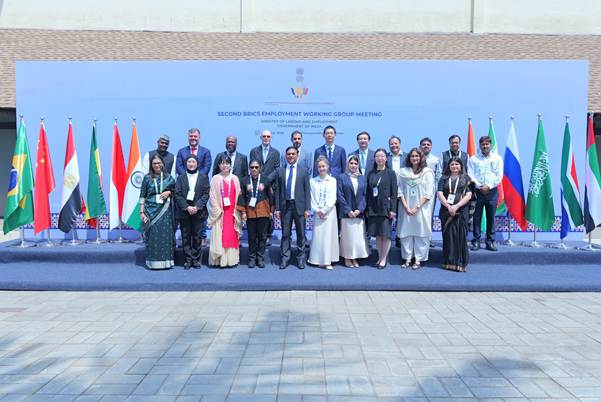
The Second BRICS Employment Working Group (EWG) Meeting under India’s BRICS Presidency successfully concluded today in Thiruvananthapuram. The meeting was firmly anchored in the theme of India’s BRICS Presidency of 2026- Building for Resilience, Innovation, Cooperation and Sustainability.
The meeting witnessed two days of intensive and productive deliberations and brought together distinguished delegates from BRICS member countries, knowledge partners including the International Labour Organization (ILO), International Social Security Association (ISSA), and United Nations India, as well as representatives from India’s Ministry of External Affairs and Ministry of Skill Development and Entrepreneurship.
The first day of the meeting focused on three priority areas: advancing social security and formalisation, enhancing women’s labour force participation, and strengthening cooperation on employability and skills development. Member States converged around a shared vision of progressively expanding social protection coverage to all forms of work through contributory and non-contributory mechanisms. On women’s participation, members emphasized that female labour force participation rate (FLFPR) is an important parameter of development, contributing directly to productivity, economic resilience, and inclusive labour markets. Under employability and skills mapping, there was strong convergence on the importance of lifelong learning, vocational training, and better skills-to-jobs matching. India’s ongoing feasibility study on a reference classification of occupations, undertaken in collaboration with the ILO, was well received as a noble initiative to develop a common language of skills and qualifications.
Delegations appreciated the spirit of collaboration and South-South cooperation that characterised the first day’s exchanges. In the evening, a cultural programme was organised for the delegates, showcasing the rich heritage of Kerala through vibrant folk and classical art forms such as Bharatanatyam, Mohiniattam, Kalaripayattu, Mayoora Nritham, Margamkali, and Oppana, offering participants a warm cultural experience of “God’s Own Country”.
The second day of the meeting witnessed continued deliberations, with delegates underscoring the convergence of priorities among BRICS nations. There was a shared recognition of the need for deeper cooperation, stronger knowledge-sharing mechanisms, and coordinated action to address common challenges such as extending social protection to informal and gig workers, closing gender gaps in labour markets, and responding to rapidly evolving skill requirements.
Subsequently, deliberations were held on the fourth priority area: leveraging digital technologies for all workers, including gig and platform workers. Member States acknowledged that digitalisation is fundamentally reshaping the nature of work and offers significant opportunities to improve access, enhance transparency, and enable inclusive delivery of social protection and employment-related services. At the same time, countries stressed the need to address emerging risks and ensure that digital transformation remains inclusive, equitable, and worker-centric. Discussions focused on the exchange of best practices related to registration systems, benefit delivery mechanisms, data-driven governance, and technology-enabled solutions.
The meeting also featured a dedicated knowledge-sharing session, during which BRICS countries presented innovative initiatives and experiences from their respective national contexts, including India’s NCS and e-Shram, Egypt’s mobile training units, UAE’s Wage Protection System and unemployment insurance scheme, and Brazil’s Equal Pay Law, among others. These exchanges reinforced the value of peer learning and mutual collaboration in addressing shared labour market challenges.
The meeting concluded with a reaffirmation of the collective commitment of BRICS member states to work together towards building inclusive, resilient and future-ready labour markets, anchored in cooperation, consensus, and shared learning.


Leave a Reply