
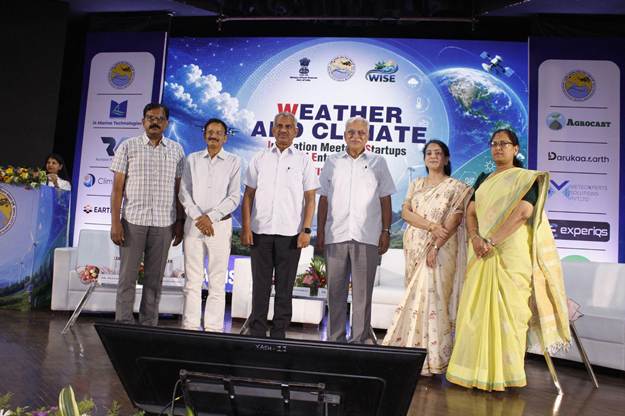
The Indian Institute of Tropical Meteorology (IITM), Pune, under the Ministry of Earth Sciences (MoES), officially inaugurated its dedicated Incubation Center for Startups in Weather and Climate today. The landmark event was marked by a one-day national meet titled ‘Weather and Climate Innovation Meet for Startups and Entrepreneurs (WISE-2026)’, signaling a new era of private-sector integration in India’s meteorological services.
The facility was inaugurated by the Chief Guest, Dr. M. Ravichandran, Secretary, MoES. The ceremony was also graced by Guest of Honour Dr. Shailesh Naik (Director NIAS & Former Secretary, MoES), Dr. Suryachandra Rao (Director, IITM), and other distinguished dignitaries. The Incubation Center is a key component of the National Enterprise for Atmospheric Technology (NEAT), an ambitious vertical under MoES’s ‘Mission Mausam,’ designed to foster technology development through public-private partnerships.
Highlighting the critical role of collective action in addressing climate challenges, the Secretary of the Ministry of Earth Sciences, Dr. M. Ravichandran emphasized that the complexity of modern weather patterns—amplified by climate change—requires a shift from traditional research to an inclusive, multi-stakeholder ecosystem. He underscored that the newly launched Mission Mausam is a foundational step toward building a “weather-ready and climate-smart nation,” integrating advanced observations, AI-driven modeling, and localized dissemination to safeguard lives.
Stressing the importance of bridging the gap between deep science and practical application, the Secretary stated:
“The young entrepreneurs from different domains, they know needs of other stakeholders better. So we need to collectively work together. That is why this collaboration will definitely lead to many solutions. It is not only for economic necessity, but also it is important to save life and livelihood.
- Four Pillars of Progress: The Secretary identified Observations, Modeling, User-specific Applications, and Dissemination as the essential pillars to improve forecasting.
- Mission Mausam: A five-year rollout aimed at scaling weather forecasts & climate-scale insights through a “health system approach” involving various ministries and startups.
- Call to Action: He invited innovators to utilize the Ministry’s “freely open” resources—including remote sensing and reanalysis data—to develop cost-effective, hyperlocal solutions for sectors like agriculture, aviation, and disaster management.
The inauguration was followed by a high-level panel discussion that highlighted a strategic shift in weather & climate science, moving from research to actionable, startup-driven solutions across critical sectors like agriculture, renewable energy, health, and disaster management. Central to the event is the recognition that “weather intelligence leads to economic intelligence,” with innovators transforming cutting-edge atmospheric data into practical tools for food security, grid stability, and urban resilience. By fostering a high-energy environment for founders and researchers to collaborate, this WISE workshop sessions emphasize that the future of climate resilience depends on “actionable prediction” and the ability to bridge the gap between complex science and the last-mile user.
The event also underscores the operationalization of Mission Mausam, emphasizing a system-wide approach where startups play a foundational role in building India’s climate infrastructure. Through thematic panels moderated by experts from leading institutions like NCMRWF, IISER Pune, and various IITs, WISE 2026 showcases a diverse ecosystem—ranging from hyperlocal forecasting to AI-driven health interventions—aimed at safeguarding lives and livelihoods. As the discussions conclude, the prevailing message is that climate-tech innovation is no longer a niche pursuit but a mainstream business opportunity and a societal necessity, requiring deep interdisciplinary collaboration to remain inclusive, scalable, and impactful.
The WISE 2026 inauguration and startup program witnessed a significant gathering of the climate-tech community, drawing a total of 400 attendees for the opening ceremony. The event featured a robust participation of 100 participants (aspiring founders of startup companies), all focused on translating scientific data into practical, real-world impact.
This collaborative ecosystem was further strengthened by the presence of distinguished experts and mentors from premier national institutions. Key participating organizations included the National Centre for Medium Range Weather Forecasting (NCMRWF), the India Meteorological Department (IMD), and the National Centre for Polar and Ocean Research (NCPOR). Academic and research leadership was represented by experts from the International Crops Research Institute for the Semi-Arid Tropics (ICRISAT), IISER Pune, various IITs (including Delhi, Bombay, and Gandhinagar), and the Indian Institute of Tropical Meteorology (IITM).




Leave a Reply