
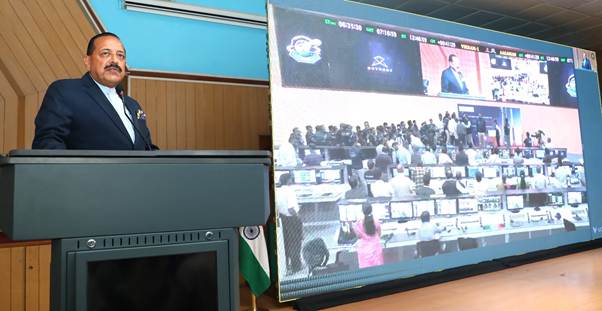
“For India, the sky is no longer the limit”: Dr Jitendra Singh
Union Minister congratulates Skyroot Aerospace, ISRO and IN-SPACe as India’s first privately developed orbital launch vehicle successfully reaches orbit from Sriharikota
Vikram-1 Mission Strengthens India’s Position in the Global Commercial Market: Dr. Jitendra Singh
The successful launch of Vikram-1, India’s first privately developed orbital launch vehicle, marks India’s emergence as a serious global player in the rapidly expanding global space economy and stands as a powerful vindication of Prime Minister Shri Narendra Modi’s landmark decision to open the country’s space sector to private participation, Union Minister of State (Independent Charge) for Science & Technology, Earth Sciences, and Minister of State in the Prime Minister’s Office, Personnel, Public Grievances & Pensions, Department of Atomic Energy and Department of Space, Dr. Jitendra Singh, said today.
Dr. Jitendra Singh witnessed the successful launch of Mission Aagaman at the Satish Dhawan Space Centre, Sriharikota, where Skyroot Aerospace successfully placed Vikram-1 into its designated Low Earth Orbit, becoming the first Indian private company to achieve an orbital launch from Indian soil. The mission marks a defining milestone in India’s space journey and demonstrates the growing strength of the country’s public-private partnership model, enabled by the collaborative efforts of the Department of Space, ISRO, IN-SPACe and India’s vibrant start-up ecosystem.
Prime Minister Shri Narendra Modi congratulated the Skyroot Aerospace team on the historic achievement, describing it as a proud milestone for India’s expanding space ecosystem and a reflection of the country’s growing scientific capability, entrepreneurial spirit and innovation-driven development.
Congratulating Skyroot Aerospace founders Pawan Kumar Chandana and Bharath Daka, Dr. Jitendra Singh said that had Prime Minister Narendra Modi not taken the bold decision to open India’s space sector to private enterprise, the country would not have witnessed this historic achievement. He said the reforms have unlocked the immense potential of Indian innovators, providing them access to national space infrastructure and creating an ecosystem where world-class technologies can now be conceived, developed and launched entirely from India.
The Minister also congratulated IN-SPACe, ISRO and the Department of Space for creating a seamless public-private partnership framework that has transformed India’s space ecosystem. He said the success of Vikram-1 reflects how visionary policymaking, scientific excellence and entrepreneurial talent can together produce globally competitive technological achievements.
Recalling his long association with the Skyroot team, Dr. Jitendra Singh said he had closely followed the journey of the company’s founders from the very beginning and had always admired their technological confidence, creativity and innovative approach. He said today’s success is the outcome of years of perseverance, scientific excellence and the determination of India’s young entrepreneurs to build globally competitive space technologies.
Dr. Jitendra Singh said Vikram-1 has demonstrated an exceptional level of technological maturity for a maiden orbital mission. Unlike many first launches across the world that carry only dummy masses, Vikram-1 carried experimental payloads designed to validate advanced technologies in orbit. The mission also flew customer payloads and technology demonstrations from Indian and international partners, reflecting the growing confidence of the global space community in India’s commercial launch capabilities.
The Minister said India’s space ecosystem has undergone a remarkable transformation since the landmark reforms introduced in 2020. From having virtually no private launch ecosystem a few years ago, India today has over 400 space start-ups, its first space unicorn, and a space economy approaching USD 9 billion, with a national vision of expanding it to nearly USD 44 billion over the next decade. He said the success of Vikram-1 demonstrates how policy reforms can accelerate innovation, create globally competitive enterprises and position India among the world’s leading space-faring nations.
Built and developed entirely in India, Vikram-1 is the country’s first privately developed orbital launch vehicle with the capability to place up to 350 kilograms into Low Earth Orbit. Standing approximately 22 metres tall, the launch vehicle incorporates several indigenous technological breakthroughs, including India’s first all-carbon composite orbital rocket, a 100 per cent 3D-printed liquid engine powering its Orbital Adjustment Module, advanced ultra-low-shock pneumatic separation systems and one of the country’s longest monolithic carbon-composite rocket stages. The successful mission validated critical propulsion, avionics, telemetry, navigation and flight-control systems, laying a strong foundation for future commercial orbital launch services from India.
Dr. Jitendra Singh said the successful launch of Vikram-1 is far more than the success of a single mission. It marks the arrival of a new era in which Indian innovation, supported by bold policy reforms and strong public-private collaboration, will increasingly shape the future of the global space economy. He said the mission reinforces India’s position as a trusted, reliable and technologically advanced partner in the international space sector.
“For India, the sky is no longer the limit,” Dr. Jitendra Singh said.





Leave a Reply