
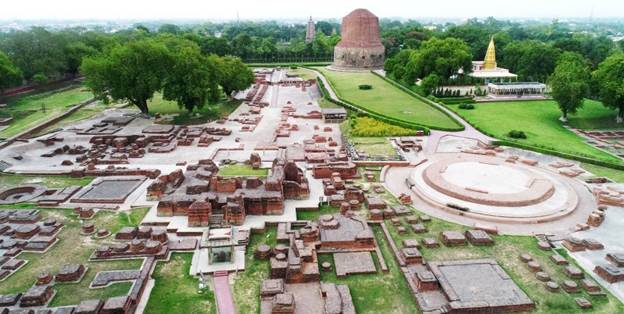
Today, in a remarkable decision taken at the 48th Session of the World Heritage Committee being held at Busan, South Korea, India’s official nomination for 2025-26 cycle, “Ancient Buddhist Site of Sarnath” got inscribed on the UNESCO World Heritage List, becoming India’s 45th property to receive this recognition. This global accolade celebrates India’s enduring cultural legacy, showcasing its diverse traditions of architectural brilliance, regional identity, and historical continuity.
Tweet by UNESCO/Hon’ble HCM/Hon’ble PM
Hon’ble Prime Minister Shri Narendra Modi, Hon’ble Union Minister of Culture Shri Gajendra Singh Shekhawat along with Hon’ble Chief Minister of Uttar Pradesh Shri Yogi Adityanath lauded the historic milestone and congratulated the people of India for this achievement.
Indian Delegation giving thanks speech at 48th COM at Busan
Ancient Buddhist Site, Sarnath
The inscribed serial property comprises two component parts – Chaukhandi Stupa and the Archaeological Remains of Sarnath (Dhamekh Stupa, Dharmrajika Stupa, Mulagandgakuti Vihara, Ashokan Pillar, etc.) – located within Varanasi in Uttar Pradesh. Together these two components preserve the architectural and archaeological remains of the ancient site of Sarnath, known in the Buddhist tradition under different names – Rishipatana, Ishipatana, Mrigadava. They all refer to a sacred geography, where the Buddha visited in the 6th century BCE and delivered his first sermon known as the “Turning of the Wheel of the Law” (Dharmachakra pravartana). This event marked the inception of the Buddhist sangha and the establishment of the principles of the Noble Eightfold Path.
Indicated by the Buddha himself to be one of the four key sites of Buddhist pilgrimage, Sarnath developed over centuries through royal, monastic and lay patronage. Numerous stupas, temples and viharas were constructed around what is believed to be the place of the first sermon of Gautama Buddha and the site where he met his first disciples. Having seen decline in the 12th century CE and subsequent destruction, it fell into obscurity until its re-discovery in the 18th century.
The site comprises an ensemble of ancient monuments constructed from the pre-Mauryan period (5th-4th centuries BCE to 3rd century BCE) up until the destruction of Sarnath in the 12th century CE (with some later additions).
Sarnath has been one of the most extensively excavated sites by the Archaeological Survey of India which resulted in a stratified settlement spread across 16 centuries (5th-4th centuries BCE to 12th century CE).
Excavations at the Archaeological remains of Sarnath, 1907-1908
(Source-Archaeological Survey of India)
After the declaration of Sarnath as the World Heritage Property, three of the four most significant Buddhist Pilgrim sites; i.e. Lumbini (Nepal), Mahabodhi Temple, Bodhgaya (Bihar) and now Sarnath (Uttar Pradesh) are now included in the World Heritage, along with several other important Buddhist sites such as Sanchi, Nalanda, Ajanta (all three in India), Anuradhapur (Sri Lanka) Paharpur (Bangladesh), Taxila and Takht-i-Bahi (both in present day Pakistan), etc.
Sarnath as a UNESCO World Heritage Property
The ancient site of Sarnath was included in the Tentative List of World Heritage in 1998. The proposal to include the site in the list of World Heritage was sent to the consideration of World Heritage Committee in Jan 2025 and after a rigorous eighteen-month long process involving several technical meetings with the advisory bodies and visit of ICOMOS’s mission to review the site, this historic decision was taken by the members of the World Heritage Committee today evening at Busan, South Korea.
ICOMOS technical evaluation mission examining the excavated staircase at Sarnath during 24 to 29 September 2025
Bird-eye view of the Excavated remains at Sarnath
(Source-Archaeological Survey of India)
During the Committee Meeting, the 21 Members of the World Heritage Committee, Member States, UNESCO Secretariat, World Heritage Centre, and Advisory Bodies of UNESCO (ICOMOS, IUCN, ICCROM) congratulated the delegation of India for this momentous occasion.
The “Ancient Buddhist Site of Sarnath” is nominated under criteria (iii) and (vi), recognizing enduring spiritual significance of Sarnath Cr. (iii), one of the four principal destinations of Buddhist pilgrimage, as demonstrated by the large number of religious buildings and other monuments that were built and rebuilt on-site during the many centuries of its existence and through Cr.(vi) direct and tangible way to the events in the life of the Buddha that are of outstanding significance to the Buddhist community – his first sermon and meeting of his first disciples. The importance of these events and their meaning is carried by the numerous constructions erected at Sarnath over the centuries, which are a response to the message of the Buddha, his teachings, and the concept of Triratna.
View of excavated Ashoka pillar and Lion Capital with the Mulagandhakuti Vihara, 1904-06 (Source-Archaeological Survey of India)
Excavated Ashokan Lion Capital, 1904-06 later declared as the National Emblem (Source-Archaeological Survey of India)
The purpose of including these heritage sites in UNESCO’s list is to preserve and promote shared heritage based on OUVs (Outstanding Universal Values) found in cultural, natural as well as mixed properties across 196 countries. On its part, India became a member of the coveted World Heritage Committee from 2021-25 and also hosted for the first time the World Heritage Committee Meeting in July 2024 at New Delhi.
Scientific Preservation Works underway on the brick votive Stupas at Sarnath
This global recognition is a testimony to New India’s relentless pursuit of highlighting Bharat’s heritage on the world forum. This recognition underscores the conservation and management efforts of the Archaeological Survey of India (ASI) in preserving these historic treasures.
For over 150 years, the Archaeological Survey of India has been excavating and conserving the Ancient Buddhist Site of Sarnath, leading to the discovery and identification of Sarnath with the place where Shakyamuni Buddha gave his first Sermon.
The famous Mauryan Lion Pillar which later became the National Emblem of India and the Dharkachakrapravartan Buddha from the Classic Gupta Art were found from the excavations which are presently displayed at the India’s earliest site Museum which was established in 1904.
World Heritage status would reinforce India’s identity as the birthplace of Buddhism and enhance cultural diplomacy with nations such as Japan, Thailand, Sri Lanka, Myanmar, Cambodia, Vietnam, South Korea, Mongolia, etc.
This recognition would further support India’s efforts to promote Buddhist heritage as a bridge for international engagement and would also showcase India’s expertise in heritage conservation and preparedness in nomination process.
Last year, ‘the Maratha Military Landscapes of India’ were inscribed in the World Heritage List at the 47th Session of the World Heritage Committee held at UNESCO Headquarters at Paris.
With 45 sites in the List, India ranks 6th globally and 2nd in Asia Pacific Region for the most number of World Heritage Sites. 196 nations have ratified the World Heritage Convention, 1972.
India also has 69 sites in the Tentative List of the World Heritage, which is a mandatory threshold for any site to be considered as a World Heritage property in future. Every year, each State Party may propose just one site for consideration of the World Heritage Committee for inscription to the World Heritage List.
On behalf of the Government of India, Archaeological Survey of India is the nodal agency of all the World Heritage related matters in the country.
With this global recognition, India affirms its commitment to protect Sarnath’s Outstanding Universal Value by Manage tourism sustainably and prevent unplanned development in the buffer zone in order to preserve authenticity and integrity of the property.





Leave a Reply