
S Viswanath
From biennial to annual, from going defunct to rebooting and revival, the Adelaide Film Festival, which got its modern day genesis in 2003 following South Australian Prime Minister Mike Rann’s visionary initiative to provide a platform for critical Oz and international films, has indeed come a long way.
Initially held independently from 1959-1980, the Adelaide International Film Festival, went defunct before it was given the kiss of life in a refurbished new avatar with the State back and rechristened Adelaide Film Festival in 2003 with the “International” being snipped off its title while severing its ties with FIAPF – International Federation of Film Producers Associations (Fédération Internationale des Associations de Producteurs de Films), founded in 1933 and based in Brussels, Belgium.
Run on a modest scale the film festival, through the, film festival, following a hiatus in 1976, held steam for a couple of years more before holding its final 21st Edition in 1980. The film festival eventually taking to modern reboot in the rebranded format in 2003 thanks to the enterprising South Australian Premier Mike Rann.
The initiative being not only to stimulate the local film industry but also celebrate the 30th anniversary of the South Australian Film Corporation with a director and board put in place alongside the creation of Adelaide Film Festival Investment Fund to finance the Film Festival and other events. The inaugural Adelaide (International) Film Festival held from February 28 to March 3, 2003 saw programme of screenings, special events and forums in a number of cinemas across Adelaide.
The film festival was relaunched alongside unique Adelaide Film Festival Investment Fund (AFFIF), providing Adelaide Film Festival its ubiquitous individuality and key differentiator to its more prominent sister film festivals aka Melbourne International Film Festival (held in August from 6th to 23rd) & Sydney International Film Festival (held in June from 3rd to 14th).
Held annually since 2022 the significant feature of Adelaide Film Festival being its strong focus on South Australian and Australian produced content besides the Adelaide Film Festival Investment Fund (AFFIF) established to fund investment in Australian films. Among its other firsts include the introduction of international competition, as well as the first to fund film production directly.
There has been no looking back for Adelaide Film Festival, which, in these last 13 years since 2003, has grown in size, scope and stature both in terms of the films being curated as also the committed audiences that ascend to attend it annually drawn by their love of, and commitment to catch up with the contemporary cinemas both from within and from without – international, the world over. The film festival, as per its 2024-2025 annual report was a resound success reporting increased box office sales connecting over 65,000 people across South Australia.
Incidentally, in May 2024, the Adelaide Film Festival launched its “Adelaide Film Festival Goes to Cannes” programme partnering with Cannes Film Festival’s Film Market, the Marché du Film, to showcase five local projects in an official presentation, as well as taking a group of ten South Australian filmmakers to participate in a programme of activities there. Besides, the AFF also tied up with Jogja NETPAC Asian Film Festival (JAFF) Market (the first major SE Asian film market).
According to CEO & Executive Director Mat Kesting “these initiatives are a direct conduit for our filmmakers to connect internationally, opening doors for creative and financial opportunities that ultimately benefit South Australia. It’s a logical extension to leverage the existing international networks held by AFF for the benefit and promulgation of creativity in South Australia.”
With the 12-day Adelaide Film Festival 2026 inching towards its formal, annual congregation to celebrate cinema from October 14-25, 2026, CEO & Creative Director Mat Kesting has announced the official launch of its ‘All For Film’ campaign unveiling the festival’s first ten highly anticipated titles that the cinephiles could look forward to.
The first set of 10 features announced include Oscar winning directors, Cannes Film Festival winners, Australian premiere and some of most exciting women directors emerging in world cinema. Across fiction, documentary and experimental cinema, these films explore grief, memory, creativity, family and the forces that reshape a life, says Mr Kesting providing a foretaste of further films to follow as the festival inches towards its D-day.
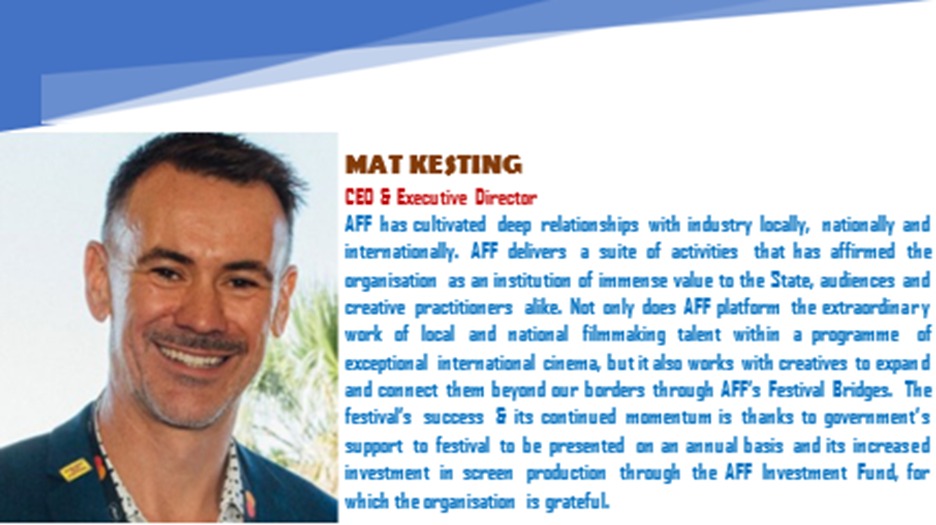
Further, describing the festival campaign – All For Film in his open letter invitation as “all because everyone is genuinely welcome here, whether you’ve been coming for twenty years or you’ve never set foot in one of our cinemas; and For Film, because we’ve always been all in on great cinema and that’s what brings us together in the first place,” Mr Mat Kesting avers that “AFF has never just been a festival for film people, it’s a festival for everyone who loves film. If you haven’t been to AFF before to experience what it is like” to be up, personal and close at AFF, “come along and try something new – pick a film and see where it takes you. Some of my own favourite festival moments came from films I almost missed.” For, as he so perfectly puts it “going to the cinema has always been better when it’s shared, so bring someone along and be part of something you’ll only find at the cinema.”
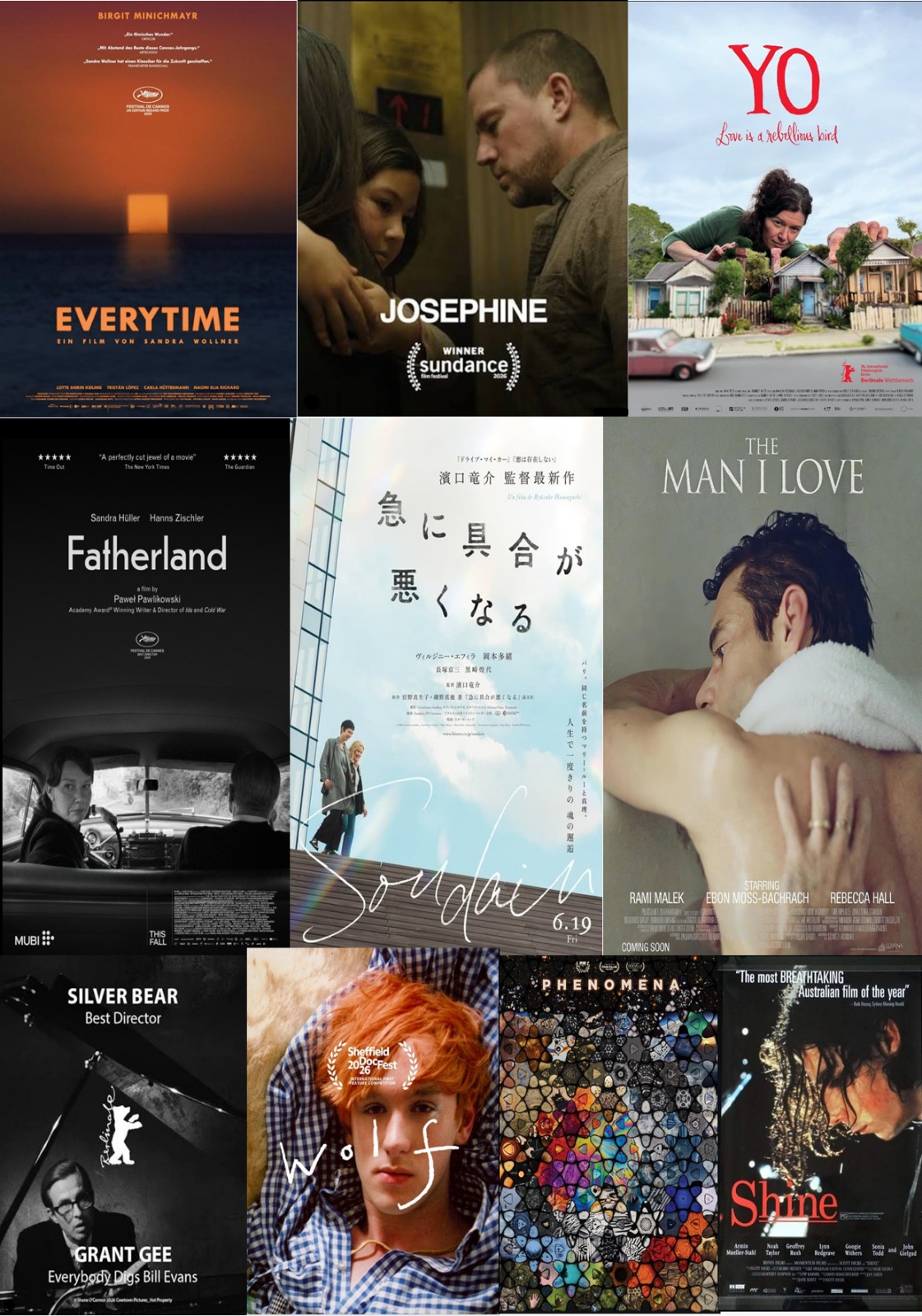
So here then are a perspective peek into the tantalising ten that awaits the committed cine buff – that’s you.
Winner of the coveted Un Certain Regard Prize at Cannes 2026, from the up-and-coming Austrian woman filmmaker Sandra Wollner’s Everytime, is a psychological family fare which follows a mother, her daughter, and a teenage boy blamed for a tragic death as they travel to Tenerife together, in its haunting exploration of grief which turns out a rather unsettling and difficult feature to watch.
Struggling with blame and forgiveness, the unlikely trio take a trip to Tenerife for a family holiday that never happened. Under the glow of the sun, past and present quietly start to overlap. The film, which also featured at Karlovy Vary International Film Festival is indeed a must watch for its poignant and perspective exploration of the trauma that the guilt-ridden woman and the young boy undergo as they go on this road trip seeking redemption from the guilt gnawing them.
The Brazilian-Chinese-American parentage San Francisco born another up-and-coming American woman filmmaker Beth de Araujo’s Josephine which won her the Directors to Watch Award at the Palm Springs International Film Festival as also fetched itself the US Dramatic Grand Jury Prize and Audience Award at Sundance Film Festival, is Araujo’s sophomore feature film.
The film follows 8-year-old Josephine who, after accidentally witnesses a crime in Golden Gate Park, acts out in search of a way to regain control of her safety, while adults are helpless to console her as the family struggles to regain their footing while navigating trauma and the legal system around them. Told through the child’s perspective, the film is an intimate and confronting study of the ways a single event can fracture a family.
Joining the ranks of up-and-coming women filmmakers is Anna Fitch, whose film Yo (Love Is A Rebellious Bird), she has co-directed with her longtime creative partner Banker White, is a documentary about a friendship that spanned over two decades between Anna (the director) was 24 and Yo was 73.
The vividly intimate portrait of the long association, the film takes audiences to the meeting two had at a rummage sale. Born in Switzerland in 1924, Yo had been a suburban Californian wife and mother before the upheaval of the 1960s prompted her to break free. Using puppetry, one-third-scale models and a replica of Yo’s home, the director reconstructs her friend’s remarkable life, including its final chapter.
From focus on women, we now turn to the three films that lit up the screens at Cannes, with each placing an intimate relationship against a much larger landscape from chronicling an happening across post-war Germany, a correspondence between two scholars and New York at the height of the AIDS crisis.
A fascinating and fantabulous biographical sojourn (this black & white film is not to be miss movie which I saw at Karlovy Vary International Film Festival) Fatherland revolving around acclaimed 1929 Nobel Literary Prize laureate Thomas Mann, is a roadie movie, that takes viewers to the height of the Cold War, when, returning to Germany after 16 years in exile, the famed writer embarks on a road trip with his daughter Erika through a country divided by the aftermath of war.
The film captures the intimate filial relationship between the writer and his daughter Erika — actress, writer and rally driver — as they embark on the road trip in a black Buick cruiser across a Germany in ruins.
The film is by the award-winning auteur of Ida & Cold War, Polish filmmaker Paweł Pawlikowski, who won the Best Director at Cannes 2026, who once again examines identity, family, guilt and belonging through the lives of people caught between private loyalties and political upheaval.
From the Oscar winning film Drive Mr Car & Silver Bear winner Wheel of Fortune & Fantasy which were much more captivating and interesting comes Japanese director Ryûsuke Hamaguchi’s All Of A Sudden of Soudain which earned the Best Actress Award at Cannes 2026, shared by its two leads, playing two scholars—one French and one Japanese —revolves round the two exchanging letters about chance and risk.
The film, loosely based on the non-fiction book You and I – The Illness Suddenly Get Worse by Makiko Miyano and Maho Isono, charts the life of the two scholars, when illness enters their correspondence, resulting in their academic discussion gradually becomes something more intimate. The director turns conversation into cinema, finding emotional weight in language, distance and the possibility of connection.
Set in New York during the height of the AIDS crisis, The Man I Love by Ira Sachs is a gay love saga set in the vibrant era of late 80s New York, and follows Jimmy George, a Downtown performance artist in an extraordinary moment between great illness and death, with follows an art-filled life shaped by love, illness and the everyday rituals shared between people. The film which premiered in competition section at Cannes 2026 is a tender portrait of love lived under the pressure of history.
From some serious sojourns to feet tapping, jig and jiving musicals sees two films – direct from Berlinale and Sheffield Documentary Festival, Everybody Digs Bill Evans and Wolf respectively.
British filmmaker Grant Gee’s Everybody Digs Bill Evans which won the Silver Bear for Best Director at the 2026 Berlinale, is an elegant black and white feature which takes one to 1960s New York and suburban Florida while examining the uneven paths taken by members of the same family. The film charts the life of Jazz pianist Bill Evans at the height of his career who is left reeling by the death of his bassist which leads him to depression and addiction as he retreats to his family home before slowly beginning to reconnect with the world and his music.
Likewise, Christian Cargill’s documentary Wolf which makes its Australian premiere at AFF, spotlights on musician Patrick Wolf , at the garden of his seaside home, where, with his friend Tilda Swinton he reflects on a life shaped by creativity, grief, addiction and return. Rising from early-2000s London music scene, Wolf moved between indie pop and the avant-garde before personal trauma made music increasingly difficult to face.
The final two films in the first ten template turns focus on Australian filmmaking wherein you have a contemporary experiment in image and sound, and the 30th anniversary return of a film that became an international success.
Australian filmmaker Josef Gatti turns scientific observation into a large-scale cinematic experience in Phenomena. Captured entirely in camera, without visual effects or digital artifice, the film uses practical experiments to reveal patterns and forces operating across the natural world, which turns it into an highly experimental and sensory encounter.
Scott Hicks’ Australian flick Shine thirty years after its release, returns in a new 4K restoration film follows the life of pianist David Helfgott which South Australian director Scott Hicks will present this anniversary screening and reflect on the film and the international career that followed.
Yes, as Adelaide, or Tarntanya, the Coastal Capital of South Australia hosts its annual cinema carnival in the heart of Kaurna Country, and turns Cinema Paradiso! it’s time to backpack and head this October to where all things cinema confluence – Palace Nova Eastend Cinemas.



Leave a Reply