
Organizations must move beyond AI experimentation to deep problem-solving, domain understanding and workforce empowerment
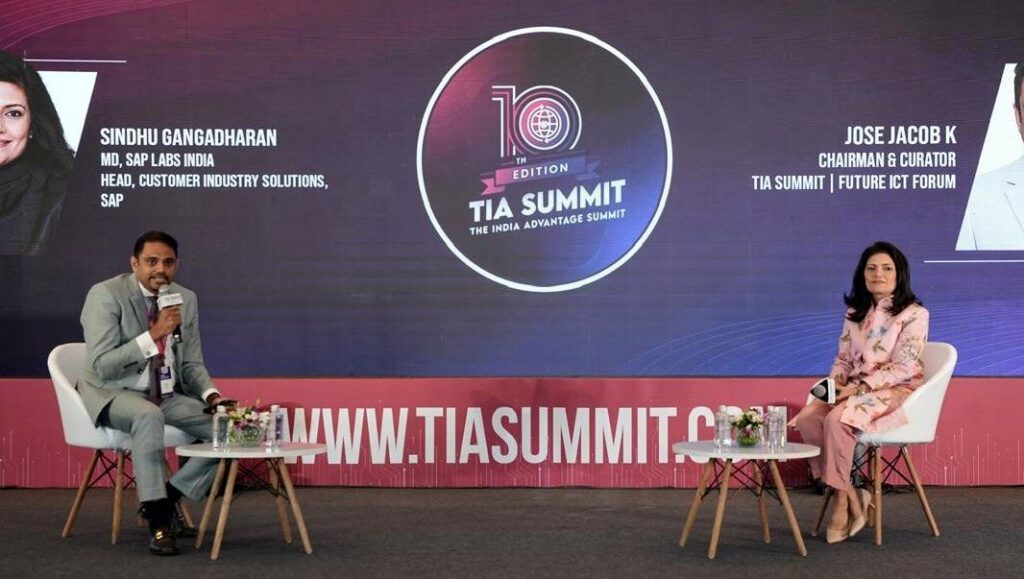
As artificial intelligence dramatically accelerates the pace at which technology can be developed, the bigger challenge for organisations is increasingly knowing what to build and which problems to solve, said Sindhu Gangadharan, Managing Director, SAP Labs India and Head, Customer Industry Solutions, SAP.
Speaking at a fireside discussion on Leadership in the AI Era at The India Advantage Summit 2026, Gangadharan said organisations need to move beyond viewing AI simply as a technology transformation and instead look at it as a transformation in leadership, business processes and people.
“AI is actually a leadership transformation that we need to look at,” she said, emphasising that organisations should begin with the outcomes they want to achieve rather than start with technology and look for a problem to apply it to.”
For Bengaluru’s technology ecosystem, where AI adoption is rapidly reshaping how technology is built and deployed, this shift has significant implications. Gangadharan pointed out that while technology can now be built much faster, understanding the business problem, the people who face it and the domain in which it operates remains critical.
“You can build a lot of things much faster these days. But if you don’t know what to build, that’s where the problem comes in,” she said, highlighting the importance of deep domain understanding and spending time with customers to identify the right problems before developing solutions.”
From AI pilots to real-world impact
The discussion also addressed a challenge facing businesses globally: moving AI initiatives beyond proof-of-concepts and into meaningful, large-scale deployments.
Gangadharan cited examples of AI being deployed in complex enterprise environments, including an AI-powered billing agent developed for a global professional services company. The solution supports processes involving workforce deployment, regulatory requirements, legal considerations and pricing, and has enabled the company to reduce work previously handled by more than 1,000 executives.
She also highlighted the use of multiple AI agents to help reimagine processes in vaccine manufacturing, as well as AI agents being deployed across manufacturing plants to transform traditionally manual quality processes.
According to Gangadharan, the organisations succeeding in moving from pilots to scaled deployments are those that combine business understanding, domain expertise, technology and strong data foundations. “AI is only as successful as you have the right data,” she said, stressing the importance of understanding access to the right datasets and ensuring that the underlying data architecture is robust.
Moving beyond the AI jobs narrative
The conversation also addressed one of the biggest concerns surrounding AI adoption — its impact on jobs and the workforce.
Gangadharan cautioned against looking at AI only through the lens of job displacement. She called for greater emphasis on the empowerment of people, including helping employees upskill, relearn and use AI to strengthen their existing capabilities.
“If you just talk about efficiency in board meetings, but not talk about upliftment of people, then you’ve missed out a big time,” she said.
She also emphasised that responsible AI and speed should not be viewed as opposing priorities. For enterprises, she said, agility must be accompanied by safety, security and clear guardrails, while employees and teams should be given the space to experiment, learn from failures and move forward.
The conversation at The India Advantage Summit highlighted a broader shift in the AI landscape: as the technology becomes increasingly accessible and the speed of development accelerates, competitive advantage will depend less on simply being able to build AI solutions and more on identifying the right problems, understanding the domain, working closely with users and creating the conditions for people to adopt and scale those solutions.
The fireside discussion was hosted by Jose Jacob K, Chairman, The India Advantage Summit and Future ICT Forum.






Leave a Reply