
Quantum & Photonics, Precision Agriculture, Biosciences, Semiconductors and Aerospace Identified as Key Areas for Collaboration
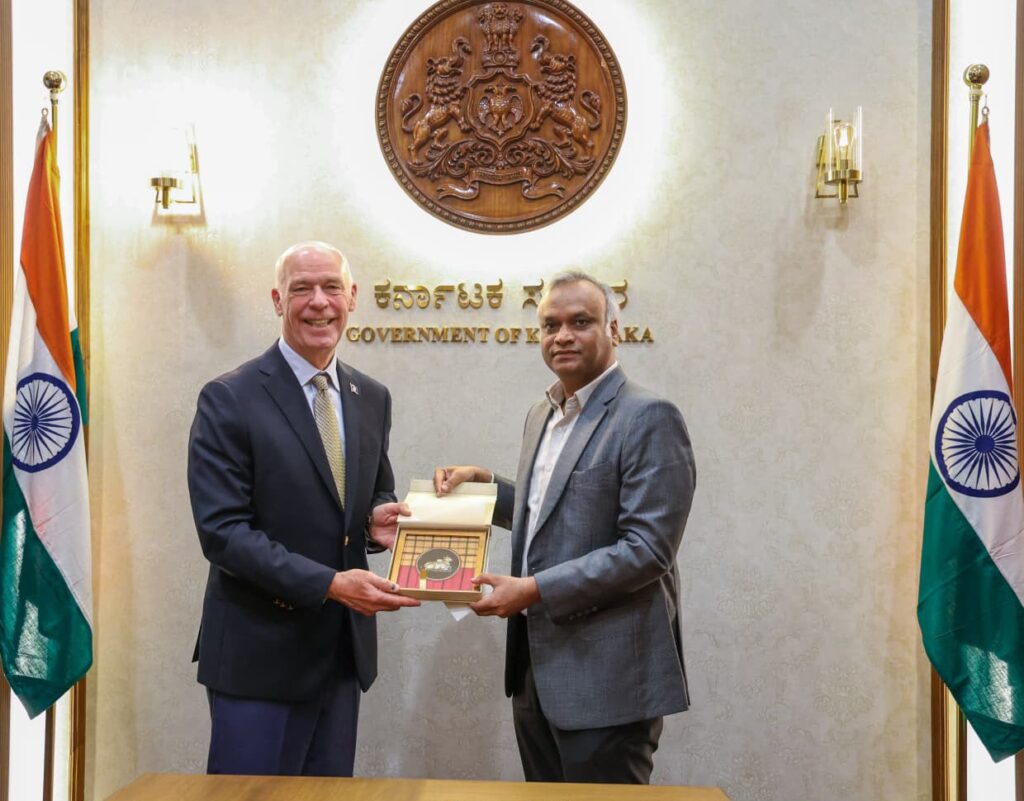
Government of Karnataka and the State of Montana, USA, held discussions and identified a set of priority areas for deeper collaboration in technology, research, innovation and market access, following a high-level meeting between Shri Priyank Kharge, Hon’ble Minister for Home, Information Technology, Biotechnology & E-Governance, Government of Karnataka, and Greg Gianforte, Governor of Montana. Dr N. Manjula, Secretary, Department of Electronics, IT & Biotechnology, Government of Karnataka, and Dr Avinash Menon, IAS, Managing Director, Karnataka Innovation and Technology Society (KITS), and Director, Department of Electronics, IT & Biotechnology, Government of Karnataka, was also present at the meeting.
The Montana delegation included Governor Greg Gianforte; First Lady Susan Gianforte; Kaitlin Timken and Anna Brightwell, State of Montana officials; U.S. Consul General Mariana Neisuler, U.S. Consulate, Chennai; Carey Arun, Principal Commercial Officer, U.S. Commercial Service, Bengaluru/U.S. Consulate Chennai; Antappa Badigair; and Manjushree Phookan, Senior Commercial Specialist & Director, U.S. Commercial Service, Bengaluru, U.S. Consulate Chennai, along with members of the Governor’s security detail.
The discussions focused on building a structured framework for collaboration between the two ecosystems, leveraging Karnataka’s strengths in technology, engineering, startups, semiconductors and biotechnology, and Montana’s specialised capabilities in quantum technologies, photonics, precision agriculture, biosciences and research-led innovation.
The two sides identified quantum and photonics, precision agriculture, bioscience and pharmaceuticals, semiconductors and chip design, and aerospace and space technologies as key areas with potential for collaboration.
Speaking during the meeting, Shri Priyank Kharge, Hon’ble Minister for Home, Information Technology, Biotechnology & E-Governance, Government of Karnataka, highlighted Karnataka’s strong technology and innovation ecosystem and the opportunities for international partnerships that create tangible outcomes.
“Karnataka has the technology ecosystem, talent, research capabilities and entrepreneurial strength to build meaningful partnerships with global innovation hubs. Montana brings highly specialised capabilities in areas such as quantum, photonics, precision agriculture and biosciences. The opportunity is to connect these strengths and move from conversations to specific collaborations between institutions, companies, startups and researchers,” said Shri Priyank Kharge.
“It was great to join Minister Kharge for a productive meeting on the many parallels between India and Montana and begin discussions on future areas of collaboration in quantum, photonics, aerospace, precision agriculture, and bioscience,” Montana Governor Greg Gianforte said. “As Montana’s economy expands from its roots in agriculture to embrace investments in emerging technologies, we stand strong on the global stage to compete for historic partnerships that will lead to more opportunities for Montanans.”
Key Areas of Discussion
Quantum and Photonics:
The two sides discussed opportunities to connect Karnataka’s emerging quantum ecosystem with Montana State University’s quantum and photonics capabilities. Karnataka highlighted its work in quantum education, research, quantum computing and quantum hardware, while the Montana delegation outlined the role of Montana State University’s QCORE ecosystem in research, technology transfer and startup incubation.
Precision Agriculture:
Precision agriculture emerged as a strong area of mutual interest, particularly around the use of technology to improve agricultural productivity, optimise water and other inputs, and develop crop varieties suited to environmental conditions. Both sides noted the similarity of challenges around water scarcity and the potential for research collaboration.
Bioscience and Pharmaceuticals:
The meeting explored opportunities for collaboration in bioscience, pharmaceuticals, clinical research and healthcare innovation. Montana shared its experience with its state-level “Right to Try” framework and its efforts to create new pathways for clinical research and access to experimental treatments. Karnataka highlighted its large biotechnology and pharmaceutical ecosystem, medical education infrastructure and its emerging focus on marine and blue biotechnology.
Semiconductors and Chip Design:
Semiconductors and chip design were identified as another important area of potential collaboration. Karnataka highlighted its strong chip-design ecosystem, while Montana presented its capabilities in semiconductor fabrication equipment as well as its quantum and photonics strengths.
Aerospace, Space and Defence Technologies:
The discussions also covered aerospace and space technologies, autonomous systems, drones, advanced materials and remote sensing. The two sides discussed opportunities to connect startups and technology companies with relevant research and commercial ecosystems.
Focused Efforts to Take Collaboration Forward
The two sides discussed establishing focused efforts to identify specific areas of cooperation and map relevant universities, research institutions, Centres of Excellence, startups and companies.
The proposed approach is to focus initially on a limited number of priority sectors and develop specific, actionable opportunities rather than pursuing a broad-based engagement across multiple areas.
The Global Innovation Alliance (GIA) was discussed as a potential platform to facilitate the engagement, including technology partnerships, startup exchanges, research collaboration, market access and investment linkages.


Leave a Reply