
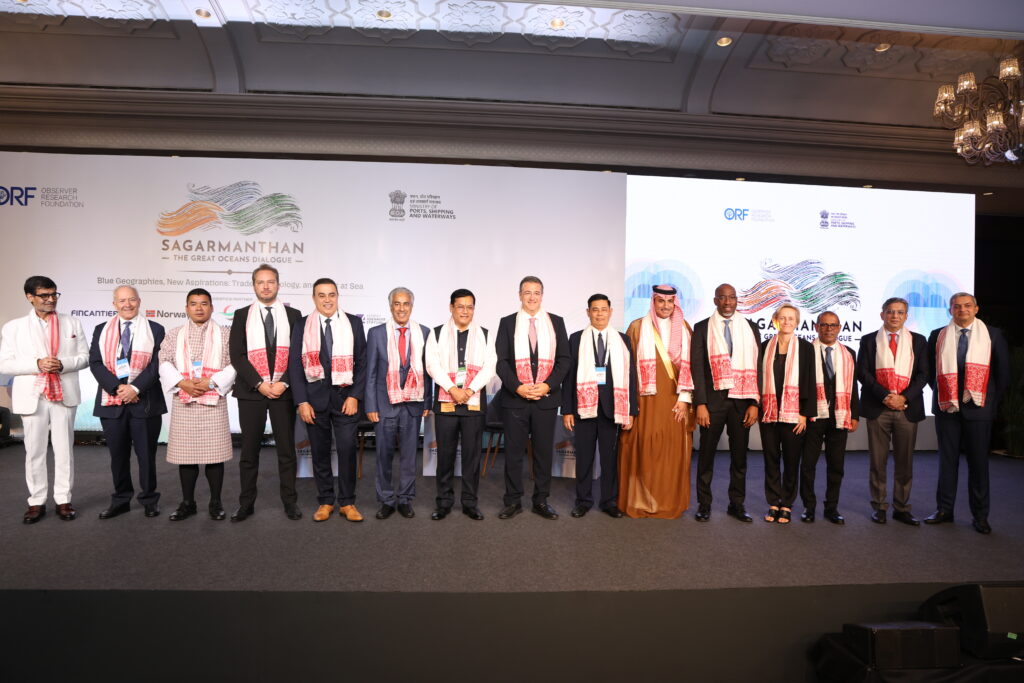
The Oceans Do Not Separate Us, They Connect Us: PM Narendra Modi’s Message Sets the Tone for the Great Oceans Dialogue
Prime Minister Narendra Modi calls for a free, open, secure and rules-based maritime order that brings peace, prosperity and progress for all
Union Minister Sarbananda Sonowal presents Maritime Amrit Kaal Vision 2047 as India’s offer of partnership to the world
Seas of Partnership: India Brings Korea, EU, Australia, Norway, UAE, Bhutan & Africa Together on Day One at Sagarmanthan 2026
The 3rd edition of Sagarmanthan: The Great Oceans Dialogue, organised by the Ministry of Ports, Shipping and Waterways (MoPSW) in partnership with the Observer Research Foundation (ORF), opened here today. The Dialogue opened with a message from Prime Minister Narendra Modi calling for a free, open, secure and rules-based maritime order. Building on the Prime Minister’s vision, Union Minister of Ports, Shipping and Waterways Sarbananda Sonowal set out a global maritime order built on trust, shared prosperity and partnership, with India as a guide and anchor for nations navigating profound change.
In his message to the Dialogue, Prime Minister Shri Narendra Modi recalled that in Indian tradition the churning of the ocean is associated with the discovery of new possibilities. He traced India’s maritime heritage from Lothal to the Cholas and the naval vision of Chhatrapati Shivaji Maharaj, and reaffirmed India’s vision of a free, open, secure and rules-based maritime order. “The oceans do not separate us, they connect us, because what happens in one part of the world can have an impact far beyond its shores,” the Prime Minister said, underlining why dialogue and global cooperation matter more than ever.
The first day of Sagarmanthan brought together ministers from different countries, naval leadership, port authorities, shipbuilders, financiers and multilateral institutions from five continents. Delegations and experts from Australia, Belgium, Bhutan, the European Union, France, Norway, the Republic of Korea, the UAE, Nigeria, Ethiopia, Ghana, Egypt, Seychelles, Ecuador and others joined the OECD, UN Trade and Development, the Asian Infrastructure Investment Bank and the African Union in a single conversation on the future of the oceans.
Closing the day’s proceedings in a high-level conversation titled Maritime Amrit Kaal 2047: India’s Ocean Vision and a New Era of Global Maritime Cooperation, Sonowal described India’s maritime transformation under Maritime Amrit Kaal Vision 2047, PM Gati Shakti and the Sagarmala programme as a contribution to the world, not only to India. In conversation with ORF President Dr. Samir Saran, he positioned India as a Vishwaguru on the oceans: a nation that shares its knowledge, capacity and talent to help shape a more collaborative global ocean agenda.
“India’s bond with the sea is civilisational. For thousands of years, Indian sailors carried goods, ideas and culture across the oceans as partners, never as conquerors,” said Sarbananda Sonowal. “Under the visionary leadership of Prime Minister Narendra Modi, India is once again offering the world a maritime model rooted in trust, capability and mutual benefit. That is the spirit of India as Vishwaguru: we lead by example and we grow together with our partners.”
“The global maritime order is going through a great churning of disruption, fragmentation and technological change,” Sonowal added. “Out of this churning, India is determined to bring forth amrit for the world: resilient supply chains, green shipping corridors, a world-class shipbuilding ecosystem and a skilled seafaring workforce that every nation can rely on. Maritime Amrit Kaal Vision 2047 is our roadmap to Viksit Bharat, and an open invitation to partners across every ocean.”
Delivering the scene-setting ministerial address at the formal opening of the conference, Union Minister of State for Ports, Shipping and Waterways Shantanu Thakur highlighted how India’s port-led development and new-generation maritime laws are building capacity for the wider region. Vijay Kumar, Secretary, MoPSW, delivered the opening address, and Dr. Samir Saran, President, ORF, delivered the welcome remarks.
“Ports today are not just gateways for cargo; they are strategic assets that shape competitiveness, energy security and trust between nations,” said Shantanu Thakur. “With our major ports having nearly doubled their capacity and a modern legal framework now in place, India is ready to serve not only its own growth but the trade of the entire Indo-Pacific and beyond.”
The Inaugural Ministerial Plenary, Tides of Trust: Ports, Partnerships, and the Making of a New Maritime Century, moderated by Dr. Samir Saran, examined how ports and shipping networks are being rethought as strategic assets. The panel featured Kevin Rudd, Former Prime Minister of Australia and Global President & CEO, Asia Society; Ms. Annick De Ridder, Flemish Minister of Mobility, Public Works, Ports and Sport, Belgium; Chandra Bahadur Gurung, Minister of Infrastructure and Transport, Bhutan; Admiral Krishna Swaminathan, Chief of the Naval Staff, India; and Rizwan Soomar, CEO and MD, DP World. Earlier, Soomar and Dr. Saran set the tone in The Great Churning: Trade, Power and Opportunity, a conversation on how maritime connectivity is redefining economic power.
India-EU Green Shipping Corridor: The India-EU Green Shipping Corridor brings together India’s potential in green fuel production with emerging European demand, creating new opportunities for green ammonia and methanol trade and maritime decarbonisation. Following the launch of the corridor’s pre-feasibility study in 2025 and the establishment of an industry coalition in 2026, the initiative is moving towards implementation. The session, India-EU Green Shipping Corridor: Innovation, Action and Scale, an associated event with the RMI, formally launched the coalition, bringing government and industry together to outline a pathway from feasibility to execution, mobilise investment and partnerships, and build a commercially viable and scalable green shipping corridor. Ministerial addresses were delivered by Apostolos Tzitzikostas, Commissioner for Sustainable Transport and Tourism, European Commission, and Shantanu Thakur, with opening remarks by Vijay Kumar.
India-Korea in the Indo-Pacific: The roundtable discussion, India-Korea in the Indo-Pacific: Maritime Cooperation and Economic Resilience, an associated event with the Korea Institute for International Economic Policy (KIEP), reviewed progress since the April 2026 India-Republic of Korea Summit, with a focus on the implementation of the India-Korea Comprehensive Framework for Partnership in Shipbuilding, Shipping and Maritime Logistics, and its alignment with the Special Strategic Partnership. It assessed how India and Korea are advancing cooperation across shipbuilding ecosystems, maritime logistics, port-led development, and supply chain integration, with emphasis on structured collaboration between government stakeholders and industry actors, including shipyards, shipping companies, port operators, and maritime technology firms. The discussion placed these developments within an evolving Indo-Pacific maritime and economic architecture shaped by supply chain disruptions, geopolitical fragmentation, and shifting patterns of trade and industry, and explored how the India-Korea partnership can strengthen maritime connectivity, diversify trade links, and deepen industrial collaboration to build more resilient systems in the Indo-Pacific. The session also saw the launch of the edited volume Oceans of Alignment: India-South Korea Cooperation in the Indo-Pacific.
Corridors, measurement and Africa: Economic corridors are emerging as important platforms for reshaping trade, investment and regional integration. Yet their success depends on more than physical infrastructure. The curtain raiser session, Governing the Corridors of Tomorrow: Lessons for IMEC, examined the governance architecture needed to translate IMEC from strategic vision into a functioning economic corridor. It explored how India, Europe and partner countries can build the frameworks, partnerships and institutional mechanisms needed to support investment, interoperability and long-term momentum, while ensuring that IMEC remains adaptable to a changing geopolitical and economic landscape.
As countries accelerate efforts to develop sustainable blue economies, the ability to measure progress, identify gaps, and align policies with long-term objectives is becoming increasingly important. The OECD Blue Economy Scoreboards offer a comprehensive framework to support evidence-based policymaking by enabling countries to benchmark progress, identify priorities, and strengthen coordination across sectors. The session, Tracking the Transition to Sustainable Blue Economies, an associated event with the OECD, brought together policymakers, international organisations, and experts to discuss how improved measurement frameworks can support more effective blue economy strategies, guide investment decisions, and foster international cooperation towards sustainable and inclusive ocean development.
Africa’s maritime corridors are becoming increasingly important to global trade resilience as geopolitical disruptions, chokepoint vulnerabilities, and shifting supply chains reshape the movement of goods and resources. Initiatives such as the Lobito Corridor and growing investments in regional connectivity highlight Africa’s potential to diversify trade routes, strengthen supply chain resilience and unlock the blue economy’s potential. The session, Africa’s Blue Gateways: From Corridors to Engines of Connectivity, explored how Africa can transform its maritime corridors from transit pathways into engines of connectivity, economic growth, and global trade resilience.
Across its sessions, the first day of Sagarmanthan, 2026 carried a single message as trade routes, technologies and alliances are reshaped, India is stepping forward as a trusted builder, partner and guide for the global maritime community. Sagarmanthan 2026 continues with further ministerial and expert sessions.



Leave a Reply