
S Viswanath
With civil unrest and strife, rioting and looting in the name of injustice and oppression, raging across Europe, and spreading across like wild fire, as also pockets of nations of the world, the Sri Lankan film Dhara could not have made its presence in a prophetic and probing manner.
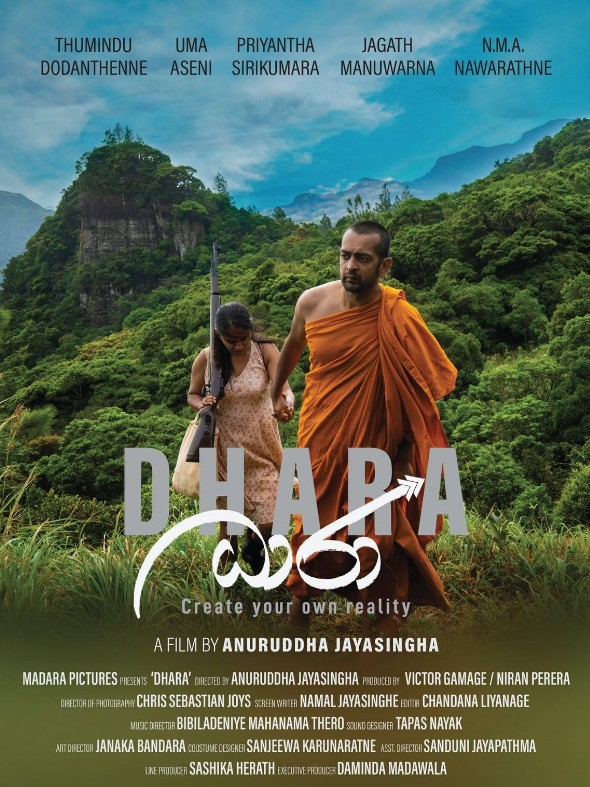
The debutant 117 min Canadian – Sri Lankan co-production feature film by Anuruddha Jayasingha, alumni of Vancouver based InFocus Film Social, which had its world premiere at the Busan International Film Festival, is an evocative, socio-political moral treatise on power, absolute power, subjugation and oppression that examines the diametrically divergent thoughts and teachings on affirmative violent action to achieve justifiable societal ends vis-à-vis pacifist, peaceful, selfless religious construct holding a reflective, ruminative and meditative mirror to the State of the World today.
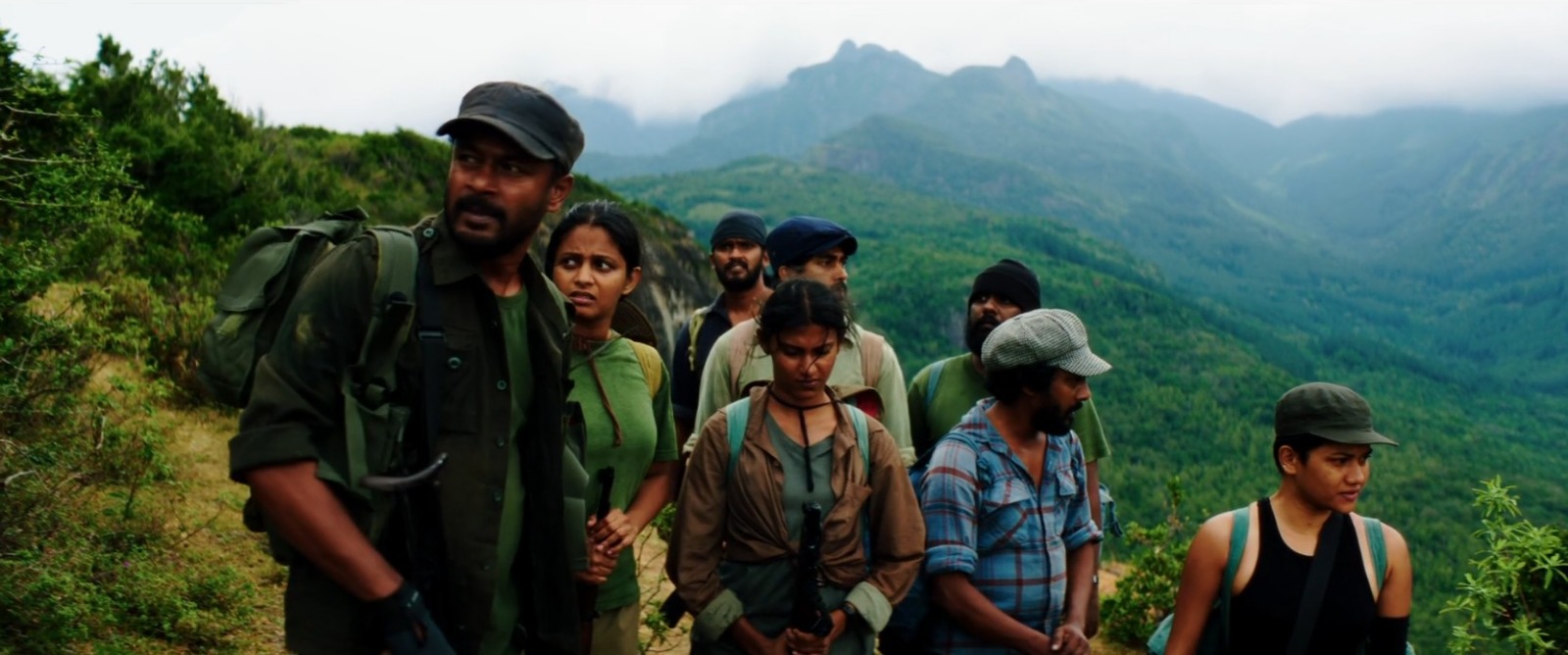
If the film’s gun-toting female aggrieved aggressor Sharada asserts in violence as means to attain the desired ends over perceived State oppression and its failure to provide even basic human needs and denial of fundamental rights to its citizens resulting in their exclusion from the mainstream, is the right path.
The renounced Buddhist monk Samitha, acolyte resident of the remote far flung monastery’s (nestled in verdant forest away from more volatile village and city yonder) on the other hand, is firm in his assertive assumption to achieve one’s life’s goal stating “by showing more power than unjust power, you’re (only) trying to create more power. At the end, more power (only) victimises the less or becomes obedient.”
The probing ping pong morality debate between the removed, tranquil monastic and the rebellious militant as to what is right and what is wrong in pursuit of one’s stated goal in civil society forms the fulminous fulcrum of Anuruddha Jayasingha’s slow burner, snail paced, profoundly philosophical and thought provoking feisty feature.
Rescued and sheltered from State’s army and police scouring country side to ferret out her comrade militants following their failed mission to seize the arms arsenal, suffering grievous wound in leg during the eight member team’s skirmish expedition at the army base, Sharada’s inherent ideas of social justice through armed offensive comes in direct conflict with monk Samitha’s of premise of purpose driven, peaceful live.
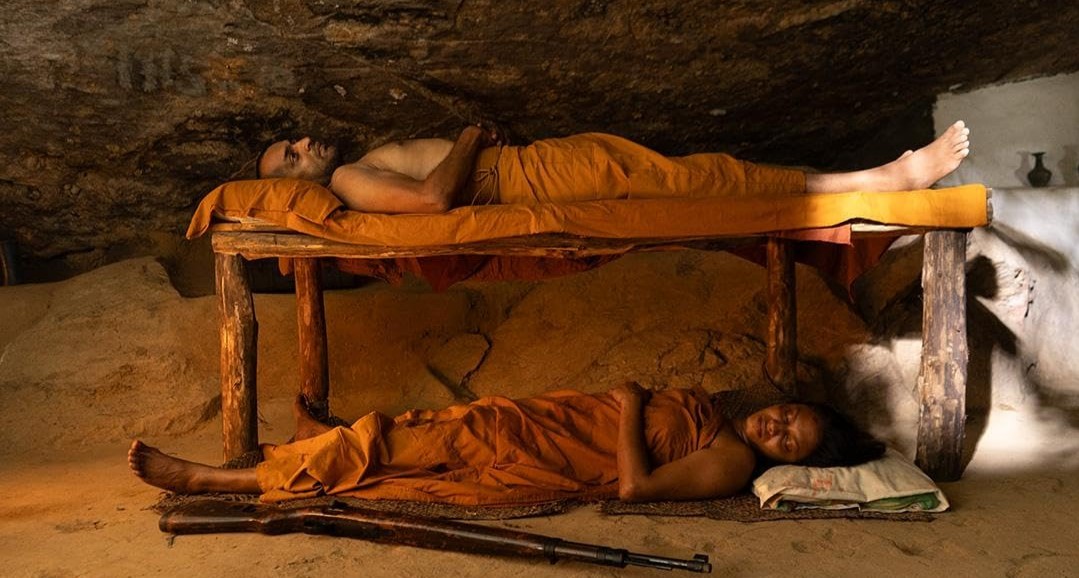
The saffron clad nirvana pursuing Buddhist savant professes to his bitter, battle scarred and bruised idealistic rebel to whose monastery’s habitants include – himself, his elder guru and multitasking cook, caretaker and errands man uncle Bandara, says it is best to live in peaceful coexistence accepting the harsh reality of social injustice since “that’s our karma,” qualifying it further ‘offensively’ stating “girls shouldn’t revolt (against) governments. It’s not necessary.”
“People (have been) oppressed since birth. You don’t need to die for that,” says the saffron clad renunciator which only roils the suffering Sharada who snarls and snaps in fuming anger “It’s not karma. It’s the ruthless authority and their fault. It’s not karma. It’s the way you think.”
Likewise, in another instance, when Samitha asks: “what are you going to do with the weapon,” when Sharadha wants her gun back, she replies “stand against this unjust centralised power…And demolish the regime.” To which Samitha sporting that saintly beatific smile quiescently quips: “Show more power than that unjust power? It is the same thing. You are trying to create more power. At the end more power victimises the lesser or becomes obedient. Even it looks like you are going against the existing nature. At the end isn’t it the same thing?”
To which Sharadha replies: “we are trying to get power to create a better life.” A smiling Samitha sallies with “the objective may differ but both need power. It is the law of nature. One man with a gun can control a 100 without one (quoting Russian Revolutionary Joseph Lenin).”
Describing Dhara as a “profound story of liberation that resonates on both personal and universal levels” Anuruddha Jayasingha observes “it’s about defining liberation through individual and collective actions” whose own life was marked by periods of social unrest, oppression and marginalisation deeply entrenched in his memories of the 1987-1989 insurgency in his country – Sri Lanka.
The turbulent period which witnessed a bloody armed revolt led by Marxist–Leninist Janatha Vimukthi Peramuna (JVP) party against the then ruling right-wing United National Party (UNP) government. The JVP and its military wing, the Deshapremi Janatha Viyaparaya (DJV or People’s Patriotic Organisation) taking up cudgels through brutal and disruptive assails such as strikes, sabotage, infrastructure bombings, subversion, and targeted assassinations of political figures, military personnel, and eventually the family members of soldiers at the Sri Lanka Armed Forces, the police, and government-backed counter-insurgency death squads/militias, which had, in mid-1989, launched the joint military and police command systematically hunted down the JVP leadership, to effectively to root out the JVP-DJV, suspending constitutional rights and vesting the military with sweeping powers of arrest and disposal of bodies without autopsies.
What led to JVP’s strong animus towards the then Lankan establishment was the July 1987 Indo-Sri Lanka Accord, resulting in Indian Peace Keeping Force (IPKF) and leading to granting of greater autonomy to Tamil minority, which the JVP was strongly averse to and viewed the development as the nation’s surrender to Indian imperialism. While the State’s Operation Combine eventually led to JVP leader Rohana Wijeweera being killed in November 1989, and subsequent leader Keerthi Vijayabahu as well with the military decimating the leadership by December 1989, the human cost of the two long tumultuous and turbulent southern conflict and state crackdown resulted in massive violence, disappearances, and an estimated 30,000-60,000 deaths, mostly youths, following the ferocious government determined crackdown on the opponents.
Appreciated as an “undiscovered gem” at Busan International Film Festival, the delectable debut directorial film vividly and visually examines the duality of approaches to individual freedom and personal liberty in a strife striven society. While Sharadha, the rebel, believes in dislodging the oppressive society by challenging the status quo toward achieving a more equitable society free from corruption and injustice, by violent means and states “we cannot think like you when people don’t have proper life. No proper meal or shelter. No medicine, no jobs. There is no life.”
The spiritual practitioner monk, prefers to differ, in keeping with his monistic pursuit, stating “chasing endless needs is a curse” propagating a more spiritually oriented “self-seeking truth path of enlightenment and liberation” thereby “transcending moral sufferings and cycles of rebirth” eschewing the violent ways. The militant in Sharadha ripostes in reply: These are no endless needs. Those are basic needs for a human being.
As the two jab and joust at each other on the ideal, empowering instrument to achieve ‘personal’ liberation, the film showcases how, whilst Sharadha ministered towards her recovery to robust health, either of them is right in her/his own way in that liberation could be both “an act of defiance against the State as also a personal realisation of truth” while, for the Savant Samhita spiritual liberation is an self-ordained means towards “enlightenment, transcending suffering and cycles of rebirth.”
This twin streams of thoughts and strands of approaches that blends the more virulent and violent outer struggles for justice and societal reforms, with much more refined and reformative inner search for personal peace and understanding, forms the dualism of Dhara’s quintessential dissection of life’s Sisyphean struggle to find meaning for peaceful coexistence – as it juxtaposes the ideological clashes and conversations between collective revolution/survival and individual meditation/inner peace.
The languid and languorous paced nuanced and niftily scripted socio-philosophical poignant drama, which deftly balances the tranquil tension of the idyllic monastic life with that of the external threats of raging civil war and quietude of monastic living amidst nature turns into an immersive, intriguing and introspective tour de force thanks also due to cinematographer Chris Sebastian Joys’ evocative and atmospheric panoramic visuals of rural Sri Lankan lush green forest, with the quietly flowing rivulet, flora and fauna as also the cave temples that form the magical milieu of the film’s site of action, equally supported and elevated by the haunting background score of spiritual music composer Venerable Bibiladeniye Mahanama Thero (nee Wanaviraja Wasala Mudhiyanselage Lahiru Madhusanka).
In sum, in keeping with its rich tradition of captivating and constructive contemporary cinema heritage, Dhara and director Anuradha Jayasingha join the illustrious and impressive scroll of filmmakers that Sri Lankan cinema has enthralled discerning cinephile with enriching, eclectic films to cherish and celebrate about.



Leave a Reply