
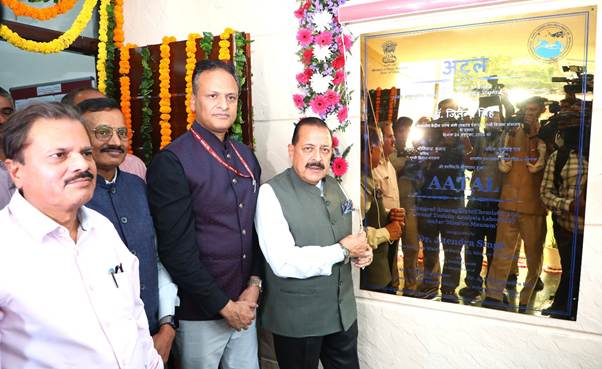
‘Integrated Atmospheric Chemistry and Aerosol Toxicity Analysis Laboratory ‘ (AATAL) also equipped to identify Real-Time Sources of Air Pollution
New facility to go beyond AQI numbers to reveal what is polluting Delhi’s air, where it is coming from and its potential health implications: Dr. Jitendra Singh
Integrated with AIRWISE to strengthen real-time source apportionment, air-quality forecasting and scientific decision-making, says Dr. Jitendra Singh
Facility to support CAQM and pollution-control agencies in targeting interventions and assessing their effectiveness: Dr. Jitendra Singh
Dr. Jitendra Singh says coordinated action across government departments is essential for evidence-based air pollution management
Union Minister of State (Independent Charge) for Science and Technology and Earth Sciences, and Minister of State in the Prime Minister’s Office, Personnel, Public Grievances and Pensions, Department of Atomic Energy and Department of Space, Dr. Jitendra Singh today inaugurated the world’s first- of -its-kind ‘Air Pollution Analysis’ facility for Delhi NCR. Known as ‘Integrated Atmospheric Chemistry and Aerosol Toxicity Analysis Laboratory ‘ (AATAL), it is also equipped to identify real-time sources of air pollution.
Describing it as a first-of-its-kind integrated facility in the world, the Minister said Delhi-NCR had been chosen in view of the serious public concern over air pollution. He said the facility would take air-quality assessment beyond simply reporting pollution levels to identifying the composition of pollutants, their sources, their relative contributions and their potential health implications, while providing real-time information and advance forecasts to support timely action.
The inauguration took place at IITM’s Delhi Branch in the presence of Dr. T. Srinivasa Kumar, Secretary, Ministry of Earth Sciences, Dr. A. Suryachandra Rao, Director, IITM and DG IMD Dr Mahapatra. The facility has been established under ‘Mission Mausam’ announced by PM Sh Narendra Modi to strengthen scientific understanding of atmospheric pollution and provide actionable evidence for air-quality management in Delhi-NCR. The laboratory brings together advanced atmospheric measurement instruments, detailed chemical analysis, pollution-source identification and decision-support capabilities within an integrated framework.
Addressing the gathering, Dr. Jitendra Singh said India had made substantial progress over the past 10–12 years in air-quality forecasting and analysis. He said the new facility represented a significant step forward because it would help establish not only how much pollution is present in the atmosphere, but also what it consists of and where it originates.
“Earlier, the discussion would largely revolve around whether the pollution level was 100 or 200. This facility will help us understand the composition of pollution as well as the contribution of different sources. This is important for addressing the concerns of the people of Delhi and ensuring that action is based on scientific evidence,” the Minister said.
AATAL will help scientists distinguish between different sources of air pollution, including vehicular emissions, industrial activity, biomass and crop-residue burning, construction and road dust, and pollutants transported from surrounding regions. By estimating the relative contribution of these sources, the facility will help authorities understand which activities are driving poor air quality at a particular time and where interventions may be most effective.
Explaining the significance of real-time source apportionment, Dr. Jitendra Singh cited an instance, while talking to the reporters, the screen showed that at that precise moment, transport was contributing approximately 25 per cent of Delhi air pollution, with the overall pollution level recorded at around 180. He said such information could help move the response to air pollution from general assessments to more targeted interventions based on the actual sources contributing to the problem.
The laboratory is equipped with advanced instruments for analysing the chemical composition of atmospheric gases and aerosols, including fine particulate matter (PM2.5), metals, toxic elements and other components. Its capabilities will help scientists investigate how pollutants interact and transform in the atmosphere and how different components contribute to the overall pollution burden.
Dr. Jitendra Singh said the facility would provide information on the smaller constituents of air pollution, including metallic elements and other potentially harmful components. He explained that pollutants can differ in their health implications, making it important to understand not only their concentration but also their composition and potential toxicity.
The resulting scientific evidence can help health authorities better understand the potential risks associated with different types of particulate pollution. It can also support closer coordination between scientific institutions, health agencies and environmental authorities in assessing the implications of air pollution for public health.
The laboratory is integrated with IITM’s AIRWISE, Air Quality Warning and Integrated Decision Support System for Emissions, which combines air-quality forecasts, observations and source-apportionment information to support pollution management.
The project team explained that AIRWISE provides air-quality forecasts at a spatial resolution of 400 metres for the next 72 hours, enabling the system to assess how pollution may vary across different pockets of Delhi. It can also help identify the sources expected to contribute to deteriorating air quality in specific locations. Dr. Jitendra Singh said the integrated capability would provide real-time information as well as forecasts for the next four days, helping authorities prepare for changing pollution conditions.
Dr. Sachin Ghude, Project Director, MAQWS, said the integrated facility would strengthen air-quality management in Delhi-NCR by providing early warnings and detailed information on the sources contributing to pollution, including stubble burning, vehicular emissions, construction and road dust. He said the information would help the Commission for Air Quality Management (CAQM) and other implementing agencies identify the major sources of pollution, plan targeted interventions and assess their effectiveness.
He added that the associated air-quality forecasting system provides forecasts at a 400-metre resolution for the next 72 hours, enabling pollution levels and their likely sources to be assessed for individual pockets of Delhi. Describing the forecasting capability as a major technological advance, Dr. Ghude said India had developed a high-resolution system comparable with global forecasting systems, with the potential to extend similar capabilities to other cities.
Emphasising the importance of coordination among government agencies, Dr. Jitendra Singh said air pollution could not be addressed by a single department working in isolation. He described the initiative as an example of the whole-of-government approach advocated by Prime Minister Narendra Modi, bringing together scientific institutions, environmental authorities, pollution-control agencies and disaster-management stakeholders.
The Minister said coordinated engagement among the Ministry of Earth Sciences, the Ministry of Environment, Forest and Climate Change, pollution-control authorities and disaster-management agencies would be important for translating scientific information into effective action.
For the Commission for Air Quality Management (CAQM) and other implementing agencies, the facility will provide measurement-based evidence to identify the sources responsible for deteriorating air quality, prioritise sectors and locations for intervention, and support coordinated measures across Delhi-NCR. When combined with AIRWISE forecasts, this information can strengthen decisions relating to preventive measures and responses under the Graded Response Action Plan (GRAP).
The inauguration of AATAL marks an important step towards connecting advanced atmospheric science with public policy and on-ground action. By bringing real-time measurements, chemical characterisation, source apportionment and forecasting together, the facility will help authorities move towards a more precise understanding of air pollution and a more coordinated response to the challenge facing Delhi-NCR.




Leave a Reply