
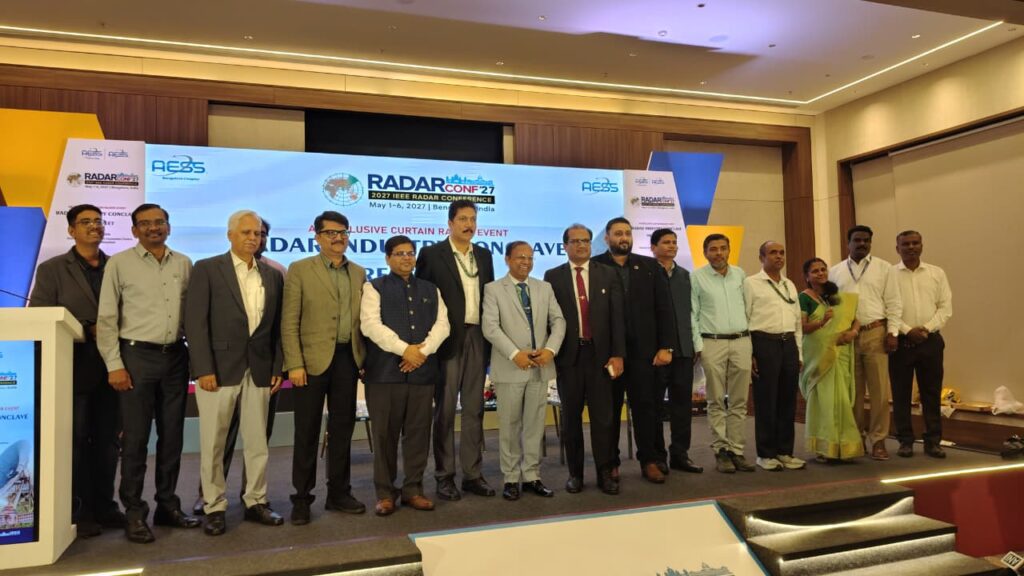
BENGALURU — India has all the potential to become topper in the world at the Radar Innovation and Technology after IEEE Radar Conference 2027 (RadarConf’27) which Scheduled for May 1–6, 2027, this marks the first time in the prestigious conference’s 47-year history that it is being hosted in Bengaluru, India, representing its historic debut across the entire Asian continent.
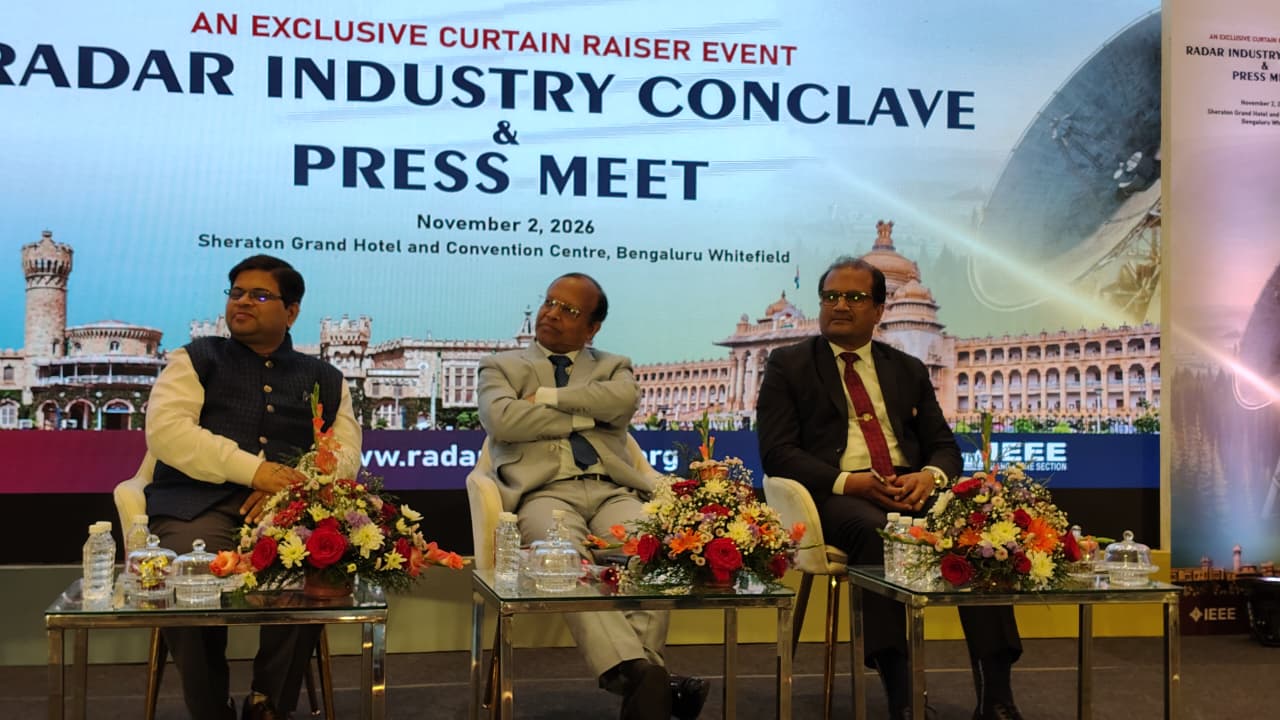
This was expressed by Dr. B. K. Das (DG(ECS), DRDO), Shri M. Sheik Althaf (Director, LRDE) and Puneet Kumar Mishra, General Chair, RadarConf’27 at the official Curtain-Raiser for the IEEE Radar Conference 2027 (RadarConf’27). held in Bengaluru yesterday hosted by IEEE Aerospace and Electronic Systems Society (AESS) Bangalore Chapter, alongside leading defence partners.
The upcoming 2027 conference is anchored by the theme, “Adaptive Waves, Resilient Skies: Global Innovations in Radar Technology.” Mr. Puneet Kumar Mishra (General Chair, IEEE RadarConf’27 and Global VP of Education, IEEE AESS) announced that it serves as a vital platform for deep-tech collaboration across three core pillars:
A Strategic Leap for Global and Indian Radar Systems
1. Spectrum: Advancing cognitive frontiers, artificial intelligence integration, and joint communications-sensing technologies.
2. Space: Expanding orbital capabilities, atmospheric monitoring, and next-generation satellite payloads.
3. Sovereignty: Strengthening global security, resilient electronic warfare systems, and collaborative defence frameworks.
Technical Program & Advanced Tutorials to Highlight Global Deep-Tech Breakthroughs
The main conference program will feature 15 highly specialized sessions. Highlighting the event’s heavy academic and industry education focus:
- Next-Gen Sensor Processing: Deep dives into Micro-Doppler Signatures, Weather Radar Signal Processing (Raw Returns to Data Products), and Radar vs. LiDAR Processing for Autonomous Driving.
- Advanced Architecture & Physics: Core Technical exploration of Active Electronically Scanned Arrays (AESA), Nonlinear Radar architectures, and advanced Radar Clutter Modelling.
- Mathematical & System Optimization: Applied frameworks in Convex Optimization for Adaptive Radar alongside operational strategies for Passive Radar in Air and Space Surveillance.
Technical Committee Announcement
To reflect current global priorities, the technical committee announced a robust line-up of 8 advanced professional tutorials covering the global industry’s most critical current domains:
• Counter-UAS Radar Systems: Specialized detection, tracking, and defeat mechanisms for emerging drone threats.
• AI-Driven Signal Processing & Cognitive Radar: Integrating machine learning for intelligent sensing and adaptive waveform design.
• Integrated Sensing and Communications (ISAC): Merging radar capabilities with 6G wireless networks to build sustainable future smart infrastructure.
Global Leadership, Icons and Defence Visionaries to Converge in Bengaluru
Highlighting the international significance of this event, Mr. Mishra announced the participation of the global top leadership of the IEEE Aerospace and Electronic Systems Society (AESS). Attending the main conference alongside other distinguished members of the AESS Board of Governors (BoG) will be Dr. Braham Himed (IEEE AESS President, Air Force Research Laboratory – AFRL), Professor Maria Sabrina Greco (Past President, University of Pisa), and Mr. Lorenzo LoMonte (President-Elect and Chief Scientist, TTM Technologies). Their presence underscores the high structural value the international scientific community places on India’s expanding role in aerospace and radar innovation.
In addition to the organizational leadership the main conference will host a legendary delegation of the world’s most celebrated titans in radar science, transforming Bengaluru into the absolute global epicenter of defence, aerospace, and remote sensing. The elite international line-up includes Dr. Alfonso Farina (the legendary inventor of modern Track-While-Scan processing), Dr. Paul Rosen (Project Scientist for the historic joint NASA-ISRO NISAR mission), and Dr. Ram Narayanan (pioneering authority on random noise radar). Joining them are global defence and industrial heavyweights Dr. Murali Rangaswami (Senior Scientist, U.S. Air Force Research Laboratory – AFRL), Dr. Luke Rosenberg (Australia’s Lockheed Martin), Dr. Arik Brown (Northrop Grumman/Raytheon AESA architect), Prof. Roberto Sabatini (aerospace and avionics systems expert), and Prof. Igal Bilik (automotive radar vanguard).
The academic and deep-tech fabric of the conference is exponentially enhanced by the presence of global pioneers driving today’s technology frontiers: Dr. Francesco Fioranelli (TU Delft, micro-Doppler human sensing), Prof. Carmine Clemente (University of Strathclyde, cognitive tracking), Dr. Sebastián Torres (University of Oklahoma/NOAA, advanced weather radar signal architectures), Dr. Rakshith Jagannath (cutting-edge industrial RF sensing), Prof. Mateusz Malanowski and Prof. Konrad Jędrzejewski (Warsaw University of Technology, global authorities on passive bistatic radar and radar clutter exploitation), and Dr. Anastasia Lavrenko (expert in intelligent RF coexistence). Their live participation establishes RadarConf ’27 as an unprecedented hub for international academic validation, strategic industrial synergy, and global technology transfer
A Vision from India’s Aerospace Hub
Addressing the gathering, technology leaders emphasized India’s evolution from a technology adopter to a primary innovator in complex sensors and electronic systems. Bengaluru, home to major public defence enterprises, space laboratories, and thousands of tech startups, provides the ideal ecosystem to host this global confluence of researchers, military representatives, and industry leaders. Mr. Mishra noted that hosting RadarConf ’27 aligns with India’s deep-rooted scientific heritage—tracing back to Sir Jagadish Chandra Bose’s pioneering work on millimeter waves—while highlighting modern achievements in indigenous radar development for defence and space exploration
Strong Global Response and Submission Metrics
Puneet Kumar Mishra also shared highly encouraging initial statistics, demonstrating massive global interest in the Bengaluru edition. To date, more than 231 research papers have already been submitted by scientific authors spanning 30 countries across the globe. A demographic breakdown of the submissions highlights a strong local and international distribution:
- India: 55% of the contributing authors
- China: 15% of the contributing authors
- United States of America (USA): 10% of the contributing authors
- Rest of the World: 20% representing a diverse spread of international research labs and academic institutions.
The technical committee reminded prospective authors that the final deadline for paper submission is November 30, 2026.
Cultivating Tomorrow’s Talent: Empowering Student Engineering Programs
Recognizing the vital role of youth innovation, Puneet Kumar Mishra introduced the extensive student framework built directly into RadarConf ’27, designed to act as a bridge connecting high-performing teams with the active defence and aerospace R&D ecosystem: • Radar Boot Camp: An intensive educational foundational track designed to deliver deep-tech onboarding and essential skill-building for budding engineering minds.
• Radar Challenge 2027: A hands-on software-defined radio (SDR) prototyping track in association with the NI India team (Emerson/NI). Selected global student and startup teams receive top-tier USRP hardware arrays on a 5-month loan to design open-source radar or Electronic Warfare (EW) proposals. Proposals are open until November 30, 2026.
• Student Paper Competition: A high-stakes arena recognizing outstanding technical manuscripts from undergraduate, master’s, and PhD scholars. Reviewed by the international AESS Radar Systems Panel, five global finalists will present live to an expert jury on May 3, 2027, competing for cash awards and commemorative plaques.
The IEEE Radar Conference 2027 (RadarConf’27) Delegates and Students registration fees for Indians also very affordable and very less compared to overseas.
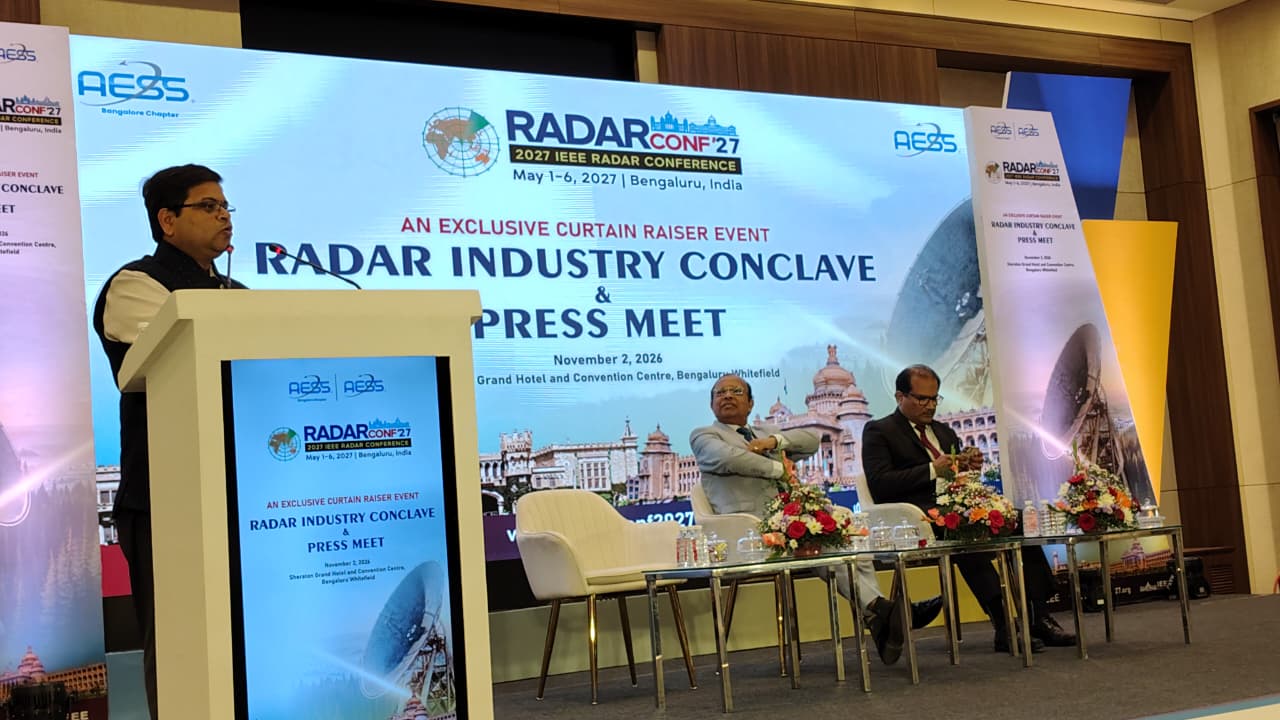
Further for my query to going forward Radar Conferences editions hosting to be in India , Mishra was highly optimistic and hoping future edition hosting in India should be with in 5 years which is 2032.
Conference Timeline
The curtain-raiser sets off a six-month countdown to the main event in May 2027, which is expected to draw over a thousand global delegates, leading aerospace corporations, and international academic institutions to Bengaluru.
…
Ajay.K.R





Leave a Reply