
S Viswanath
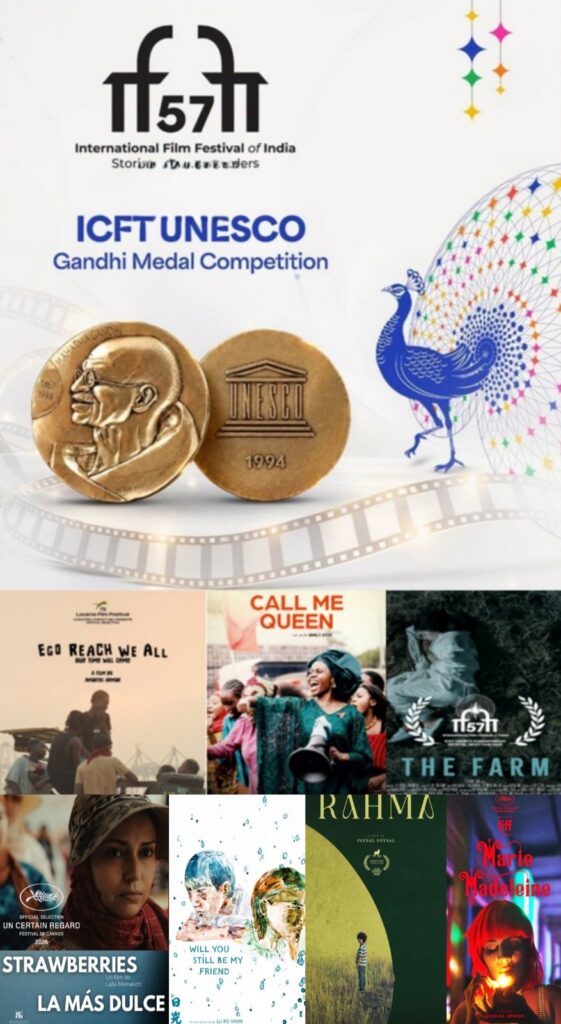
Awarded annually at the International Film Festival of India (IFFI) in Goa the ICFT–UNESCO Gandhi Medal,instituted in 2015, at the 46th edition of IFFI,is an international film honour, instituted by the Paris, France headquartered International Council for Film, Television &Audiovisual Communication (ICFT Paris) in collaboration with UNESCO.
The honour is bestowed upon a filmmaker and his work that best reflects Mahatma Gandhi’s ideals of peace, non-violence, tolerance, and intercultural dialogue, which is assessed and adjudicated by a four member international jury which evaluates a curated selection of global and Indian feature films competing in the section at the festival.
The International Jury, this time around, comprises of Jury President Dr Prof Ahmed Bedjaoui, the octogenarian Algerian film director, producer, critic, and academic & Artistic Director of International Film Festival of Algeria, along with Argentina’s Maria Cristina Iglesias, former head of UNESCO’s Cultural Sector Programme, Manouj Kadaamh, ICFT Member & filmmaker, and Luxembourg based Georges Dupon, former Director General of International Council for Film, Television & Audiovisual Communication.
The genesis of the commemorative Gandhi Medal dating back to 1994, when UNESCO issued the commemorative medal, marking the 125thbirth anniversary or quasquicentennial celebrations of Mahatma Gandhi.
The films in the section have been picked from Ghana, Haiti, Kenya, Morocco, Taiwan, Turkey, and India (three films — 2 Hindi [Kabir Sir Ki Akhir Lesson, Sev Michhar] and 1 Tamil-Scroll]). The international films in contention and their brief narrative sketch and thematic concern are as under:
Ghanaian-American writer-director Amartei Armar’s Ego Reach We Allfollows two orphans, Owusu and Adobea, travel through the Ghanaian countryside in search of their last living parent, hoping to regain their identities. When they reach the busy city of Accra, they meet the Jackals, a gang of young people who survive by breaking into places and stealing. This unexpected encounter changes their journey and turns their original plan upside down.
Iranian-German-French writer and director Emily Atef’s Call Me Queen revolves around Queen is a single mother living in Nairobi in the 1990s, struggling to support herself and her two children. Her life changes when she meets Anna, an Irish journalist, and the two develop an unexpected friendship. When Queen discovers that she has AIDS, Anna helps her get medical treatment. Queen survives, while many of her friends and neighbours die from the disease. Her experience changes the way she sees life, and she becomes determined to stand up against injustice. The film explores friendship, support and how people can help one another through difficult times.
Anna, a British reporter, never expected to find kinship in Mercy, a sharp, fearless woman from Nairobi’s largest slum. But their bond grows, and so does their determination to act. As the AIDS pandemic devastates African communities and pharmaceutical greed denies access to treatment, the two women take on a fight far bigger than themselves.
Set in 1990s Nairobi, the drama explores the bond between a British/Irish reporter named Anna and Mercy/Queen, a fearless local figure, as they fight against the AIDS pandemic and pharmaceutical greed.
Istanbul born Elif Eda is women writer-director’s The Farm (SütÇiftliği) After suddenly losing her parents, 12-year-old İrem moves in with her estranged grandmother on a dairy farm near an industrial area. She becomes upset when she sees newborn calves being separated from their mothers so the farm can produce more milk. Troubled by this everyday cruelty, İrem decides to free the pregnant cows from the farm. With the help of Halid, an orphan working as an apprentice to the farm’s veterinarian, she sets out to carry out her plan.
After the sudden loss of her parents, twelve-year-old İrem moves in with her estranged grandmother on a semi-industrial dairy farm. As she witnesses the routine separation of newborn calves from their mothers, İrem becomes increasingly troubled by the quiet violence embedded in everyday practice to obtain more milk. This unsettling realisation leads her to make a small but radical decision: to liberate the pregnant cows from the farm, with the help of Halid, an orphan apprenticed to the farm’s veterinarian.
The Farm explores grief and empathy through a child-led story while also addressing human-animal relationships and systemic injustice.
Casablanca born woman film director Laïla Marrakchi’s Straberries (La más dulce) Hasna and Meriem leave their native Morocco to work as seasonal labourers picking strawberries in Southern Spain. Hoping to return home and provide a better life for their families, their dreams clash with a harsh reality: abuse, harassment, and undignified working conditions at the hands of their employers. The bond they share as a unified sisterhood, empowers them to rise above their situation, despite the risks that are needed to advocate for their rights. They must make the difficult decision to speak out against a powerful patriarchal system, risking everything for their own personal justice.
The bond they share as unified sisterhood, empowers them to rise above their situation, despite the risks that are needed to advocate for their rights. They must make the difficult decision to speak out against a powerful patriarchal system, risking everything for their own personal justice.
Yunlin, Taiwanese filmmaker Lu Po-Shun’s debut film Will You Still Be My Friend set in a rural Taiwanese village, thirteen-year-old Jun tries to preserve his friendship with Jasper, his new best friend, who has recently moved to the village. Growing up in Singapore in a way more wealthy environment, Jasper is different from the other children and is therefore not well accepted. But when tensions between the adults in the village begin to escalate, their friendship is also caught up in a conflict that threatens to tear them apart.From Andalusian strawberry farms to the courts, this film celebrates sisterhood amidst a tale of exploitation.
The film, which took six years in the making, says the filmmaker, begins with Andalusia, this so-called promised land, a few kms from Morocco and delves into the human need to dream, to weave a narrative to be able to move forward. For these women, speaking out becomes the only way to freedom and their only support system is each other.
Turkish filmmaker Faysal Soysal’s Rahmaspotlights on a childless archaeologist plans to pursue surrogacy overseas until her path crosses with a Syrian refugee child, leading her to question her original intentions and discover unexpected possibilities.
Meryem is an archaeologist working in Şanlıurfa who dreams of becoming a mother. After several surgeries and unsuccessful IVF treatments, she begins to lose hope. Despite her husband İbrahim’s objections, she decides to try surrogacy in Georgia as a last resort.
Meanwhile, she meets Rahma, a nine-year-old Syrian orphan struggling to survive on her own. When Meryem discovers the secret of Rahma, a special and mysterious bond develops between them. As their relationship grows, Rahma’s presence brings comfort to Meryem and helps heal her emotional pain.
An deeply moving and eminently engaging work of cinema wherein a “collision of several sets of lives, among them a childless couple, a people trafficker, and a street refugee child” form the fulcrum of the film.
Gessica Généus’ Marie Madelinewinner of Grand Prix du Jury, Festival de Cabourg, is a vibrant, contemporary reimagining of the biblical story of Mary Magdalene which follows Marie Madeleine, a fiercely independent sex worker living a bohemian lifestyle, whose path crosses with Joseph, the dutiful and sexually repressed son of an evangelical preacher. As Joseph’s faith begins to waver, the two form an unexpected bond that explores the tension between desire, religion, and personal freedomoffer new possibilities for both of them.
The film follow-up to her 2021 narrative feature debut Freda, tracks a free-spirited Haitian sex worker whose serendipitous involvement with a repressed preacher’s son opens each to possibilities, who navigates the nights without submitting to the rules of those who save souls.
The city itself becomes a character in the film with its constant soundscape underscoring the island’s conflicting rhythms of lapping waves, boisterous street festivals and parades, radio broadcasts of religious sermons, and parties spilling out into the streets, while the filmmaker interjects moments of sublime surrealism as Marie and Joseph become closer — and she inspires him to pursue desires that his stern pastor father does not condone. All of their worlds collide explosively when the pastor opens a church directly across from Marie’s brothel and aggressively campaigns its madam to close up shop.
Incidentally, the first ICFT–UNESCO Gandhi Medal was won by Kaushik Ganguly’s Bengali feature Cinemawala in 2015, thereon the award going to Mustasfa Kara’s Turkish film Cold of Kalandar, Manouj Kadaamh’s Marathi film Kshitij: A Horizon, Prafveen Morchhale’s Ladakhi film Walking With The Wind, Italian film Rwanda by Riccardo Salvetti, Palestine’s 200 Meters by Ameen Nayfeh, Mahamat=Saleh Haroun’s Lingui: The Sacred Bonds from Chad, Iranian film Nargesi by Payam Eksandari, Singaporean filmmaker Anthony Chen’s Drift, Levan Akin’s Crossing from Sweden and Norwegian Safe House by Eirik Svensson, respectively.



Leave a Reply