
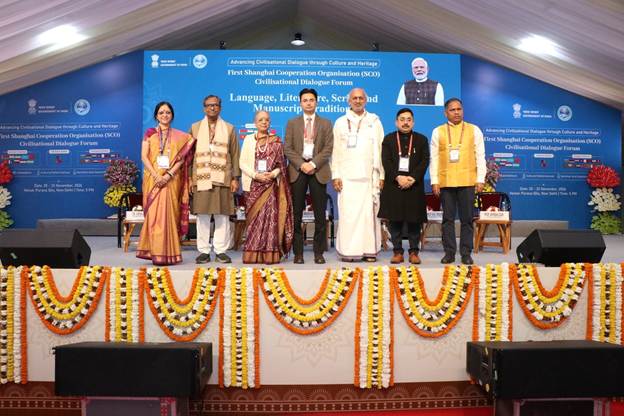
Scholars and delegates from SCO Member States and Dialogue Partners discuss manuscript preservation, translation, digitisation and international cooperation
India’s manuscript heritage, encompassing knowledge of polity, economy, medicine, mathematics, astronomy, agriculture and sustainable living, reflects a rich civilizational journey in which knowledge travelled across regions through lipi (script), bhāṣā (language) and jñāna (knowledge). Rooted in the spirit of the Ṛgvedic prayer “ā no bhadrāḥ kratavo yantu viśvataḥ” (let noble thoughts come to us from all sides), this shared legacy was the focus of Session IV on “Language, Literature, Script and Manuscript Traditions”, convened by the Ministry of Culture under the Gyan Bharatam Mission on 22 November 2026 at Purana Qila (Old Fort), New Delhi. The session brought together eminent scholars, experts and delegates from SCO Member States and Dialogue Partners to deliberate on the shared manuscript heritage and avenues for collaboration.
The session was part of the 1st SCO Civilization Dialogue Forum, held from 20 to 22 November 2026 and inaugurated by the Hon’ble Prime Minister of India Shri Narendra Modi.
Shri Inderjeet Singh, CEO (Gyan Bharatam) & Joint Secretary, Ministry of Culture, briefed participants from SCO countries on the Gyan Bharatam Mission and its operational activities to the participation SCO Countries: Survey and Cataloguing; Conservation and Capacity Building; Technology and Digitization; Linguistics and Translation; and Research, Publication and Outreach. He highlighted the key features of AI and its integrated features, Gyan-MitramAI, Pandulipi Darpana and BharatiyaGPT, and the milestone achieved that over 1.26 crore manuscripts have been reported through the National Manuscript Survey.
Emphasising the collaborative vision of the Mission, he stated, “For the Gyan Bharatam Mission, this is both a responsibility and an invitation to work together.” He also highlighted the significance of Indic scripts across the SCO region and the role of manuscripts in fostering global dialogue and building a global digital repository of knowledge.
Prof. Anirban Dash, Project Director, Gyan Bharatam, Ministry of Culture, moderated the session and welcomed the participants. He observed that language gives voice to our thoughts, Language and literature preserve them, and these manuscripts carry wisdoms across time and places. He highlighted how knowledge travelled across mountains and seas, underwent translation and adaptation, and became part of the intellectual life of diverse societies.
Thereafter, the session begin with discussion over 4 key themes, “Many tongues, Many scripts: India’s Linguistic and Script Heritage and its imprint on Asian Languages; Literature in Motion: transmission, translation, and Localization of Indian texts across Asia; Manuscripts Beyond Borders: The Global Presence and Dispersal of India’s Manuscript Heritage; Reconnecting Dispersed Knowledge: Gyan Bharatam and the Digital Future of Manuscript Heritage”.
Prof. Rajnish Kumar Mishra, Professor, SSIS, Jawaharlal Nehru University, emphasized India’s vivid linguistic and script heritage and its imprint on Asian languages. He spoke on the varied nature, concepts and modes of expression that spread across the world through the communication and writings of our great seers, and noted that Indian culture also spread across the oceans via the Silk Route. He talked about scholars such as Shankaracarya, Ramashekhar, Acarya Abhinavagupta and others, and also threw light on the different regional manuscript traditions and recessions.
Prof. K.K. Mishra, Head and Associate Professor, Department of Sanskrit, University of Calcutta, focused on enhancing the pathway for digitisation, translation into more languages, multiple uses of AI, and global accessibility via the establishment of NDR. He referred to the BnF, Thailand and Vietnam, Mongolia and Russia, Google Arts & Culture, and bilateral and archival ties, and also touched upon translators, pilgrims and Nalanda.
Dr. Viswajanani J. Sattigeri, Head, TKDL Unit, spoke on Gyan Bharatam and the digital future of manuscript heritage. She stressed the need to protect our knowledge from piracy and spoke on the published nature of our traditional knowledge, IPR, patent codes, codified metadata on the database, and controlled access to avoid duplication and misappropriation, like TKDL.
Prof. K. Rama Subramaniyam, IIT Bombay, spoke on manuscripts and their importance in interpreting things rightly, as it shapes thought, expression and mind. Citing the example of the Pañcatantra, which has been translated into over 50 foreign languages, such as Arabic, Persian and others, he stressed the need to keep translations of the content free from biased interpretation. He observed that knowledge is bound to decay and has to be preserved. A manuscript preserved for hundreds of years is treasured not only for its content but also for the journey of time and traditions it carries.
Delegates from several SCO countries, including Iran, Kyrgyzstan, Pakistan, Cambodia, Uzbekistan, Laos and Nepal, actively participated in the discussions. They shared their respective efforts and initiatives for manuscript preservation and expressed interest in collaborating with Gyan Bharatam, Ministry of Culture, Government of India, in various manuscript related activities.
The session concluded with a shared commitment to strengthen cooperation in manuscript preservation, script training, comparative literary studies, research and translation, cataloguing, academic exchanges, authorised digital access and joint research, reaffirming the role of shared heritage and knowledge traditions in fostering cultural understanding and cooperation across the SCO region.



Leave a Reply