
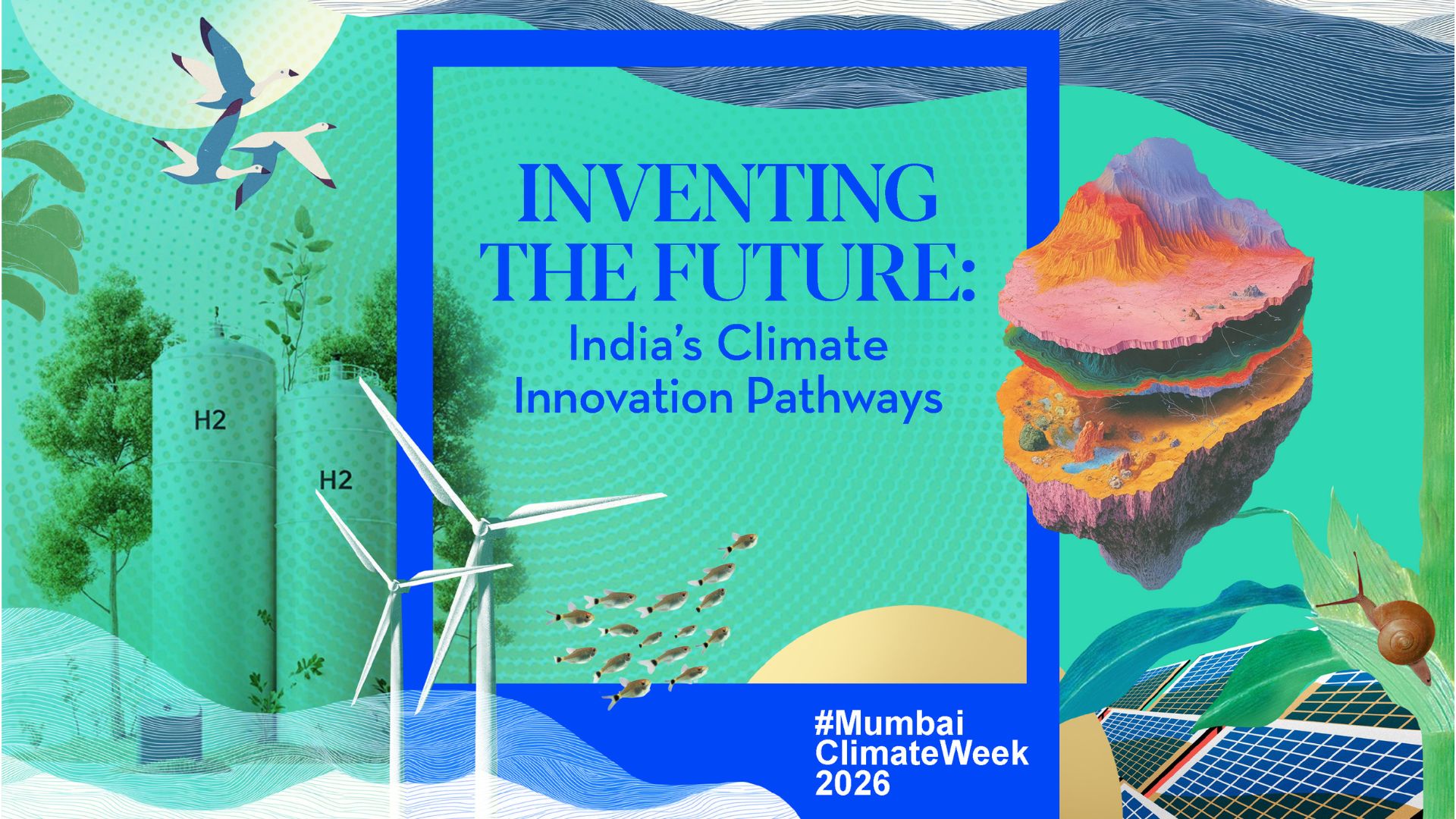
India is entering a decisive decade for climate action, one defined not only by rising climate risks but by the scale of opportunity to shape global solutions. The country has already begun to demonstrate what is possible when technology, policy, and markets align.
Over the past decade, the cost of utility-scale solar power has fallen by more than 70 percent, making it one of the cheapest sources of new electricity in India. Energy efficiency programmes such as LED adoption have reduced electricity demand while cutting tens of millions of tonnes of carbon emissions annually. Electric mobility is also gaining traction, with electric two- and three wheelers now forming the backbone of new EV registrations, reflecting India’s ability to innovate for affordability and scale.
Yet, as climate extremes intensify, the challenge ahead is no longer just about deploying proven technologies.
Integrating large volumes of renewable energy will require investments in grid flexibility, forecasting, storage, and digital infrastructure, while climate resilience will increasingly depend on hyperlocal data, early-warning systems, and smarter urban design. India’s cities, buildings, and transport systems will determine long-term emissions and exposure, even as new technological frontiers, from green hydrogen to carbon management,
open up opportunities for industrial leadership and energy security.
Avid Learning presents Inventing the Future: India’s Climate Innovation Pathways in collaboration with the Tata Institute of Fundamental Research (TIFR), Mumbai, National Gallery of Modern Art, Mumbai, and Project Mumbai, in partnership with the Government of Maharashtra’s Department of Environment and Climate Change, and supported by the Brihanmumbai Municipal Corporation.
It brings together three leading voices from policy research, investment, and systems thinking, namely Fellow and Director (Strategic Partnerships), CEEW Karthik Ganesan, Founding Partner, Aureolis Ventures, Investor, and Mentor Paula Mariwala, and Chief Executive Officer, India Health Fund Madhav Joshi, to examine how India can move from being a large market for climate solutions to becoming a global laboratory
and scaler of climate innovation. After the presentation, the discussion moderated by Dean, School of Natural Sciences, TIFR, Mumbai Dr Shankar Ghosh will unlock how innovations across foundational, transitional, and breakthrough technologies position India not just to meet its own climate goals, but to offer credible, scalable solutions for the Global South.
This special program is the third event in our series leading up to Mumbai Climate Week 2026, scheduled for February 17–19, 2026, and marks India’s first dedicated platform to accelerate climate action, empowering Mumbai, India, and the Global South to shape transformative, citizen-driven solutions. Our first program in this
series, ‘Living Seas: Towards a Sustainable Marine Future, ’ bridged disciplines and communities to chart bold pathways toward a sustainable marine future, while the second was an immersive performance, Plan B/C/D/E by Meghana AT, which asked how we would prepare, adapt, and imagine survival in a city shaped by water.
The last program in this series is scheduled for February.
Avid Learning has consistently engaged with the concerns of climate change and environmental degradation, particularly through its flagship series, Sustainability NOW. Since its inception in 2020, the series has featured
more than 90 speakers and 70 programs, including discussions, online episodes, masterclasses, and more, designed to convert audiences into changemakers and active custodians of a greener future. Speakers have included artists, designers, material researchers, chefs, architects, creative entrepreneurs, policymakers,
environmentalists, urban planners, educators, scientists, social media influencers, philanthropists, scholars, technologists, business leaders, museologists, and many other voices.
Join us to consider how innovation, investment, and governance can position India as a global source of
climate solutions.
When: Thursday, January 22, 2026 | 6:30 pm – 8:00 pm
Where: Tata Institute of Fundamental Research, Mumbai
Register: www.avidlearning.in
Press: Ayeshah Dadachanji (ayeshah.avid@gmail.com)
About Speakers:
An engineer by training, Karthik Ganesan is a Fellow and Director, Research Coordination, at The Council.
As Director, he has a bird’s eye view of CEEW’s ongoing and planned research and ensures cross-team coherence for CEEW’s research direction and imperatives. He also dons the hat of an internal adviser across research teams, creates institutional platforms that spur innovation and, in partnership with other senior researchers, continues to strengthen CEEW’s foundation for world-class research. He has played a pivotal role
in conceptualising and executing some of CEEW’s biggest successes and collaborative efforts, such as the ACCESS and IRES surveys and the associated studies, the GHG Platform Initiative, and the first full-fledged
office programme office based out of Lucknow. He continues to be an active researcher with the power sector and air pollution work programmes. Karthik holds a Master’s degree in Public Policy from the Lee Kuan Yew School of Public Policy at the National University of Singapore. He also holds an undergraduate degree in Civil
Engineering and an M.Tech in Infrastructure Engineering from the Indian Institute of Technology, Madras.
Shankar Ghosh, Professor of Experimental Physics at TIFR, Mumbai, investigates how ordinary materials self-organize into functional systems. His distinctive tabletop approach uses simple experiments with everyday objects like grains, toothpicks, and beads to capture fundamental physics. He focuses on materials driven out
of equilibrium, where factors such as friction, shape, and collective motion lead to the emergence of order.
Crucially, his work harnesses friction, noise, and disorder as active ingredients, showing how these emergent organized states can be engineered to perform functions such as supporting loads or directing motion. A central insight of his research is that feedback between friction, geometry, and motion allows systems to selftune into robust states, even in noisy environments. His work also informs the design of air-filtration media and
clarifies how frictional wear at tire-road contacts contributes to urban particulate pollution. He received the Shanti Swarup Bhatnagar Prize in 2019.
Paula Mariwala is a well-known venture capitalist, who has been part of building the startup ecosystem in India since 2006. One of the first women VC in India, she is the founding partner at Aureolis Ventures, Aureolis an early-stage venture capital firm investing in deep-tech, climate and health in India, the USA, and the UK.
She is also the Founder/President of Stanford Angels & Entrepreneurs India and Director of the Hinditron Group.
As an engaged philanthropist, she is deeply committed to the causes of education, environment, gender equality, human rights and the arts. Paula is a founding member of the Board of Management of Krea University and sits on management and advisory boards of companies and foundations.
Paula holds an MS in Applied Physics from Stanford University and BSc (Hons) in Physics from St. Xavier’s College, Mumbai. She lives in Mumbai with her family and enjoys painting, writing poetry, trekking, birding, supporting the arts and engaging with various social issues



Leave a Reply