
S Viswanath
It has been a trailblazing and tumultuous two and half decades for Indian Cinema since it stepped into the 21st Century.
The first quarter ending 2025 of this century sees Indian cinema stand at a inflection point with digital disruptions through various avatars determining and dictating the way the industry functions and delivers.
According to the Report, authored by Yaminie Patodia, Head, IMDb India, Kashika Saxena, Editorial & Content Marketing Lead, IMDb India, Kalpana Nair, Industry Relations Lead, IMDb India, “India’s mass audience is seeking stories in which they feel seen.”
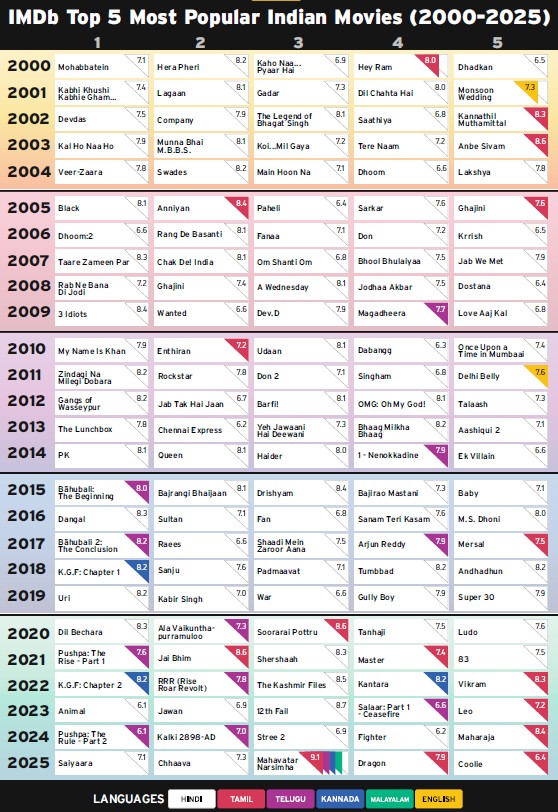
In this regard, the report observes that, “one of the most consequential developments in Indian cinema over the last decade has been the ascent of the Southern industries — Tamil, Telugu, Kannada, and Malayalam — into the national consciousness.”
This, says the report, has been fuelled by “the arrival of streaming services, lowered distribution and language barriers, enabling discovery and access at scale.”
As a result, “this has triggered a fundamental shift in audience behaviour. Viewers now explore cinema across linguistic lines and through multiple formats, while, filmmakers, in turn, are recalibrating long-held assumptions to find their footing in this new normal.”
CREATIVE ARSENAL
Pointing out that while “an appetite for Southern cinema always existed beyond its home states,” as to what led to the rise of South Cinema, according to the report is there “has been the unleashing of industry’s creative arsenal comprising diverse styles, stars, and storytelling traditions, ultimately engaging a broader and more dynamic audience base.”
This was primarily possible thanks to the “stories, styles, and cinematic traditions emerging from these industries, which found resonance with the audiences,” according to the report
Furthermore, what saw Southern Cinema capture and captivate the imagination of audiences across the country was, that while since 1990s, Hindi cinema has consciously leaned toward urban-centric storytelling, catering to multiplex audiences in major cities and affluent Indian diaspora, thereby creating a gap in mass-appeal entertainment for domestic audiences, the Southern cinema, on the other hand, rooted in themes with wider resonance, filled this lacunae being well-positioned to fill this, finds the report.
This is auguring well for India’s entertainment industry finds the report as across regions, industries are leaning on cross-industry collaborations to expand audiences, widen cultural entry points, and tap into pre-existing fanbases.
“Collaboration, long recognised as an effective lever for audience expansion, is now being deployed across talent verticals — actors, directors, musicians, and technicians — amplified further by robust distribution networks. Together, these elements are reshaping Indian cinema into a cultural infrastructure where stories are designed less as regional products and more as expansive universes with the potential to travel across India and beyond.”
Stating that lately “stars function less as guarantors of success” and “the star-fan contract less sacrosanct today, with fandom becoming less devotional,” the report observes that “the fans of today may line up for a selfie, but they may not show up for the movie.”
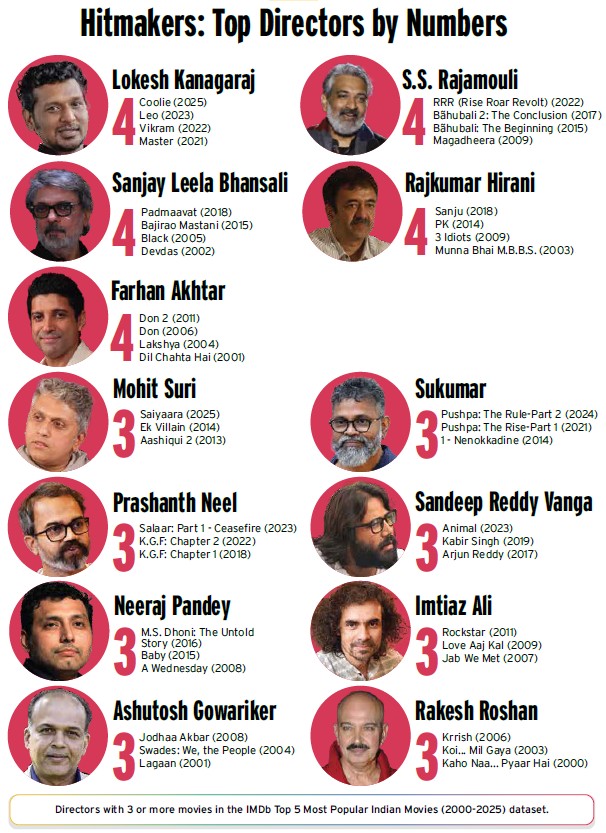
As a result, “director-led collaborations stand out as especially effective. Unlike star casting, which can be surface-level, directors are serving as the key architects of this new era of cinema, bringing a coherent creative vision and storytelling sensibilities that carry across industries, ensuring scale, tone, and ambition are aligned,” the report adds.
CINEMATIC DIALECT
According to the report, with each language industry developing its own unique cinematic dialect, viewers are approaching movies in a particular language with genre expectations already in mind and
associate specific storytelling attributes with different language industries.
If Telugu and Kannada films are looked upon for blockbusters, synonymous with maximalist spectacle and heightened heroism, Malayalam Cinema, on the other hand, is seen distinctive being its rooted realism, while Tamil movies are tonally more versatile and characterised by ideological themes balanced with commercial grammar.
With films made in multiple languages simultaneously it is the director’s distinctive narrative style which is helping audiences navigate content with greater confidence and select movies that align with their preferences. For creators in this new equilibrium, this underscores the value of authenticity, says the report.
Noting that cultural impact is now reflected in the long term value of the movie, the report states that movies with universal themes and storytelling styles that resonate across geographies are well-positioned to outlive their theatrical moment. This reflects a healthier creative and consumption spectrum: an ecosystem where multiple styles coexist, flourish at different paces, and offer audiences a la carte choices to match varied tastes and moods.
The report, led by the leadership led of Nikki Santoro, IMDb Chief Executive Officer, Emily Glassman, Director of Worldwide Communications, Jessica Scheibach, Head of Engagement & Community and Nic Bachhuber, Head of Business Intelligence, has adopted a data-led, audience-first approach, and iks based on IMDb data from over 250 million monthly users worldwide. It includes movies released between January 1, 2000 and August 31, 2025. All analysis in this report is based on these 130 movies, five from each year, referred to as the ‘dataset’, and ranked by their all-time page views as tracked by IMDb. These 130 movies (five from each year from 2000 to 2025, both years included) collectively account for more than 9.1 million user ratings — an average of over 70,000 per movie.
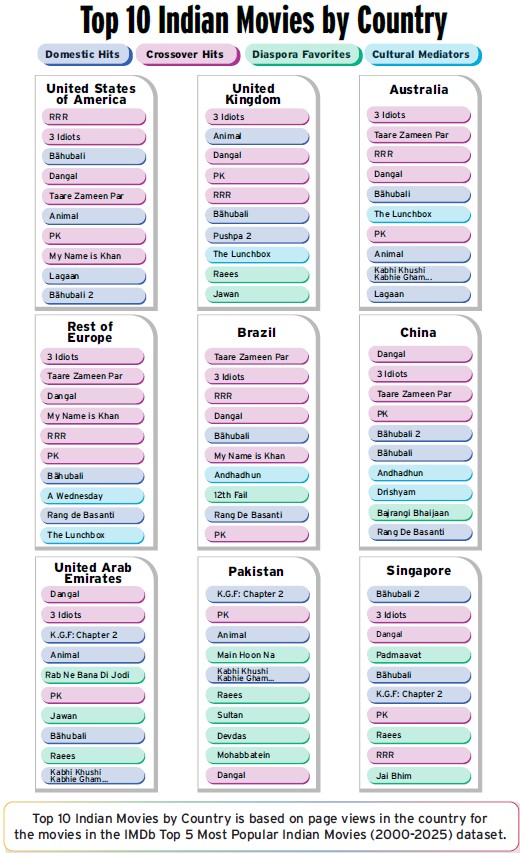
In conclusion, the report notes that rise of regional cinema is hard to miss, but more intriguing are the new forms of storytelling and cinematic experiences born from cross-industry collaborations. The old bond between star and fan may be fraying, but it is making space for a wider constellation, one that is more inclusive and shares the spotlight with many more voices and faces. And finally, the desire to define a pan-India identity lingers, but it may be the very multiplicity of voices that offers the greatest
opportunity to reach a diverse, global audience.
It sums up saying that the country’s unique advantage lies in its multiple thriving industries that serve as creative laboratories for genre experimentation, star-building, and cinematic innovation.

S VISWANATH is a veteran film critic who officiates as JURY at several National & International Film Festivals.





Leave a Reply