
S Viswanath
“In order to study critical practice as such, we must pretend that all theories are correct, all methods are valid, and all critics are right.” – David Bordwell – American film theorist & film historian.
“All in all, the creative act is not performed. by the artist alone; the spectator brings the work in contact with the external world by deciphering and interpreting its inner qualifications.” – Henri-Robert-Marcel Duchamp – French American artist, chess player, and inventor
“Deciphering the hidden meaning, in the apparent meaning,” and “unfolding the levels of meaning implied in the literal meaning”* has been made into an astute academic art by Bengaluru-based noted film critic and prodigious author Mr M K Raghavendra.
A Homi Baba Fellowship recipient as also National Award Winner for Best Film Critic Mr Raghavendra, as Mr Bordwell would observe, is an erudite scholar and commentator who shows “how critics interpret films with the ethnographer’s calm curiosity”* and made it his professional passion and prime pastime to illuminate and illustrate “how film critics build up interpretations and try to convince others that those interpretations warrant attention.”*
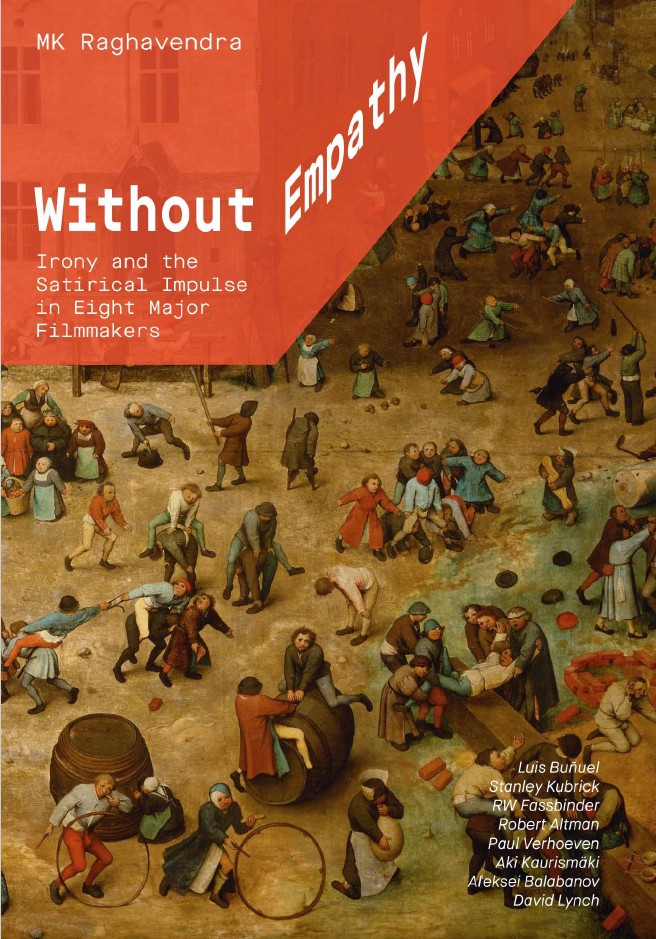
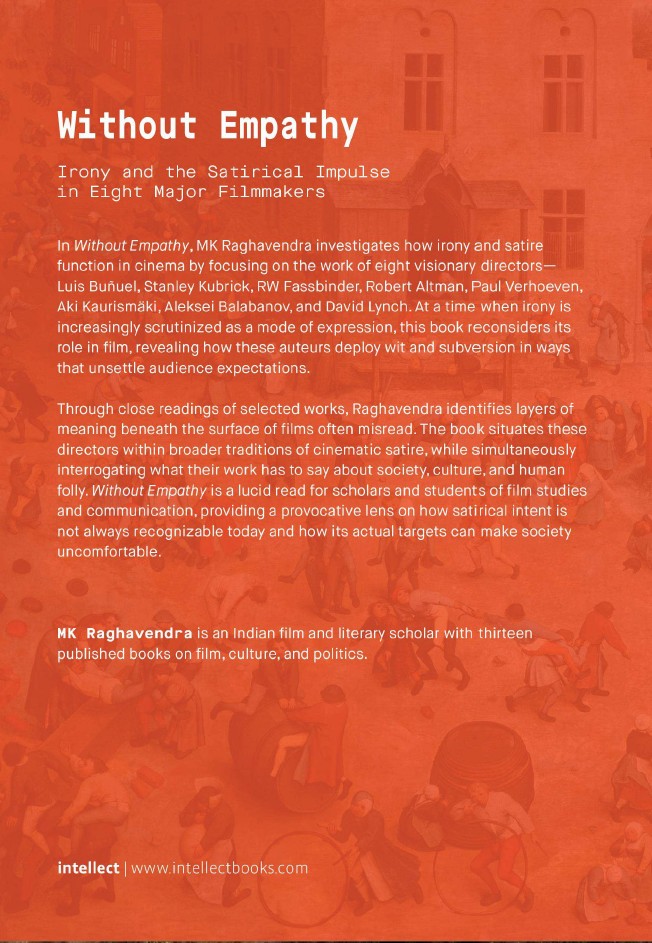
A fine and fitting example of his scholarship in his singularly, stupendous study of films to ferret out underlying meanings, messages and metaphors, is his latest work – Without Empathy – Irony & the Satirical Impulse in Eight Major Filmmakers a Bristol, UK based academic books publisher Intellect Books, wherein “the bulk of the book is devoted to proving it.”
Assiduously undertaking a “thematic explication” and “symptomatic reading” of the eight auteur filmmakers’ films, Mr Raghavendra, through his “reading” of them, exactingly extracts the “semantic” dimension of each of the films he discourses upon and dissects to “illuminate how, when, and to what extent” these films are profoundly laden with “irony and satirical impulse(s)” conveying deeper socio-political aspects of the periods they are set in and the state of the nation and its people as witnessed and portrayed by these great practitioners and pioneers of film art.
By embarking upon a “critical discourse” on these eight feted filmmakers, Mr Raghavendra, going beyond the “apparent, manifest, or direct meanings,” these films purvey to general audiences, with his critical eye, concerns himself with providing deeper “interpretation” of them thereby “revealing hidden, nonobvious meanings,” making a case out as to how these auteurs’ films thrive and throb with “irony and satire” in the nifty and nuanced narratives they have undertaken.
Backed by his years of studious and serious study of films and what they seek to mean and project beyond their otherwise peripheral narratives, Mr Raghavendra, with the “minutiae of the task at hand” like a surgeon with sharp scalpel gets behind the “façade” of these films to diligently “dig (in)to reveal (their) hidden meanings” their masterly makers have aesthetically crafted.
As an acclaimed film analyst, in his own right, Mr Raghavendra, having painstakingly poured over these films and their thematic narratives, culls out contexts and scenarios to reveal how they contain “veiled meanings” and, to state the obvious, how, “in these meanings lies the significance of the work or works,” that he has sought to exemplarily explore and elucidate upon for his entourage of eager-beaver readers, practitioners of film studies, film students and the last, but not the least, the academia itself, interested in understanding and studying cinema beyond its immediate obvious functional contours.
Providing a “fresh analogy” Mr Raghavendra through his “interpretation” and “close examination” of the films at hand goes on to prove how “cinema produces rich, complex experiences that could form the occasion for intellectual reflection and debate,” probing “how irony and satire function in cinema in the films of Luis Bunuel, Stanley Kubrick, R W Fassbinder, Robert Altman, Paul Verhoeven, Aki Kaurismaki, Alexsei Balabanov and David Lynch.”
By exploring and examining them, Mr Raghavendra “looks at the role of irony in films positing how these filmmakers deploy wit and subversion in ways to unsettle audience expectations.” Like an ardent film archaeologist, Mr Raghavendra, extracts and “identifies layers of meanings beneath the surface of films often misread. He situates these directors within the broader traditions of cinematic satire, and human folly. How satirical intent is now always recognisable today and how its actual targets can make society uncomfortable.”
From Luis Bunuel’s Unaffiliated Radicalism, Stanley Kubricks’ The Failure of Human Systems, R W Fassbinder’s The Original Sin, Robert Altman’s History, Ideology, and Generic Revision, Paul Verhoeven’s Satirical Impulse Goes Clandestine, Aki Kaurismaki’s Irony & Hopelessness, Aleksei Balabanov’s Collapsed Utopia and David Lynch’s Public Mythologies & Personal Fantasies, Mr Raghavendra, through structured chapters with thematic subtexts, illustrates and impresses upon “the various kinds of irony and how irony is a useful strategy to use when the theme dictates a certain emotional response.”
Asserting that the filmmakers examined “are all complex in terms of their cinematic achievements whose satirical/ironic aspects need to be excavated through interpretive – namely identify irony and satirical objective” Mr Raghavendra goes on to “decipher the strategm of these octet of filmmakers who have consistently used irony as an effective tool, and, whose films are so ambigious to be labelled as ‘satire’ exhibit the impluse consistently in a significant body of their works.”
According to Mr Raghavendra, “irony and satire are constantly used to say something contrary to the truth in order for the truth to be exposed to the general public for the purpose of awareness and change” and the interesting and intriguing facets in the films of these filmmakers “is that they same something they do not actually mean and expect people to understand not only what they actually mean but also their “filmmakers” attitude toward it.”
Mr Raghavendra examines, explores and enumerates on specific films “that are not openly satire but more ambiguous and inviting interpretations.” The idea, according to Mr Raghavendra, in the genesis of the book is to speak about “the satirical impulse in cinema” and “how satire and irony” are two sides of the same coin but for the fact that while “irony is a rhetorical trope,” satire, on the other hand, “is a genre” in itself.
The films, specifically culled and taken up for their thematic and textual exploration, on deeper examination, show how, when “something is apparently being said,” on deeper examination emerges as “something different from what it is taken to be.” With innumerable examples and explanations of the films taken up for “interpretational” treatment, Mr Raghavendra provides a new meaning and texture to the way we, as audiences, need to approach not just these films and filmmakers but rework our engagement with cinemas in a more informed and intellectual way rather than receive them for just perfunctory entertainment purposes.
Stating that the “films, with satirical strain, have been specifically chosen in order to get a sense of the filmmaker’s preferred targets or methods, and “the eight individual filmmakers studied in the book” says Mr Raghavendra “are not alike.” However, they all have a “kind of artistic sensibility that can be termed sardonic with a satirical bite.”
The common denominator that saw Mr Raghavendra club these eight together to put forth his case is “that where satire is usually transparent, these filmmakers’ films “can be described as puzzling, inviting interpretation.” The fact that these filmmakers evidentially “conceal their ironic or satirical intent,” kindled Mr Raghavendra’s “interest” in them, and “hence interpretive” in nature “to find evidence of it.”
Mr Raghavendra, taking a post-modernist stance towards our understanding and assimilation of cinema and its visual contents and contexts, has sought “to interpret the films based on their attitude toward their subjects – as mocking or debunking something and identifying that somethings.”
Mr Raghavendra has sought to “retrain the mystery of their work” and not perfunctorily “identify the satirical intent in it.” Further since they have been rather prolific in their cinematic output, Mr Raghavendra has sought to pick on only a handful of their works to press home his point. The approach, he further observes, being as varied and diverse given each of them “are markedly different” in their cinematic oeuvres and approach to cinema.
In summation, while the Introduction lays the framework as to what constitutes irony, satire and empathy, burlesque and parody, sarcasm, the burlesque, in the familiar lexicon parlances and authorial interpretations, in the Afterword of his highly instructive, illustrative and illuminating book, Mr Raghavendra says that the “overall effort” was “to make difficult films intelligible, with an eye on how audiences for whom the films were meant would likely understand them.”
“The emphasis,” he points out, has been to “speculate on each filmmaker’s artistic vision,” more pertinently, to get audiences “interested not only in the filmmakers but also in the(ir) ironic mode of expression, alongside the analysis through descriptions” of the films per se itself.
The Afterword also provides perspective peek into how each filmmaker has picked a particular segment of the stakeholders – say humankind, the social system and its authors, mythologies, the relationships between different social categories, and other attendant aspects to make their films in the schemata of socio-political apparatus they have operated in to give expression to their larger cinematic visions.
Besides, other added dimensions such as how these filmmakers approach the cinematic craft, their idioms, grammar, technical virtuosity in the films’ making be it ‘disjunctive’ music, visualisation, mise en scene, strategies to indicate irony such as understatement or cliché, use of expressionist spaces, the book’s exhaustive bibliography makes the tome a worthy work of academic excellence and a must possess reference research guide at bibliothèque of colleges and universities, as also those whose engagement with cinema forma a formal critical academic avocation.
- PAUL RICOEUR: Theory of Interpretation: An Instrument for Data Interpretation in Hermeneutic Phenomenology.
** DAVID BORDWELL: Making Meaning: Inference and Rhetoric in the Interpretation of Cinema.

S VISWANATH is a veteran film critic who officiates as JURY at several National & International Film Festivals.




Leave a Reply