
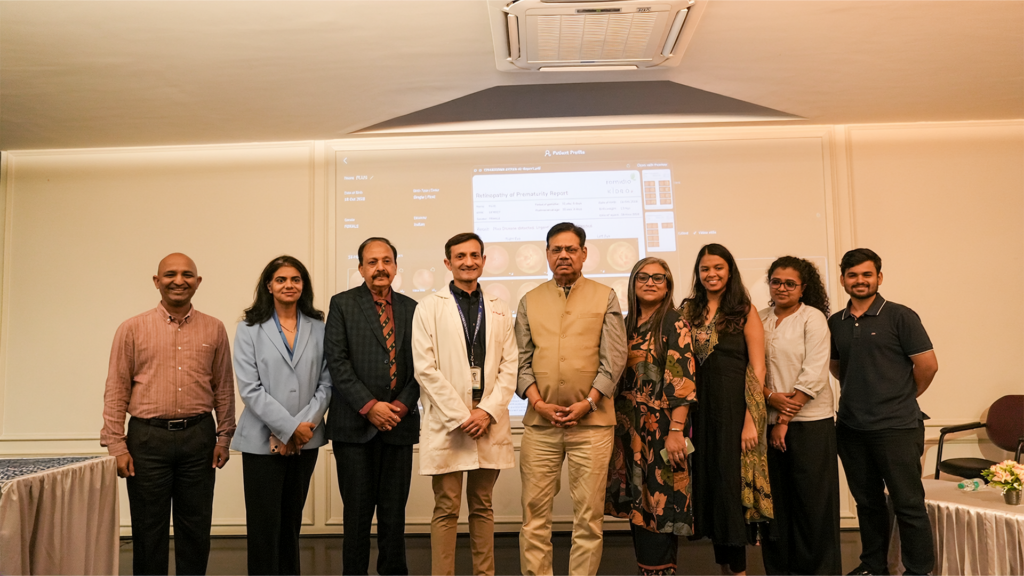
Bengaluru : Timely eye examinations can help prevent lifelong vision loss in babies born prematurely. The focus was a World Prematurity Day briefing by the Indian Retinopathy of Prematurity Society (iROP) and Narayana Nethralaya, Rajajinagar in Bengaluru. The event highlighted India’s efforts to expand screening for retinopathy of prematurity (ROP) and the approval of an AI tool that can help screening teams flag retinal images for specialist review.
An estimated 30 lakh babies are born annually in India, the highest number of any country. ROP affects the developing blood vessels in a baby’s retina and can progress before families notice any signs. Timely screening, follow-up and treatment can help prevent blindness.
The Central Drugs Standard Control Organisation (CDSCO) has approved the ROP AI tool, jointly developed by Remidio and KIDROP with funding from the Biotechnology Industry Research Assistance Council (BIRAC), Government of India. The software can analyse retinal images captured at the bedside and help screening teams flag images for specialist review.
Babies who weigh less than 2,000 grams at birth or are born before 34 weeks of pregnancy should have their first ROP examination within the first month of life. Some babies need an earlier examination, and the neonatal team may also recommend screenings for babies with other risk factors. On average, babies need three to four screening sessions before their eye care team can confirm that ROP risk is no longer present.
“Over the past decade, iROP has grown from a handful of mentors into a network of more than 300 specialists across the nation,” said Prof. Rajvardhan Azad, President of the Indian Retinopathy of Prematurity Society. “Our priority now is to raise awareness among parents, caregivers and policymakers and develop affordable ways to screen these babies across the country.”
Narayana Nethralaya’s KIDROP program has provided ROP care since 2007 through a public–private partnership with the Government of Karnataka. Its teams work in over 175 neonatal units across that state to bring retinal screening closer to where babies receive care.
“To date, KIDROP has screened 1,14,738 babies, recorded more than four lakh screening sessions and provided 6,493 treatments,” said Dr. Naren Shetty, Director, Narayana Nethralaya. “Treatment is provided free of charge to all babies born in government hospitals. We also follow these children over time to assess how well they see in daily life and monitor other complications associated with premature birth.”
“During the COVID-19 pandemic, we began taking the KIDROP model beyond Karnataka because we had seen it work here,” said Dr. Anand Vinekar, Founder Program Director of KIDROP and Principal Investigator for the ROP AI project. “With the Have A Heart Foundation and local clinical teams, we have now reached ten other Indian states. By October 2026, the partnership had screened more than 28,000 babies across India and it has since crossed 2,000 treatments. We are also working with teams in African nations. As new programs get started, we see a role for AI in shortening training and helping teams get images that need attention to a specialist sooner.”
“The AI developed for ROP screening is an important milestone in neonatal eye care. In collaboration with KIDROP, and with support from the Department of Biotechnology, Government of India, we have combined clinical expertise and indigenous engineering to create an offline solution that can detect and grade ROP, even in areas with limited internet connectivity” said Dushyantsinh Anopsinh Jadeja, Senior Vice President – AI & Software, Remidio.
For families, the first step is to ask the neonatal team before discharge whether their baby needs an ROP examination, when it should take place and where to go. Keeping each follow-up appointment matters because ROP can progress between visits, even when a baby’s eyes look normal.
About the Indian Retinopathy of Prematurity Society (IROP)
The Indian Retinopathy of Prematurity Society (IROP) brings together ROP specialists from across India to prevent blindness in premature babies. Founded in July 2016, it promotes uniform screening and treatment guidelines and shares best practice among clinicians. It also works to extend screening to underserved areas through training and technology, and supports research in ROP.
About KIDROP
KIDROP (Karnataka Internet Assisted Diagnosis of Retinopathy of Prematurity) is the tele-ROP programme of Narayana Nethralaya, Bengaluru. Launched in 2007 as a public-private partnership with the Government of Karnataka, it was India’s first tele-ROP programme and is among the world’s largest ROP screening networks. Trained technicians image babies in neonatal units, and specialists read the images remotely. KIDROP has screened more than 114,000 premature babies and treated over 6,650, and it supports ROP programmes in ten other states.
About Remidio
Today, the human eye is unlocking early insights into systemic health, and Remidio is at the forefront of this transformation. Remidio is a pioneer in AI-driven eye care, leading the shift from care of the eye to healthcare through the eye. As the first company to receive CDSCO approval in India for our adaptive ophthalmic AI, in addition to CE marking in Europe under Class II EU-MDR, we are redefining how diseases like diabetic retinopathy, glaucoma, and AMD are detected early, in close to patient contexts, while remaining confident of extending this to systemic disease detection such as CVD, CKD and liver diseases, in the future.
With CE-marked, FDA 510(k)-registered devices, our solutions have screened 16 million+ patients across 55 countries, integrating teleophthalmology and AI for fast, accurate diagnoses. Our innovative retinal imaging solutions ensure precision and efficiency in clinical workflows. Our journey began humbly – thanks to the chance meeting of our founder, with a mission driven ophthalmologist, who brought into focus the need for decentralizing eye testing with simple to use and affordable devices. That conversation, 15 years back, sparked a vision to make high-quality preventive care accessible to all. Guided by innovation, empathy, and a commitment to global impact, our journey is just beginning!



Leave a Reply