
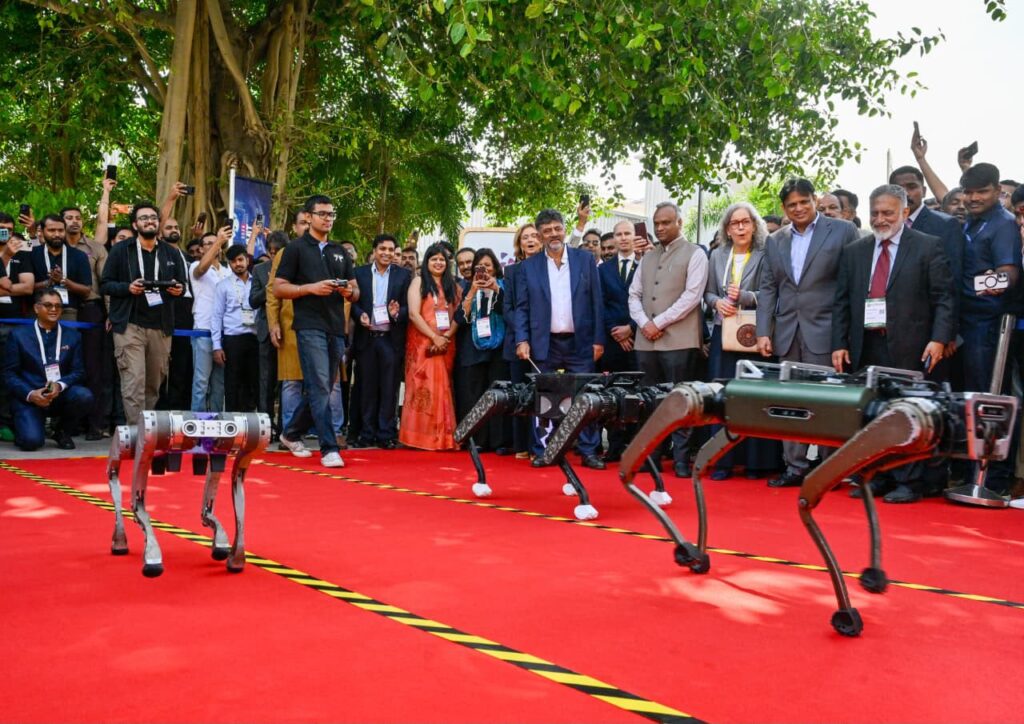
Bengaluru: Showcasing India’s growing capabilities in robotics, autonomous intelligence and Physical AI, a quadruped robot race was held ahead of the inaugural session of the 29th edition of Bengaluru Tech Summit 2026.
The demonstration featured four-legged robots developed by Indian robotics companies, navigating a specially designed track. The participating robots were required to complete one lap and return to the starting line, with the fastest robot to complete the circuit declared the winner. The event was organised as a technology showcase to highlight India’s progress in robotics and its growing ability to develop advanced autonomous systems.
General Autonomy Pvt. Ltd. emerged as the winner, with its four-legged robot, Param, recording a top speed of 4.3 metres per second. Designed to navigate challenging terrains, Param has potential applications across defence and entertainment. General Autonomy is a Physical AI company focused on developing quadruped and humanoid robots, with a primary emphasis on defence applications.
Another participant, Xterra Robotics, showcased its quadruped robot, Dhav, developed for industrial and security applications. Equipped with autonomous intelligence, Dhav is designed to undertake surveillance in hard-to-reach industrial locations and collect multiple forms of data.
Its capabilities extend to security surveillance, including detecting open doors and movement in monitored spaces. In the construction sector, Dhav can generate 3D maps of sites, monitor construction progress and identify structural defects such as cracks.
Strider Robotics’ quadruped robot, M3, secured third place in the race. Incubated at the Indian Institute of Science (IISc) in partnership with the defence sector, M3 was initially developed for defence applications and has since expanded into industrial surveillance, construction site monitoring, and safety and security applications.
A key differentiator of M3 is its payload capacity of approximately 45 kg, which is higher than that of Xterra Robotics’ Dhav. However, Xterra’s newer-generation robots offer comparable payload capacities.
The demonstration highlighted the expanding potential of indigenous robotics and autonomous systems, showcasing the capabilities of Indian companies in developing advanced robotic solutions for applications spanning defence, industrial operations, infrastructure and security. It also underscored the growing role of Physical AI in translating technological innovation into practical, real-world applications.




Leave a Reply