

S Viswanath
Fifteen films from as many as 13 countries are all set to vie for the prestigious and most coveted Golden Peacock & Silver Peacock awards, whose cash purse strings has been pushed up further this year, at the 57th International Film Festival of India, all set to roll out from November 20 to 28, across multiple venues at the India’s premier film festival’s permanent home – Goa. Indeed, a total prize money of ₹1.36 crore in all.
The film festival, which promises a veritable fiesta of films, from over 86 countries, showcasing multiple genres, thematic concerns, visual narrative styles and idioms, and languages, will see the India’s calendar cinema carnival providing a platform for cross cultural exchange and cinematic excellence bringing scintillating stories from every nook and niche of the globe, all united and knit by the universal and ubiquitous language of cinema bringing them together.
Indeed, while IFFI offers a veritable smorgasbord of cinematic treats under its various curated segments and sections celebrated the Seventh Art – the International Competition Section – the film festival’s anchor and principle piece de resistance showpiece that makes the film festival what it is, is indeed the section to catch up with for its distinctive cinematic voices and compelling creative stories from across the globe – wherein nearly 12 countries find pride of place from where the 15 films have been shortlisted for the festival awards. These countries include Argentina, Chile, India (Kannada, Malayalam & Marathi)Germany, Japan, Kyrgyzstan, Mexico, Netherlands, Portugal, Serbia, Spain, and Vietnam,
Now getting to the brass tracks, here then are a perspective pen sketches for the films in contention for the itinerant cinephile to mark up on his schedule and watch them as the festival kicks off celebrating the contemporary cinemas bringing “Stories Without Borders” as goes this year IFFI’s festival tagline of the world today.
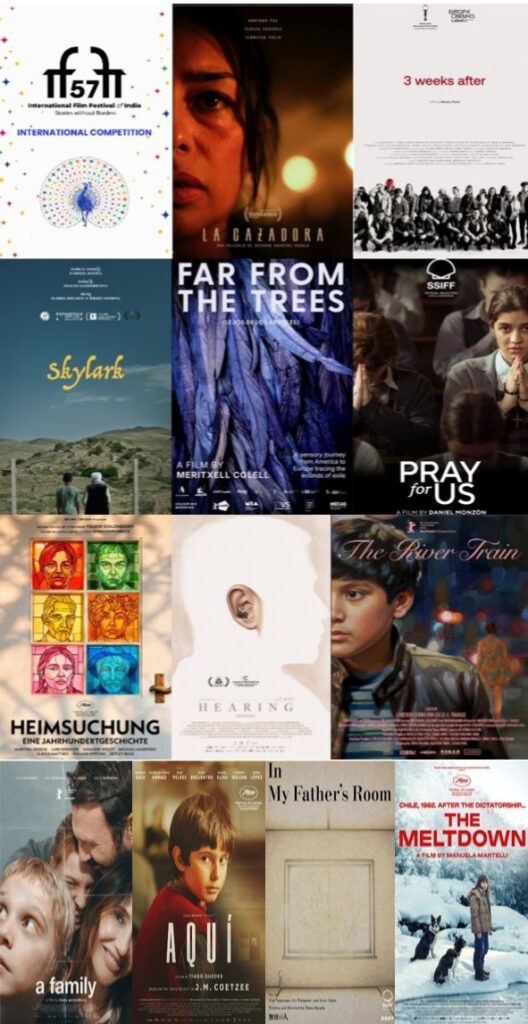
Mexican-American woman director Suzanne Andrews Correa’s Spanish film The Huntress (La Cazadora)set in Ciudad Juárez, Mexico, is loosely inspired by true events and real-life urban vigilante of “Diana, Hunter of Bus Drivers,”who targeted bus drivers responsible for assaults against women in Juárez.
In the border city of Juárez, México, where violence against women is perpetrated with impunity, an unlikely defender emerges with a desperate call for change.
The story follows Luz, Ciudad Juárez factory worker turned vigilante who attains the status of a legend, is an unlikely defender and mother who is pushed to extreme measures to protect her fourteen-year-old daughter and other young women factory co-workersand confront a culture of fear, intimidation, and police inaction.
Serbian film director Miroslav Terzić’s debut feature 3 Weeks Afterwinner of the Europa Cinema Label Award, Karlovy Vary International Film Festival, revolves around a group of teenagers who getstranded in an old, run-down hotel during a school excursion.
Tsota, still grieving the suicide of his best friend, Andrija, confronts his classmates and teachers for staying silent about the bullying Andrija faced. His accusations turn others against him and reveal hidden secrets and tensions within the group. When the person he trusts most betrays him, Tsota runs into the forest. There, something disturbing begins to happen, threatening to change everything by morning.
The third feature of the director, shows the unremitting exploration of young society that pulls no punches in displaying the infinite cruelty of children. We watch with dread, as Tsota, despised by the boys and girls alike, struggles to keep away from Milos and his cruel pranks. All we can do is watch, the horror slowly, brutally, unfolding. The film presents a deeply pessimistic view of the kids today, and shows simply how vacuous and empty-headed these teens truly are.
3 Weeks After takes us into the vulnerable world of adolescents, where innocence is mixed with cruelty. It also exposes the mechanisms of bullying in a society that closes its eyes at decisive moments when looking away is the last thing we should do.
Narghiza Dotieva, a Kyrgyz woman filmmaker’s Skylark, winner of the Grand Prix at Amur Autumn Film Festival, spotlights on the land disputes along the borders created after the collapse of the Soviet Union have long affected Central Asia.
Rooted in the legacy of Soviet-era border-making, the film follows Aibek, a teenager living in a Kyrgyz village near the Tajik border. Raised by his grandmother Ene, he balances family life with the tensions surrounding their village. When Ene dies, Aibek tries to fulfil her final wish to be buried beside her husband. However, the cemetery is now in Tajikistan, across a newly drawn border. As Aibek faces this challenge, his personal struggles reflect the wider divisions in family, land and history.He navigates the delicate balance between tender domestic life and the heightened tension of living near a border.
As tensions reignite, he’s caught between memories, duty, and his mother’s absence. Skylark is a coming-of-age story shaped by the partition of land and family.Aibek’s personal loss intertwines with political division, revealing a coming-of-age shaped by divided land, memory, and the search for one’s inner spiritual core.
Barcelona born, Spanish woman director Meritxell Colell’s Far From The Trees(LEJOS DE LOS ÁRBOLES)winner of Best Film Award, FIPRESCI at Locarno Film Festival, revolves around Adela, a Mexican sound artist, who travels from the jungle to the Peruvian Andes alongside Lucho, a guide and translator.
Following the legacy of her grandfather, a Republican exiled in Mexico, she weaves a sound map of endangered languages. When the fear of death breaks in, reality fractures. The journey turns into an intimate passage that confronts her with memory, grief, uprooting and identity.
Weaving together sound recordings, archival footage, and flashbacks, the film builds a poetic narrative about memory, loss, and belonging, the film is a moving story of grief and reckoning that follows a trail of voices and memories.
Pray For Us (Ruega Por Nosotras), the Spanish film by Daniel Monzón, is set in 1974 in Spain, and follows 19-year-old Ana. Her wealthy parents consider her rebellious after she sneaks out to a concert. Her father commits her to a reformatory run by Franco’s Women’s Protection Board for girls labelled as “morally deviant.”
Under the strict control of nuns, she faces harsh rules, punishment and abuse. Struggling to survive, Ana finds hope through her fellow inmates. She forms a close friendship with Sole, a lively village girl. Their strong bond gives Ana the courage and emotional strength to face the institution’s cruelty and oppressive rules and endure a harsh disciplinary and labour-driven regime.
The film exposes the abuses of the Patronato de Protección a la Mujer (Women’s Protection Board), a state-backed, church-run institution that operated from 1941 to 1985 to confine and “reform” tens of thousands of women and single mothers.
Volker Schlöndorff’s German film Visitation aka Heimsuchung(Eine Jahrhundertgeschichte) shows how alakeside house by a lake near Berlin witnesses a century of change. It sees the rise of Nazism, the destruction caused by war, Soviet rule, the reunification of Germany, and the beginning of a new era.
Over the years, different people live in the house, including a Jewish family, an ambitious architect and his wife, a writer with strong ideals, and her granddaughter. Their lives reflect the struggles and changes of each period. As generations come and go, the house remains a place of shelter and comfort amid years of conflict and uncertainty, tells the story of twelve people who dream of a home.
Based on the novel by Jenny Erpenbeck, the film is an intimate portrait which reflects on 100 years of German history. The only character who never ages is the gardener. Keeping his mouth shut throughout the film, he tends to the flowers, bushes and trees while the house and its garden cottage by the side of a lake are built, inhabited and taken over by people across the generations.
A farmer’s daughter drowns herself in the lake. A Jewish textile manufacturer moves in with his family. An architect and his wife throw parties with champagne and crayfish only to be replaced later by a communist writer. Her granddaughter is the film’s narrator. With a static camera acting like its visual mouthpiece, the house, like the gardener, watches the comings and goings stoically.
Vietnamese filmmakerLê Bảo’s Hearing (Thính Giác)follows Ninh living with his mother and misses his ex-wife Ngoc and their young children. As a mechanic who installs decibel meters in public spaces and homes, Ninh observes the silence that haunts relationships. Ninh hopes his separated parents will make peace and start talking again. Afraid of losing the people he loves, he must learn to face the unexpected changes life brings.
Lê Bảo’s mysterious and immersive second feature follows the estrangement of two generations of a Vietnamese family and the strange audiovisual phenomena haunting them. Compared to Apichatpong Weerasethakul,over its finely paced two-hour running time, its first and second halves correspond to explaining Ninh’s painful and fractured family situation, before switching quite smoothly to the sensory experience.
Director duo Lucas A. Vignale&Lorenzo Ferro’s The River Train (El Tren Fluvial)is a coming of age film which showcases nine year-old Milo who lives in a remote village in Argentina, where he trains as a Malambo dancer. But his true dreams lie elsewhere – he longs to ride trains and explore Buenos Aires, the city he has only seen in movies. To break free from his small world, he must dare to embark on a new journey: loneliness.
In an isolated riverside village in Argentina, nine-year-old malambo prodigy Milo secretly boards a train to Buenos Airesto escape his father’s strict expectations. Milo is a prodigy at the gaucho folk dance, with its whipcrack footwork and machismo. During the journey, he encounters unfamiliar people and places that challenge his understanding of family, tradition, and the world beyond his rural upbringing.
At once naturalistic and fanciful, with a sparkle of mischief animating nearly every scene, this debut feature is guided by a rambunctious spirit that exhausts itself only as the end credits roll.
Winner of SpecialMention, Youth Jury Generation 14 Plus Best Film, at Berlinale Film Festival, Tokyo born, London based Dutch filmmaker Mees Peijnenburg’s A Familyis a coming of age drama that revolves around siblings Nina and Eli struggling with anger, confusion and the need to be understood with their parents caught in divorce.
Each retreats into their own world, while dealing with divided loyalties and emotional pain. Told from both their perspectives, the story explores how family relationships can break apart yet find a way to heal, despite the distance, hurt and silence that separate them.A messy divorce and custody battle seen through the distinct, mirrored perspectives of two teenage siblings, 16-year-old Nina and 14-year-old Eli, as they navigate grief, loyalty, and the breakdown of their family home.
Portuguese filmmakerTiago Guedes’ Aqui(Here)takes viewers to a dystopian universe, where people begin their lives without any memories of the past, Simón takes care of David, a child he meets while travelling to this new world. Believing the boy needs a mother, he finds Inés and feels she is the right person. She agrees, and the three slowly form an unusual family.
However, society expects everyone to follow its rules, while David refuses to fit in. Through his imagination and desire for freedom, he challenges these expectations. Simón and Inés must learn that raising a child is an uncertain journey, full of questions and without easy answers.
We watch how an improvised family navigates uncertainty in Tiago Guedes’s three-hour lengthy, challenging adaptation of JM Coetzee’s so-called ‘Jesus trilogy’ that consistently leaves the audience trying to decipher its riddles. For audiences willing to make peace with the picture’s overt preciousness and inconsistent storytelling, Aqui offers substantial rewards. A film that occupies an uneasy alternate reality in which an adult man and a boy who are strangers to one another fall into a traditional father-and-son dynamic.
One of Japan’s bestselling writers, Maha Haradabrings one of her own short stories – An Unnecessary Man – to the screen in her directorial debut feature In My Father’s Room(Muyou no Hito) winner ofFIPRESCI Award at San Sebastian Film Festival andAteneo Guipuzcoano Award at San Sebastian Film Festival, follows Satomi, a worker at an art museum.
One day, she receives an envelope containing a mysterious key to a room that belonged to her late father, who died a month ago. Curious about the key, she begins to explore the final days of his life. Although he seemed forgotten by society, he found comfort in words, the art of tea and the small beauties of everyday life. As Satomi follows the traces he left behind, she gradually discovers the world he lived in and learns to understand him better.
A man seemingly left behind by society, yet sustained by a quiet devotion to words, the art of tea, and subtle beauty. Through the traces of his solitude, Satomi slowly discovers the quiet grace of the world he inhabited.Through a minimalist approach, In My Father’s Room transforms absence into presence and transformation.
Manuela Martelli’s Chilean woman filmmaker’s feature The Meltdown (El Deshielo)set in 1992 set in Chile in 1992—shortly after the end of the Pinochet dictatorship—at a remote Andean ski resort, is a slow burn mystery thriller that follows nine-year-old Inès, who is staying at her grandparents’ hotel.
She befriends Hanna, a 15-year-old German skier. When Hanna suddenly disappears, the search to find her reveals secrets and hidden truths, pulling Inés into a web of dark secrets, family complicity, and buried national history.Seen through a child’s eyes, the coming of age mystery exposes the cracks in an apparently sheltered world, where the key lesson is to keep what you know to yourself, while truthis less important than the ability to anticipate how people will react to it.





Leave a Reply