
Union Minister Dr. Jitendra Singh Pushes for City-Based Scientific Clusters, Stronger Synergy and Wider Public Outreach of India’s Scientific Achievements
Minister Seeks Greater Synergy Among Science Ministries and Departments to Take Scientific Achievements Closer to the People
‘Vigyan Ki Baat’ to Deepen Public Connect with Science; Second Edition on September 26 to Focus on Foundational Physical Sciences and Quantum Technology
Dr. Jitendra Singh Reviews Digital Library of Scientific Achievements, CSIR@85 and ESTIC-2026 Preparations
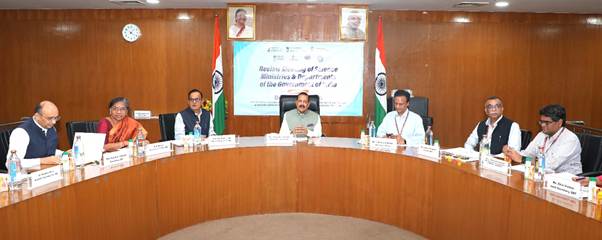
Union Minister of State (Independent Charge) for Science & Technology and Earth Sciences, and MoS in the Prime Minister’s Office, Personnel, Public Grievances and Pensions, Atomic Energy and Space, Dr. Jitendra Singh, today called for stronger coordination among Science Ministries and Departments, development of city-based scientific clusters and wider public outreach of India’s scientific achievements.
Dr. Jitendra Singh also reviewed the just concluded ‘Swachh Sagar Surakshit Sagar’ 5.0 and the scale of public participation generated by the campaign. Conducted from September 12 to 19, 2026, the coastal clean-up covered 231 locations across 13 States/UTs, with 15 lakh people taking the Ocean Conservation Pledge.
The Monthly Review Meeting of Scientific Ministries/Departments, chaired by Dr. Jitendra Singh, was attended by Principal Scientific Adviser to the Government of India Prof. Ajay Kumar Sood; Secretary, Department of Biotechnology, Dr. Rajesh Gokhle; Secretary, Department of Science & Technology, Prof. Umesh V. Waghmare; Secretary, Department of Scientific & Industrial Research, Prof. N. Kalaiselvi; Secretary, Ministry of Earth Sciences, Dr. T. Srinivasa Kumar; and CEO, Anusandhan National Research Foundation (ANRF), Dr. Shivkumar Kalyanaraman, along with senior officials of the concerned Ministries, Departments and scientific institutions.
Dr. Jitendra Singh emphasised that India’s scientific institutions should work with greater synergy and visibility, with city-based scientific clusters helping bring together institutions and stakeholders working in related areas. He also called for continuous identification and showcasing of new and impactful scientific achievements, so that important work emerging from laboratories and institutions reaches a wider section of society.
The Minister called for strengthening the communication ecosystem across Science Ministries and Departments so that significant achievements in science, technology and innovation are communicated in a timely, accessible and engaging manner. The emphasis was on taking scientific achievements beyond institutional boundaries and creating a stronger connect between India’s scientific ecosystem and citizens.
The meeting reviewed progress on the proposed Digital Library of Scientific Achievements, envisaged as a common repository of videos and other communication products showcasing the work of India’s scientific institutions. CSIR-NIScPR is working as the nodal institution for developing the institutional mechanism and implementation framework for the Digital Library, while modalities for participation and resource pooling among the concerned Ministries and Departments are being worked out.
The review also took stock of the ongoing digital outreach efforts of DST, DBT, DSIR/CSIR and MoES, including the creation and dissemination of short-form content highlighting significant scientific and technological achievements. The coordinated approach is aimed at giving wider visibility to the work of scientific institutions and ensuring that important developments are communicated beyond the scientific community.
The Minister called for sustaining this momentum of public participation and strengthening the connection between scientific awareness, environmental responsibility and citizen action. The campaign brought together citizens, students, coastal communities, government agencies, scientific institutions and volunteers in a nationwide effort for cleaner coasts and safer seas.
The meeting also reviewed the progress of ‘Vigyan Ki Baat’, the monthly lecture series launched by the Department of Science & Technology to showcase the work of India’s autonomous scientific institutions and take their achievements to a wider audience. The second edition is scheduled for September 26, 2026, featuring the Director of the S.N. Bose National Centre for Basic Sciences, with the session focusing on advances in foundational physical sciences and quantum technology.
The inaugural edition of ‘Vigyan Ki Baat’, held on August 29, 2026, witnessed participation of more than 7,500 people from academia, research organisations and industry. The series is envisaged as a regular platform for communicating cutting-edge research, technological innovation and their national relevance, while strengthening the public interface of India’s scientific institutions.
The meeting also reviewed preparations for CSIR@85, including the programme scheduled for September 25, 2026, as well as updates relating to ESTIC-2026. The discussions covered programme preparedness, coordination and effective communication of the achievements and contributions of India’s scientific institutions.
The review further covered mechanisms for inter- and intra-ministerial coordination, including thematic interactions and cluster-based engagements aimed at promoting collaboration and synergies across the scientific ecosystem. Regular exchange among the communication teams of the scientific Ministries and Departments was also emphasised to facilitate coordinated outreach and wider dissemination of scientific achievements.
Dr. Jitendra Singh stressed the importance of ensuring that India’s advances in science, technology and innovation are visible, accessible and relevant to society, with stronger institutional collaboration, coordinated communication and sustained public engagement forming an integral part of the scientific ecosystem.
The meeting concluded with emphasis on taking forward these initiatives in a coordinated manner, strengthening the interface between scientific institutions and the public, and ensuring wider visibility for India’s scientific achievements and innovations.




Leave a Reply