
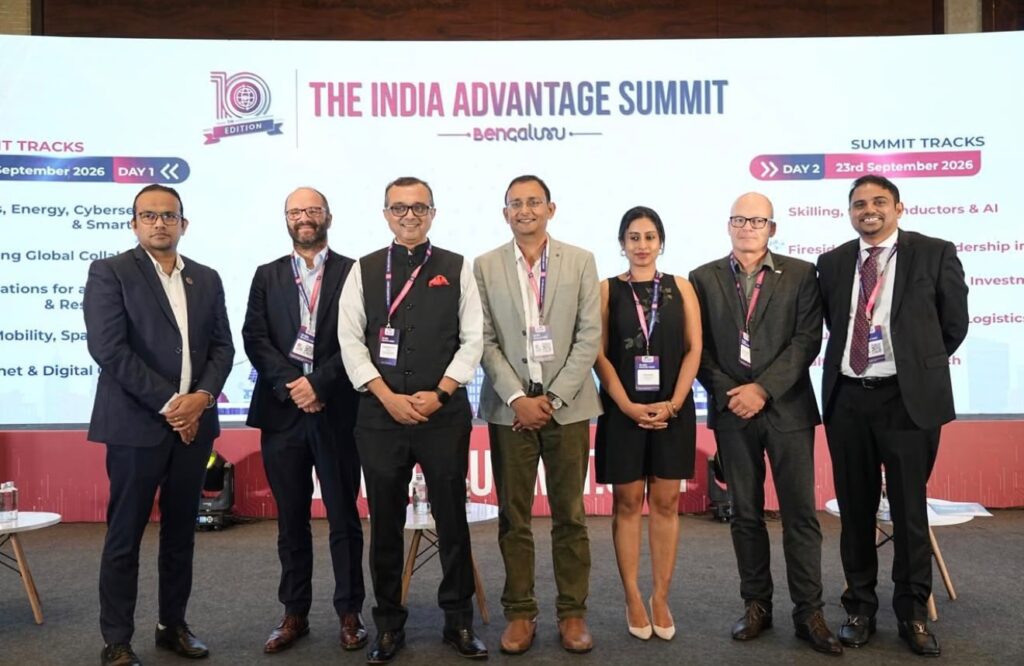
Electric air mobility, hydrogen-powered commercial vehicles, indigenous drone technology and shared transport solutions take centre stage at TIA Summit
Bengaluru: The future of mobility is rapidly moving beyond conventional road transport, with electric air taxis, hydrogen-powered vehicles, autonomous drones and technologyenabled shared mobility emerging as important components of the next-generation transportation ecosystem, speakers said at the 10th edition of The India Advantage Summit (TIA Summit) 2026 in Bengaluru.
The session on “Mobility, Space & Drones” brought together innovators, technology companies, academia and mobility operators to examine how transportation is evolving across land, air and space, while addressing congestion, decarbonisation, energy requirements, safety and last-mile connectivity. Ms. Payal Satish, Chief Commercial Officer, Sarla Aviation, outlined the company’s work on electric vertical take-off and landing (eVTOL) aircraft and the potential for air taxis to transform urban mobility. She said India, and particularly highly congested cities such as Bengaluru, Mumbai and Pune, could become an important market for advanced air mobility.
Sarla Aviation has moved from concept development to testing its half-scale prototype and is working towards having eVTOL aircraft operating in the Indian subcontinent by 2030. The company is developing aircraft designed to carry six passengers and one pilot, with the first variant planned to be fully electric. Sarla Aviation is also working with the Indian defence ecosystem. Professor Lutz Fügener, Professor of Advanced Mobility Design and Programme Director, Design and Mobility, Hof University of Applied Sciences, Germany, highlighted the changing role of design in mobility. He argued that design should be viewed as a productive force, bringing together engineering, technology and user experience.
He also highlighted Hof University’s new approach of bringing designers and engineers together to work on mobility projects, including through AI-enabled design processes. One of the key sustainability themes was the exploration of alternative energy storage, including compressed-air energy systems, alongside the development of new mobility products. The session also showcased India’s growing capabilities in indigenous drone technology. Mr. Paul Antony and Mr. Kartik Matad, Co-founders of Tolle Labs, spoke about the need to build reliable and secure indigenous technology for the drone ecosystem. The company is developing its own flight controllers, telemetry, video transmission and other components, while working on applications ranging from surveillance and mission-critical deliveries to counter-drone systems. Tolle Labs also highlighted its work on a fully indigenous nano drone and a larger platform designed for mission-critical payload delivery, reflecting the growing emphasis on building critical technology capabilities within India.
The discussion then moved to hydrogen and electric mobility, with Dr. Till Kaz, Founder and CTO, IONTRAK, and Mr. Sitaram, Head – India Operations, IONTRAK, highlighting the role of hydrogen fuelcell technology in decarbonising commercial and heavy-duty transportation. Dr. Kaz said transport contributes significantly to global carbon emissions and argued that the question is no longer whether transport can be decarbonised, but how quickly. IONTRAK is working on fuel-cell and electric powertrain solutions for commercial vehicles, including retrofitting existing vehicles and integrating hydrogen range extenders with battery-electric platforms. The company sees particular potential for hydrogen in heavy trucks, buses, construction and other specialised vehicles, where charging infrastructure, vehicle range and energy requirements present challenges. Mr. Jinu Mathew Oonnonny, Business Head – E2E, VTT Mobility Private Limited, brought the discussion back to Bengaluru’s everyday mobility challenge, highlighting the role of shared employee transportation and fleet electrification. VTT Mobility currently operates a fleet of around 6,000 vehicles, with approximately 25% already electric, serving around 20,000 users daily. The company is targeting zero tailpipe emissions by 2035 and is exploring fleet retrofits, renewable energy partnerships, hydrogen technologies and demand consolidation to reduce the number of vehicles required to transport the same number of people.
Key Takeaways from the Session
• Air taxis move closer to reality: eVTOL technology is progressing from concept to prototype testing, with India emerging as a potential major market for advanced air mobility.
• Mobility must become cleaner: EVs, hydrogen fuel cells, alternative energy systems and fleet retrofits are emerging as complementary pathways to decarbonise transport.
• Bengaluru’s congestion creates an opportunity: Severe urban congestion is accelerating the search for new modes of mobility, including air taxis and shared transportation.
• Indigenous drone capabilities are expanding: Indian companies are developing critical drone components, secure systems, autonomous platforms and counter-drone technologies.
• Hydrogen has a role in heavy mobility: Speakers highlighted hydrogen fuel cells particularly for trucks, buses and specialised commercial vehicles where battery-only solutions may face range and charging constraints.
• Shared mobility can reduce vehicles on the road: Consolidating transport demand and improving fleet utilisation can help move more people with fewer vehicles.
• The future is integrated: The discussion pointed towards a mobility ecosystem connecting road, air, drones, clean energy, digital technology and eventually space.
The session reinforced the wider theme of the TIA Summit that mobility is no longer limited to moving people from one point to another, but is evolving into an integrated ecosystem connecting people, goods, information and assets across land and air, supported by new technologies and energy systems.
The 10th edition of The India Advantage Summit 2026 is being held on 22–23 September at Conrad Bengaluru, bringing together global leaders, policymakers, diplomats, technology companies, innovators and industry experts.




Leave a Reply