
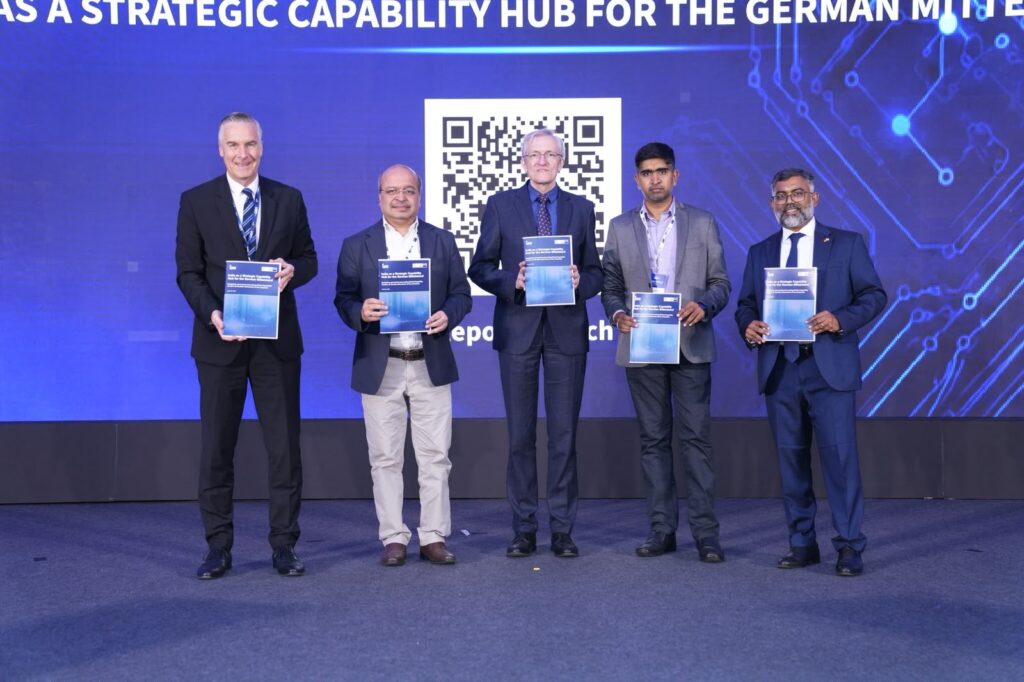
Indo-German Engineering Summit 2026 highlights growing opportunities for German companies in AI, advanced manufacturing, engineering and sustainable supply chains; Bengaluru emerges as a strategic partner for Germany.
The India-EU Free Trade Agreement is expected to create a new dynamic in India-Europe trade and drive greater German investment into India, Jan Noether, Director General, Indo-German Chamber of Commerce, said at the inaugural Indo-German Engineering Summit 2026 in Bengaluru.
Speaking on the sidelines of the Summit, Noether said the FTA would open the door for a more intense business relationship between India and Europe, but stressed that increased trade must be accompanied by greater investment in India.
“The FTA opens the door for a more intense business relationship. However, that has to be followed by investments in India. German companies have to improve their foothold in India in order to be long-term competitive. India is a very competitive market. The world meets in India.”
The comments came as German and Indian business leaders, engineering experts, technology companies, startups and industry stakeholders gathered for the first edition of the Indo-German Engineering Summit 2026, organised by the Indo-German Chamber of Commerce (IGCC) under the theme “Co-Innovate. Co-Engineer. Co-Create.”
From trade to deeper industrial partnerships
A key focus of the Summit was the opportunity to move the India-Germany relationship beyond conventional trade and investment towards joint engineering, technology development, manufacturing, innovation and global value creation.
Noether highlighted the particular opportunity for Germany’s Mittelstand — its mid-sized companies — to expand their presence in India and contribute to building stronger industrial capabilities and sustainable supply chains.
“We still have to import quite a few components and materials in order to get our industrial setup positioned. German Mittelstand companies can contribute to closing these gaps and create a lot of opportunities when it comes to building sustainable supply chains in India.”
India’s talent advantage meets German industrial expertise
The Summit also highlighted the complementary strengths of the two ecosystems. While Germany brings engineering depth, industrial expertise, precision and experience, India offers talent, entrepreneurship, speed, technology capabilities and scale.
Noether said India’s talent would be particularly important as industrial growth increasingly converges with AI and advanced manufacturing.
“We need the speed, the passion and the wonderful education and capabilities that are available here. Everything will increasingly revolve around AI development, smart manufacturing and advanced manufacturing. If that comes together with the experience of German mid-sized companies, new initiatives will be unveiled.”
Across the Summit, industry leaders discussed how AI, automation, digital technologies and advanced engineering can improve productivity, quality and resilience, while emphasising that technology must translate into measurable business outcomes.
Bengaluru positioned as a strategic hub
Bengaluru’s combination of global capability centres, engineering talent, technology companies and entrepreneurship was identified as a key strength for deepening the India-Germany relationship.
Noether said the city’s ecosystem and its ability to bring people and teams together make Karnataka strategically important for German companies.
“It is the spirit, the wonderfully positioned GCCs, the entrepreneurship, and the intent to form teams and build initiatives together.”
He also called for greater cross-border engagement, including investment delegations to Karnataka and stronger outreach by Karnataka to Germany.
“We have to bring people together. Every kind of relationship is based on people coming together, finding common ground, accepting each other, respecting each other and forming trust with each other.”
Building the next generation of India-Germany partnerships
The Summit discussions also emphasised the importance of trust, localisation and long-term collaboration, with speakers calling for deeper partnerships between German companies, Indian suppliers, technology companies, startups and engineering teams.
The opportunity extends across established sectors such as automotive and chemicals, while growing areas including sustainability, engineering, AI, smart manufacturing and advanced manufacturing offer new avenues for collaboration.
With German companies increasingly looking to India not only as a market but as a source of engineering and technology capabilities, the Summit reinforced Bengaluru’s potential to serve as a bridge between German industrial expertise and Indian talent, technology and entrepreneurship.
The Summit concluded with a call to translate the growing India-Germany relationship into greater investment, stronger supply chains, deeper engineering partnerships and joint innovation for global markets.





Leave a Reply