
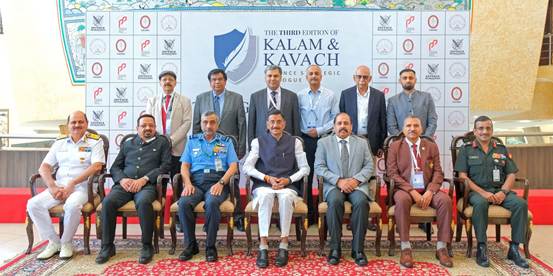
“A nation’s strength will increasingly depend on how quickly its defence forces, laboratories, and industries think & act as one,” said Raksha Mantri Shri Rajnath Singh as he underscored the importance of self-reliance and jointness to secure strategic autonomy & remain future-ready for emerging security challenges. He was addressing policy makers, military leadership, defence industry stakeholders, diplomats, innovators, start-ups, academia & strategic experts through a video message during Kalam & Kavach 3.0, a defence strategic dialogue organised at Manekshaw Centre, New Delhi on May 14, 2026.
Raksha Mantri emphasised that the battlefield of tomorrow will reward those who can shorten the time between an idea, a prototype, and operational deployment. He added that national security cannot rest on old assumptions in the current geopolitical tensions, ongoing conflicts, cyber threats, supply-chain vulnerabilities, and new forms of hybrid warfare. “National security demands our preparedness, resilience, innovation, and strategic confidence,” he said.
Shri Rajnath Singh described self-reliance as not only an economic goal, but also a strategic necessity, asserting that a nation that depends excessively on others for critical defence capability remains vulnerable in times of crisis. “We must design, develop, produce, maintain, and upgrade key systems within our own national ecosystem. That is how we will be able to secure our strategic autonomy,” he said.
Underlining the need to achieve jointness, Raksha Mantri stated that modern warfare does not respect silos, and success will depend on how efficiently “we bring together our defence forces across land, sea, air, cyber, and space.” It will also depend on how closely laboratories, industries, start-ups, policymakers, and military institutions work together, he said.
Delivering the inaugural address, Raksha Rajya Mantri Shri Sanjay Seth highlighted the significance of Kalam & Kavach as a platform where ideas converge with national purpose. He highlighted that Kalam represents knowledge, science, research and innovation, while Kavach symbolises protection, resilience and the responsibility of safeguarding the nation.
Emphasising the rapidly evolving nature of warfare, Raksha Rajya Mantri stated that threats today extend beyond traditional domains, necessitating preparedness backed by foresight. He reiterated the importance of JAI (Jointness, Aatmanirbharta & Innovation) as articulated by Prime Minister Shri Narendra Modi, as central to India’s future security architecture. He asserted that India’s road to Viksit Bharat @ 2047 will pass through joint military capability, indigenous manufacturing-led innovation and global partnerships.
Shri Sanjay Seth stated that all efforts are being made to create a nation which is technologically advanced, strategically confident and self-reliant in defence capabilities. India firmly believes that global security and progress are strengthened through cooperation, trust and shared innovation, he told the foreign delegates present on the occasion.
Referring to recent operational achievements, Shri Sanjay Seth described Operation Sindoor as a defining example of New India’s capabilities, highlighting the role of indigenous systems, speed of response, technological integration, and seamless jointness among the Defence Forces. He noted that such operations reflect the nation’s zero-tolerance approach towards terrorism and its firm resolve that those supporting terrorism will be held accountable.
On the progress achieved due to the steps taken by the Government to strengthen the country’s defence sector, Shri Sanjay Seth stated that defence exports, which were a meagre Rs 686 crore a decade ago, have skyrocketed to a record high of Rs 38,424 crore today. He added that annual defence production has touched an all-time high of Rs 1.54 lakh crore in Financial Year 2025-26. He reaffirmed the Government’s resolve to achieve the target of Rs 50,000 crore of defence exports and Rs 3 lakh crore of defence production by 2029-30.
In his special address, Chief of Integrated Defence Staff to the Chairman Chiefs of Staff Committee (CISC) Air Marshal Ashutosh Dixit stressed the importance of indigenous innovation in securing India’s strategic future. He stated that India’s defence capability must be built on self-reliance and the ability to create cutting-edge technologies.
Kalam & Kavach 3.0, themed ‘Taking JAI Forward With I²’, featured wide-ranging deliberations on India’s evolving defence and national security landscape. The conclave focused on advancing India’s journey towards Aatmanirbharta through innovation, industrial partnerships, capability development, and future-ready defence technologies.
Various industry representatives underlined the importance of a robust indigenous manufacturing ecosystem capable of supporting surge capacity and modern conflict requirements, while positioning Indian industry as globally competitive. They highlighted the importance of collaboration among nations, industry, innovators, and academia in building resilient, technology-driven defence ecosystems, noting India’s growing potential as a global hub for aerospace and security innovation.
The conclave witnessed participation from senior representatives of the Ministry of Defence, HQ Integrated Defence Staff, members of the National Security Advisory Board, senior officers from the Armed Forces, Defence Attachés, scientists, industry leaders, startups, academia, and international partners.
The event comprised multiple high-level sessions, keynote addresses, and panel discussions focusing on critical areas including AI-enabled warfare, autonomous systems, hypersonic technologies, quantum-enabled Command, Control, Communications, Computers, Intelligence, Surveillance, and Reconnaissance (C4ISR), defence manufacturing scale-up, aerospace advancements, and strategic partnerships.
The conclave also featured an exhibition from Indian private industry, MSMEs, and startups in advancing defence innovation.




Leave a Reply