
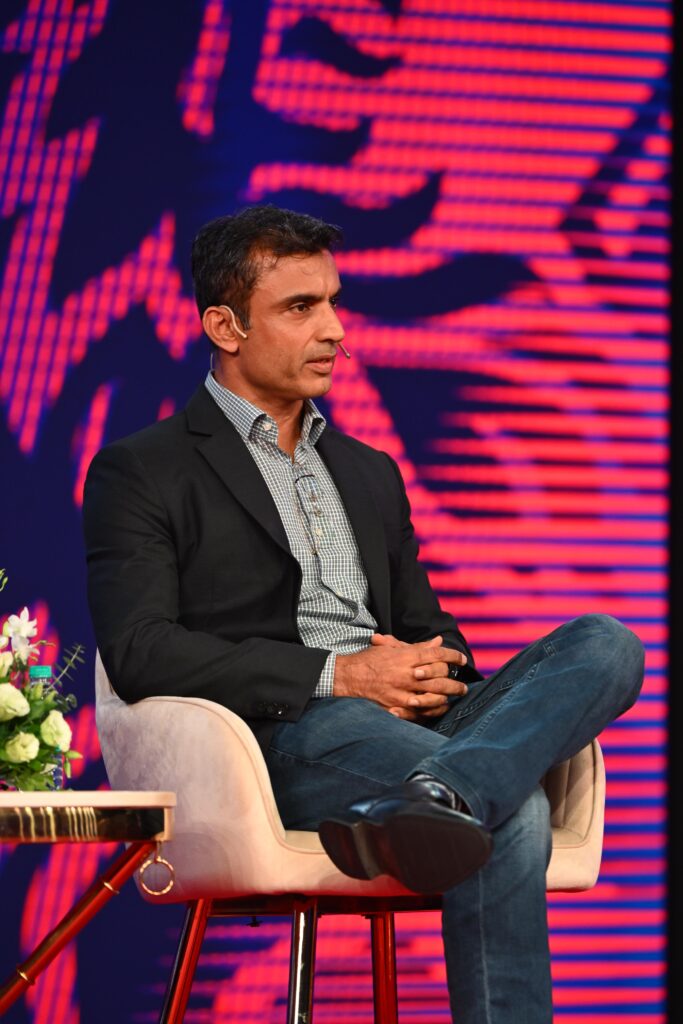
Bengaluru : Conversations around the commercial evolution of the IPL, India’s Olympic ambitions and enhancing fan experience took centre stage at the third edition of the RCB Innovation Lab Indian Sports Summit Powered by Leaders, held at the Padukone Dravid Centre of Excellence, Bengaluru, on Tuesday.
The Vision Behind Aditya Birla Group’s RCB Investment
Speaking about the commercial evolution of the IPL and long-term investment in sport, Sandeep Agrawal, Head – Group Corporate Finance, Aditya Birla Group, reflected on the company’s entry into the league.
“RCB is a franchise a lot of us have personally been looking forward to being associated with. RCB’s overall fan engagement is simply at a different level. Those opportunities come literally once in a decade, and we felt this was the opportunity.”
On the appeal of owning a Women’s Premier League franchise as well, he added, “The growth we have seen in the WPL has been incredible. Globally, sports viewership has materially shifted in terms of how many women are watching. The overall market used to be less than 5% women till about 2017.
Globally, it has gone up to about 25% now. Clearly, owning the women’s franchise as well was a very important consideration for us.”
India’s Olympic Ambitions and Sporting Transformation
In another panel, Hari Ranjan Rao, IAS, Secretary, Department of Sports, Government of India, discussed India’s sporting transformation and Olympic ambitions.
Calling this “an inflection point” for Indian sport, Rao said, “We are trying to address certain fundamental issues which have been ailing Indian sport, and the time has come to start looking at them directly in their eyes and try to fix them.”
Building on the idea of the Olympics as a ‘North Star’ for the sporting ecosystem, Rao added, “If we want to host in 2036, this is the decade where we need to prepare and get things right.”
Rao also highlighted the broader role of sport in nation-building, saying, “Sports can be a very big engine to drive India’s aspiration of becoming a developed nation by 2047,” while underlining the importance of governance reforms, innovation and private-sector participation in building a sustainable sporting ecosystem.
Enhancing the Fan Experience at Stadiums
In another engaging panel, Seemant Kumar Singh, IPS, Commissioner of Police, Bengaluru City, shed light on the extensive work undertaken to redesign the fan experience at the M Chinnaswamy Stadium from an infrastructure and operations perspective.
“Our aim was to provide a safe environment to hold the matches. There was pressure both from the spectators, the anticipated crowd who wanted the matches to be held here, and also because Bengaluru is one of the most vibrant cities in India. That was the challenge, and all credit goes to all stakeholders and the city police, who have done an excellent job,” he said.
Vamsi Krishna, Joint Commissioner of Police – West, Bengaluru City Police, also elaborated on the planning and operational improvements introduced around the stadium experience.
“Most important was the flow of crowd. This was thought through with minute details. The entire stadium was covered with more than 450 cameras. The beauty is these cameras are also integrated to our command centre and also to the traffic management centre,” he said, while adding that metro integration significantly improved post-match dispersal around the stadium.
“Previously till last year, we took more than two to two and a half hours to clear the entire crowd from that area. But this time we were able to do it in flat 35 minutes. By the time the fifth match happened, metro usage touched 70 percent. That means that people are willing to change their habits provided we provide a better solution to them,” Krishna added.




Leave a Reply