
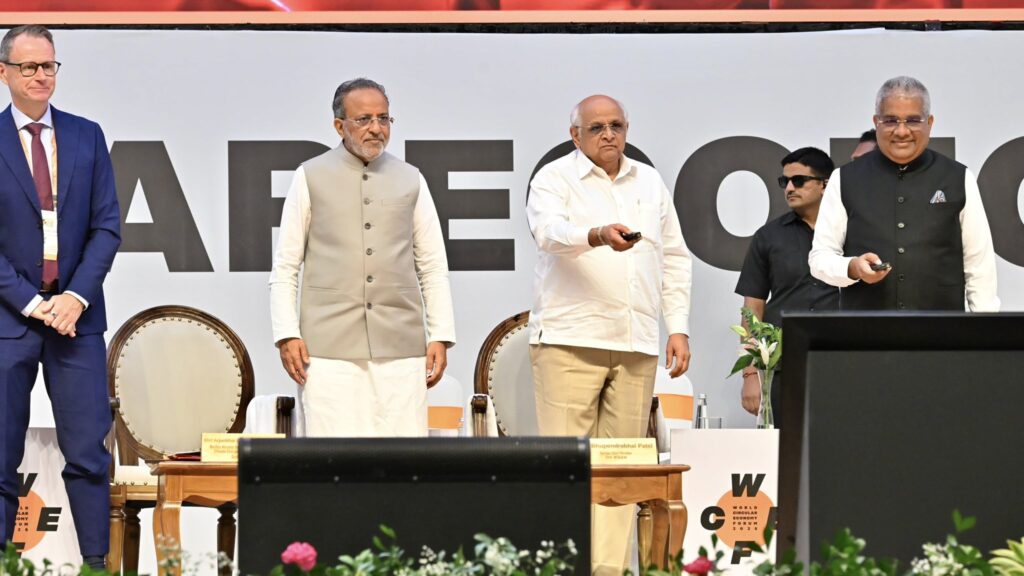
WCEF2026 must embody spirit of Vasudhaiva Kutumbakam by developing Practical Circular Solutions for the World: CM (Gujarat), Shri Bhupendrabhai Patel
Repair before Replace, Reuse before Discard, Recover before Waste – India’s Circularity Ethos rooted in Tradition: Shri Bhupender Yadav
Circularity inherently Collaborative – Knowledge, Technology, Finance and Responsibility need to move across Borders and Sectors: Union Environment Minister
Union Minister for Environment, Forest and Climate Change Shri Bhupender Yadav, along with Chief Minister (Gujarat), Shri Bhupendrabhai Patel, inaugurated the World Circular Economy Forum 2026 at Gandhinagar today. The forum is being organised under the theme ‘Circular Economy: Transition for People and Prosperity’, from 15th – 18th September. Other dignitaries gracing the inaugural session included Minister for Forest, Environment and Climate Change (Gujarat), Shri Arjunbhai Modhwadia; Minister of State for Forests and Environment, Climate Change (Gujarat), Shri Pravinbhai Mali; Ambassador of Finland to India, Ambassador of Finland to India, H.E. Mr. Mikko Kivikoski; Dy. Directoe General (Circular Economy), Ministry of Economic Affairs and Climate (Netherlands), Ms. Marieke Spijkerboer; President SITRA, Mr. Atte Jääskeläinen, along with senior officials from the Government of India and Government of Gujarat.
In his special address, Shri Bhupendrabhai Patel said the first-ever hosting of WCEF in South Asia reflects India’s growing global leadership under the vision of Prime Minister Shri Narendra Modi. He said Mission LiFE is emerging as a foundation for the global circular economy and expressed confidence that the Forum would showcase practical circular economy practices for the world.
The Chief Minister reflected on Gujarat’s journey towards environmental conservation, while maintaining a balance between development and the environment. Highlighting traditional circular practices, he cited the example of offerings at the Somnath Temple being recycled into reusable resources and generating livelihoods for local communities. He emphasised that the culture of reuse and the concept of converting waste into wealth have long been part of Indian traditions, and called for WCEF to embody the spirit of Vasudhaiva Kutumbakam by developing practical circular solutions for the world.
In his keynote address on the occasion, Shri Bhupender Yadav said that for India, the circular economy is “not a new destination; it is a new way of looking at an old wisdom”. He said the principles of reuse, repair and respect for resources have been deeply embedded in India’s social and cultural fabric. “What we now describe in policy language as circularity was once simply common sense in everyday Indian life – repair before replace, reuse before discard, and recover before waste”, he stated. The Minister said the choice is not between growth and the environment, but an opportunity to make growth itself more resource-efficient, resilient and sustainable. “The true measure of a circular economy will not be how much waste we recycle, but how little value we allow to be wasted,” he said, expressing confidence that WCEF 2026 would forge partnerships and solutions for a circular future.
Shri Yadav highlighted that under the leadership of Prime Minister Shri Narendra Modi, India has shifted towards a circular economy through regulatory reforms and digital compliance systems, including strengthened sector-specific waste management rules and the introduction of Extended Producer Responsibility (EPR). He said the objective is to ensure that “waste should no longer be seen as the end of a product’s journey, but as the beginning of another resource cycle.” As of August 2026, more than 83,000 producers and 4,802 recyclers were registered under various EPR frameworks, with nearly 482.24 lakh metric tonnes of waste processed across regulated waste streams, he informed.
The Minister stressed that regulation alone cannot create a circular economy and that circularity must also begin with how people consume. Referring to Lifestyle for Environment (LiFE), he said a circular economy cannot be built only at the recycling plant, whereas it must begin in the marketplace, continue in homes and ultimately become a habit in daily life. Calling circularity inherently collaborative, the Minister said no country, company or community can close the loop alone, and emphasised the need for knowledge, technology, finance and responsibility to move across borders and sectors. He highlighted India’s international cooperation on the circular economy, including the Resource Efficiency and Circular Economy Industry Coalition (RECEIC) launched during India’s G20 Presidency. The Minister also stated how India’s BRICS Chairship has placed the circular economy alongside sustainable lifestyles, ecosystem restoration and adaptation as interconnected priorities.
Addressing the occasion, Shri Arjunbhai Modhvadia recalled Mahatma Gandhi’s message that the Earth has enough to fulfil everyone’s needs, but not everyone’s greed. He said Prime Minister Shri Narendra Modi had laid the foundation for a circular economy in Gujarat, which is now being advanced under the leadership of Chief Minister Shri Bhupendrabhai Patel, positioning the State as a global hub for circular transition. He called for turning waste into resources and resources into value to build a sustainable and resilient future.
H.E. Mr. Mikko Kivikoski said circularity is not a separate environmental agenda but a fundamental way of thinking about growth and has become an integral part of Finland’s national policy. He highlighted Finland’s ambition to keep resource consumption below 2015 levels by 2035 and noted that over 100 Finnish companies operating in India are working with sustainable technologies and circular principles. He emphasised the need to move circularity upstream by rethinking what is produced and how value can be retained for as long as possible, noting that “the best waste is that which is never created”. He mentioned the elevation of the India-Finland relationship to a strategic partnership, focusing on digitalisation and sustainability.
Ms. Marieke Spijkerboer underlined that the circular transition is an integral part of Dutch industrial policy, with the country aspiring to become fully circular by 2050. She highlighted progress in reducing material consumption, efforts to strengthen the circular economy law and EPR systems, and stressed that international cooperation is imperative to build circular value chains. Noting the participation of over 20 Dutch companies and organisations at WCEF 2026, she lauded India’s energy and ambition in advancing circularity across large companies as well as start-ups.
The dignitaries inaugurated and reviewed the WCEF2026 exhibition at the venue featuring 135 national and international exhibitors, showcasing practical circular solutions. The Forum is witnessing participation of over 3600 cross-sectoral stakeholders from 62 countries, including business leaders, entrepreneurs, innovators, researchers, policymakers, academicians, changemakers and others. The Dignitaries also released two publications during the Inaugural Session. They are ‘Best Practices for Reuse of Treated Sewage’ and ‘Driving Sustainability – A Guide to India’s Circular Economy and EPR Initiatives’.
The event is being jointly organized by the Central Pollution Control Board (CPCB) of India, the Finnish Innovation Fund Sitra, Government of Finland, Ministry of Environment, Forest and Climate Change (MoEF&CC), Government of India, Government of Gujarat and Gujarat Pollution Control Board (GPCB).




Leave a Reply