
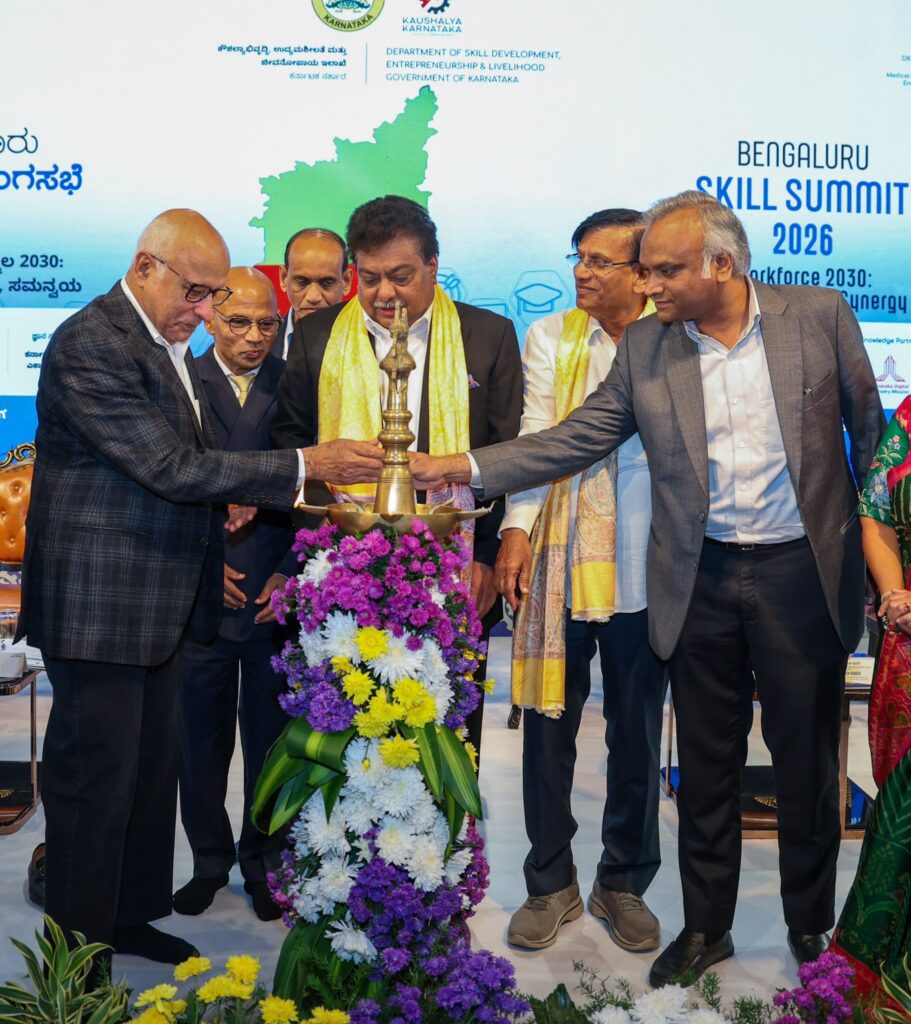
Dr. Sharan Prakash Patil , Minister of Medical Education & Skill Development , Entrepreneurship and Livelihood Department – Government of Karnataka in his speech at Bengaluru Skills Summit 2026 mentioned Karnataka to turn its Workforce 2030 vision into inclusive, measurable employment outcomes through stronger industry partnerships and continuous skills development
He further continued extremely encouraging. More than 6,500 delegates participating over next three days. We brought together thought leaders, employers, policymakers, educational institutions,
But what gives me great satisfaction is the summit has now become an annual platform for a much larger conversation about Karnataka’s future. Last year, we initiated the conversation. This year, we are taking that conversation towards implementation and measurable outcomes. That is the spirit behind this year’s theme, Workforce 2030, Scale, System, and Synergy. The world of work is changing, and it’s changing rapidly. We are living through one of the most significant transformations in human history. Artificial intelligence is changing the nature of work. Robotics is transforming manufacturing. Semiconductors are redefining strategic industries.
Green energy is creating entirely new occupations. Digital technologies are changing financial services, healthcare, education, and almost every other sector. The traditional understanding that one acquires an educational qualification, enters a profession, and continues with the same skill throughout one’s career is no longer relevant. Today, learning must be continuous. A young person entering the workforce in 2026 may find that skills required in 2030 are entirely different from those required today. Therefore, our responsibility as a government is not simply to prepare young people for the jobs that exist today. It is to prepare them for the opportunities that will emerge tomorrow. I strongly believe that greatest economic resource of Karnataka is not merely in its infrastructure, its industries, or its technology parks. It is the talent.
It is the talent, intelligence, and aspirations of its people. Our task is to unlock that potential from training numbers to employment outcomes. One of the important lessons we must recognize is that skilling cannot be measured merely by the number of people trained. The training is a means, not the final objective. The real questions are: how many people, how many young people have secured meaningful employment . How many have acquired skills that industry actually needs How many people have progressed in their careers How many have become entrepreneurs and job creators And how many have been able to access opportunities beyond geographical boundaries These are the outcome that must define the success of our skilling ecosystem. We must move from a supply-driven approach to a demand-driven approach.
Industry must become an active partner in identifying skill requirements, designing curriculam, providing practical training, and creating employment pathways. Our educational institutions and training centers must work closely with employers. Our ITIs, polytechnics, government tool room training centers, and other vocational institutions must become the center of excellence that respond to the changing industrial requirements. I would like to emphasize one important principle. Every skill development program must have a clear pathway to employment, entrepreneurship, and sustainable livelihood. That is the direction in which we must move. Karnataka must lead the Workforce 2030 agenda. Karnataka has an unique advantage. Bangalore is recognized globally for information technology, innovation, research, startups, and entrepreneurship.
Our state is also a strong manufacturing ecosystem in aerospace and defense industries, biotechnology, electronics, automotive industries, and emerging green energy opportunities. But our ambition must extend beyond Bengaluru. We must connect the talent of Mysuru, Mangaluru, Hubli-Dharwad, Belgaum, Kalburgi, Ballari, Vijaypura, Raichur, and every district to the opportunities created by Karnataka’s economic growth. We must ensure that the next generation of industrial growth creates opportunities for young people across the state.
…
Ajay.K.R




Leave a Reply